Lecture 6: Interferometers (Part 1)
Keywords
Summary
240 words
Critical Evaluation
Value of the Information & Strength of the Argument
The informational value of this lecture lies in its step-by-step mathematical derivation of the Mach-Zehnder interferometer’s output intensity and its spectral characteristics. The argumentation is built from first principles: the instructor starts with the electric field in each arm, applies the beam splitter and combiner operations, and uses trigonometric identities to obtain the interference term. The derivation of the free spectral range is particularly instructive, as it connects the phase difference between adjacent peaks (2π) to the physical path length difference and the group index. The group index is introduced through the derivative of the propagation constant with respect to wavelength, which is a standard and correct approach. The numerical example of a thermo-optic switch, where a temperature change of 41.44 K produces a π phase shift in silicon, demonstrates the practical relevance of the theory. The argumentation is coherent and logically sequenced, with each step following from the previous one. The instructor also highlights the importance of FSR in sensing applications, such as glucose concentration monitoring or cancer detection, where peak shifts must be resolved without overlap. Overall, the value is high for learners seeking a rigorous, calculus-based understanding of interferometer operation.
Scientific Rigor, Source Quality, Title Accuracy
The scientific rigor is solid within the scope of the derivation. The mathematical steps are correct and follow standard photonics results. The use of the group index and the FSR formula is consistent with established literature. However, the lecture does not cite specific textbooks or papers during the derivation, and the description contains no links or references. The only external source mentioned is a 2010 research paper on a thermo-optic switch, but no title, authors, or URL are provided, which limits verifiability. The title ‘Lecture 6: Interferometers (Part 1)’ accurately describes the content, as the lecture focuses on interferometer types and their mathematical treatment. There is no mismatch between the title and the material covered. No comments were provided for analysis.
329 words
Title / Content Match
The title 'Lecture 6: Interferometers (Part 1)' accurately reflects the content, which is a lecture-style treatment of interferometer types, starting with the Mach-Zehnder configuration and its mathematical description. The scope matches the title well.
Quality & Reliability
7/10
The lecture is a coherent, mathematically explicit derivation of Mach-Zehnder interferometer behavior, from field superposition to the output intensity, the free spectral range (FSR), and the group index. The reasoning is internally consistent and follows standard photonics textbook results. However, no external references are cited in the description, and the single research article mentioned (thermo-optic switch, 2010) is not linked, so source traceability is limited. The content is reliable as a pedagogical derivation but not independently corroborated within the video.
Key Moments
Markers derived by PSI from the transcript: the creator did not define chapters.
- Introduction and overview of interferometer types, focusing on the Mach-Zehnder configuration.
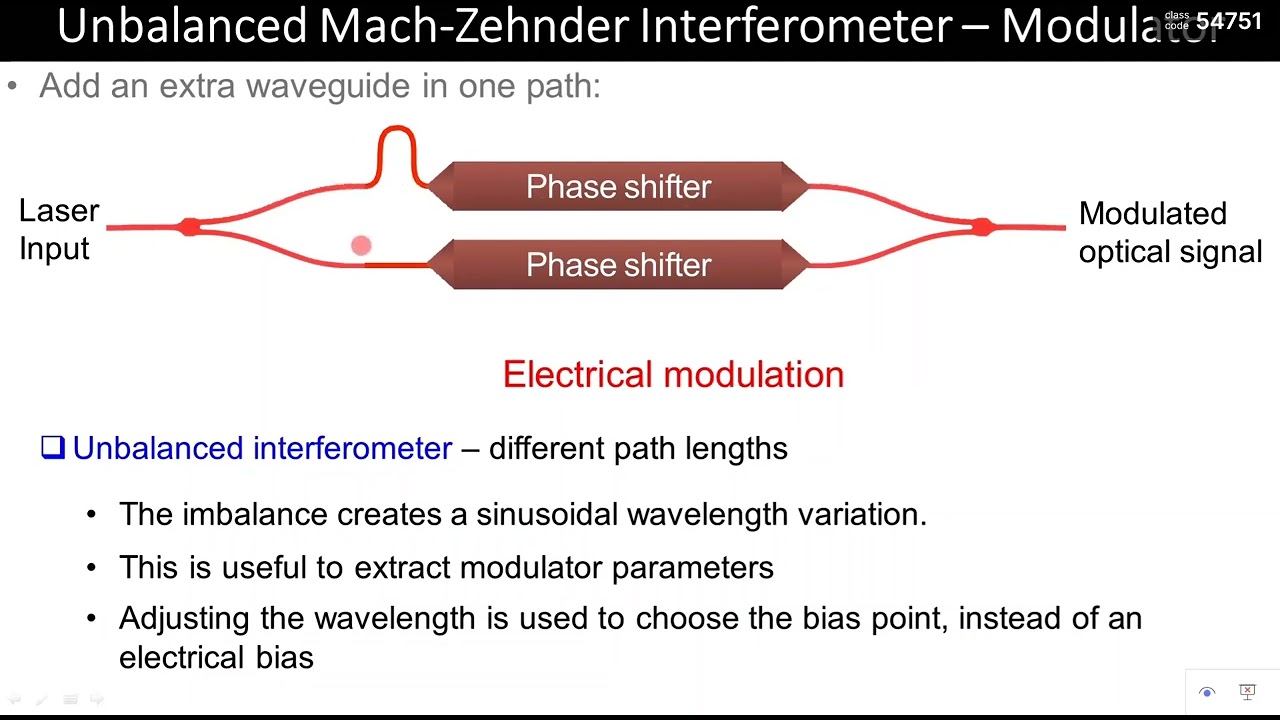
- Basic setup: beam splitters, mirrors, and phase shifters; input light split and recombined.
- Derivation of the electric field in each arm, introducing beta1, beta2, L1, and L2.
- Expansion of exponential terms into cosine and sine, and application of trigonometric identities.
- Output intensity expressed as a function of the phase difference, leading to cos^2 dependence.
- Introduction of free spectral range (FSR) and its relation to wavelength spacing between peaks.
- Derivation of FSR = lambda^2 / (Delta L * n_g) and definition of group index.
- Numerical examples showing how Delta L affects FSR, with 25 and 50 micrometer cases.
- Application: thermo-optic switch in silicon, calculating temperature change for pi phase shift (41.44 K).
- Conclusion, mention of a 2010 research paper, and preview of next lecture on silicon photonics.
Cited Sources
- Thermo-optic switch research paper (2010) — Mentioned as a practical application of the thermo-optic effect in silicon waveguides, but no title, authors, or URL provided.
Contribution & Novelties
This lecture provides a clear, self-contained derivation of the Mach-Zehnder interferometer’s output intensity and free spectral range, with a focus on the group index and its role in determining the FSR. The step-by-step mathematical treatment, including the use of trigonometric identities and the derivative of the propagation constant, is valuable for learners. The practical example of a thermo-optic switch, with a calculated temperature change of 41.44 K for a π phase shift, bridges theory and application. The lecture also emphasizes the importance of FSR in sensing applications, such as glucose monitoring and cancer detection, where peak overlap must be avoided.
Pour aller plus loin :
- Mach-Zehnder interferometer — Wikipedia article covering the basic principles and applications.
- Group index — Wikipedia article explaining the concept of group index in optics.
- Thermo-optic effect — Wikipedia article on the thermo-optic effect used in silicon photonics switches.
143 words
Radar Profile
The radar profile shows high scores in information quantity, quality, and technical level, reflecting the detailed mathematical derivation and practical examples. The reliability score is slightly lower due to the lack of explicit citations and external references. Overall, the lecture is technically strong and pedagogically effective.