Lecture 3-4: Solved Examples and Poynting Vector (Spring 2021)
Title history
- Lecture 3-4: Solved Examples and Poynting Vector (Spring 2021) — observed on 20261026-1206 UTC (YouTube)
Keywords
Summary
205 words
Critical Evaluation
Value of the Information & Strength of the Argument
The video provides a value by walking through multiple solved problems that illustrate core concepts in electromagnetic wave propagation, such as deriving the electric field direction from the Poynting vector relation (E × H), handling phase shifts due to complex intrinsic impedance, and classifying media based on loss tangent. The argumentation is mathematically sound and consistent with standard textbook approaches. The instructor clearly explains each step, from determining the unit vectors to integrating Maxwell’s equations, making the reasoning accessible to learners with a background in electromagnetics. The examples increase in complexity, from lossless to lossy and conductor media, effectively building problem-solving skills. However, the presentation relies heavily on verbal explanations and may not elaborate on deeper physical insights or alternative methods beyond the two shown.
Scientific Rigor, Source Quality, Title Accuracy
The scientific rigor is adequate for an engineering lecture, with correct use of Maxwell’s equations and standard formulas for intrinsic impedance, attenuation, and phase constants. The instructor does not cite external sources in the transcript, but the content aligns with established electromagnetic theory. The title mentions the Poynting vector, yet the visible transcript lacks explicit discussion of it, which could be an inconsistency; however, it is likely covered later or assumed as background. The provided links (Google Drive) may contain lecture notes or problems, but they are not directly cited in the video. Adéquation between title and content is generally good, but the incomplete coverage of Poynting vector in the presented portion suggests a potential mismatch. No comments are available to gauge audience reception.
264 words
Title / Content Match
Title accurately reflects the main topics: solved examples and the Poynting vector, although the transcript provided does not explicitly discuss the Poynting vector in the visible portion.
Quality & Reliability
7/10
The lecture presents detailed derivations and solved examples for electromagnetic wave propagation in different media. The mathematical treatment is rigorous and aligns with standard physics textbooks, though no external references are provided in the transcript. The use of Arabic as the medium may limit accessibility, but content is technically sound.
Key Moments
Markers derived by PSI from the transcript: the creator did not define chapters.
- Introduction and recap of wave propagation in different media, parameters alpha, beta, eta, and phase velocity.
- Example 1: Lossy dielectric – computing electric field from magnetic field, using intrinsic impedance and phase difference.
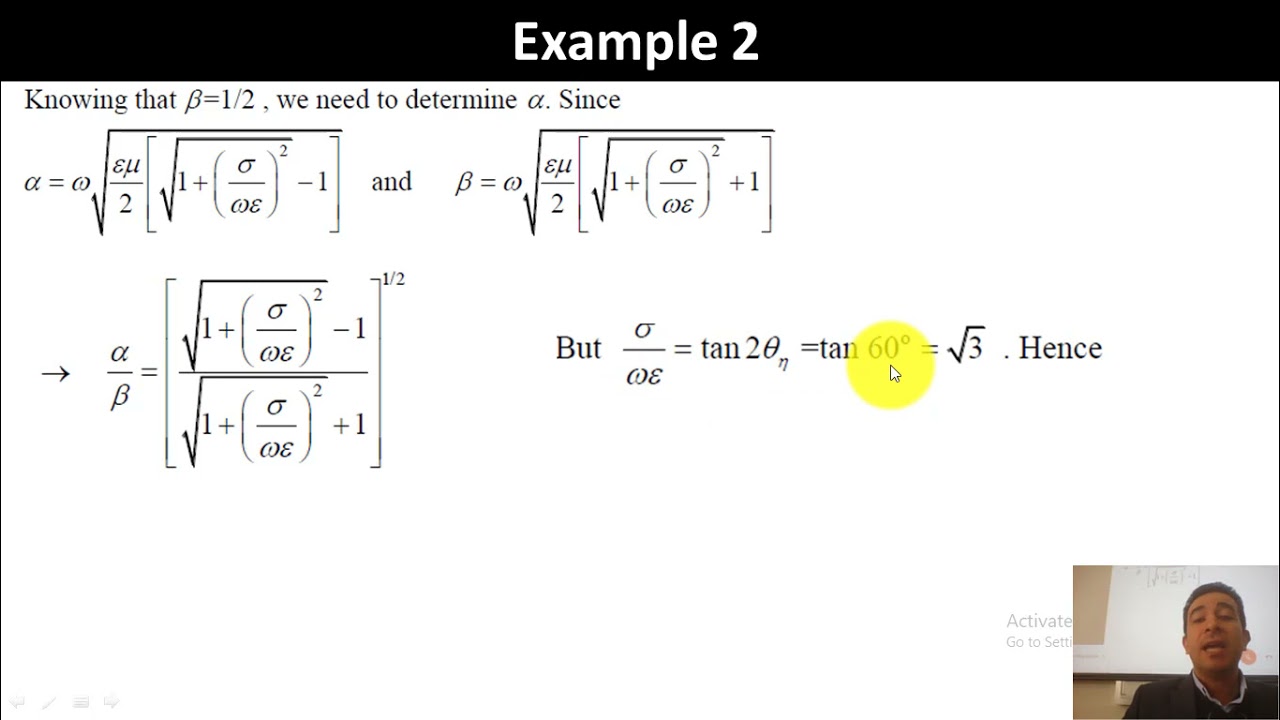
- Example 2: Lossless dielectric – determining epsilon_r and omega, and solving for two electric field components using decomposition.
- Alternative solution for Example 2 using Maxwell's curl equations directly.
- Example 3: Good conductor – calculating alpha, beta, and H-field using loss tangent and intrinsic impedance.
- Example 4: Plane wave incident on a good conductor – deriving current density via wave equation.
Cited Sources
- Lecture notes or problem set (Google Drive PDF) — Mentioned in description; likely contains slides or problems for the lecture.
- Additional lecture materials (Google Drive PDF) — Second resource in description, possibly supplementary notes.
Contribution & Novelties
The lecture’s contribution is primarily pedagogical, offering systematic methods for solving wave propagation problems. It reinforces the use of loss tangent to categorize media and demonstrates the application of Maxwell’s equations in practical calculations. The two method comparison (decomposition vs. direct Maxwell equation) provides a deeper understanding. For further exploration:
Pour aller plus loin :
- Maxwell’s equations – Foundational to all derivations; useful for reviewing the curl equations used.
- Wave equation – Central to deriving propagation and current density solutions.
- Poynting vector – While not explicitly covered in the transcript, it’s a key concept in energy flow and relevant to the course.
- Attenuation constant – Related to the alpha parameter discussed in losses.
113 words
Radar Profile
The radar profile shows moderate to high scores across all dimensions, with strongest in technical level and information quantity, and slightly lower in source rigor due to lack of citations. This indicates a solid educational resource but one that could benefit from referencing external authoritative sources.