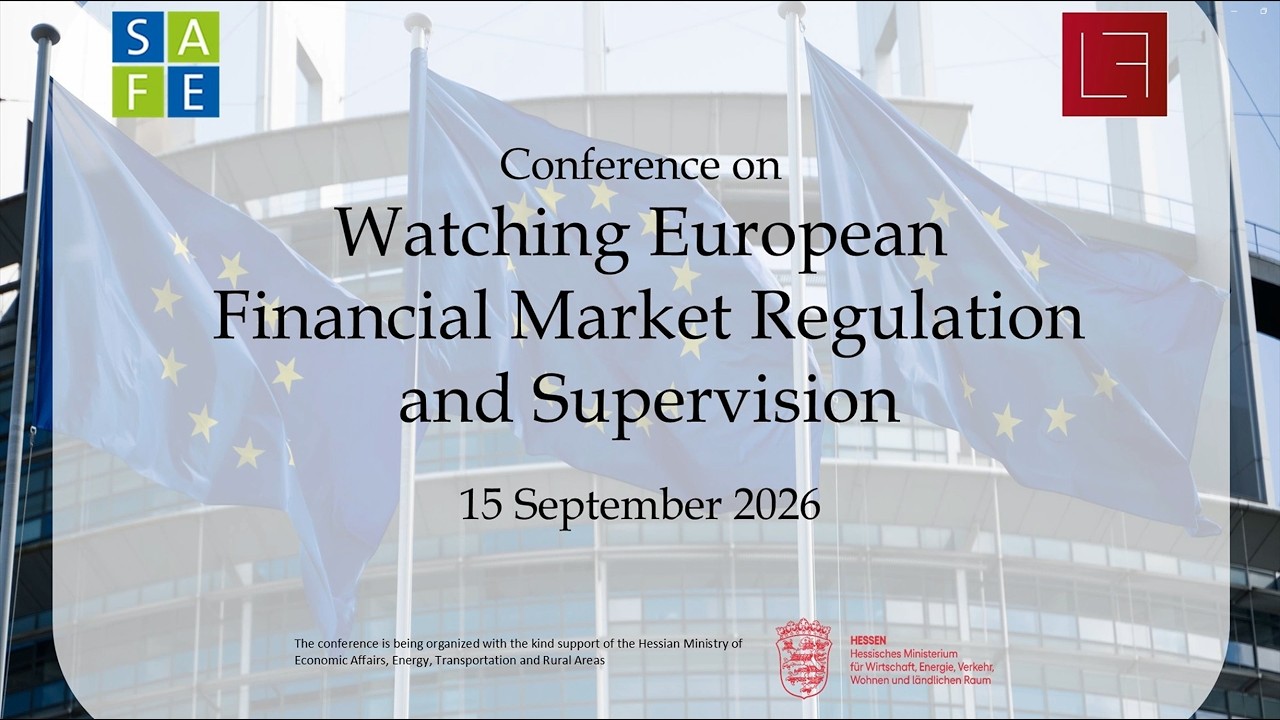
Panel 1: Integration of European Banking Markets (and beyond?)
Keywords
Summary
199 words
Critical Evaluation
Value of the Information & Strength of the Argument
The value of this video lies in its multi-stakeholder perspective, combining academic research, supervisory experience, and practical banking insight. Carletti’s presentation is well-structured, using quantitative data from the ECB and referencing reports by the European Parliament and IMF to quantify the costs of fragmentation. Her argumentation is logical, moving from the benefits of integration to the obstacles and potential reforms. The subsequent contributions from the European Commission and a bank executive reinforce and complement her points, offering real-world policy and industry perspectives. The discussion is academically grounded and policy-relevant, making it highly valuable for those interested in European financial regulation.
Scientific Rigor, Source Quality, Title Accuracy
The video maintains high scientific rigor, with panelists citing official reports (ECB Financial Integration Report, European Parliament cost of incomplete banking union, IMF growth study) and using established academic literature. The sources are reliable and verifiable, though no direct URLs are provided in the description. The title accurately reflects the content, which is a focused panel on European banking integration. The panelists’ credibility (academics, EBA, European Commission, Bundesbank, ING) adds to the overall trustworthiness. No conflicts of interest are apparent, and appropriate disclaimers about personal roles are made. The video is from a reputable research institute, ensuring quality.
213 words
Title / Content Match
The title clearly reflects the content: a focused panel discussion on European banking market integration.
Quality & Reliability
8/10
High-level panel with experts from academia, supervision, and banking. Arguments are data-driven, referencing ECB, European Parliament and IMF reports. Slight limitation: no original research, but a rigorous exchange of informed views.
Chapters
Cited Sources
- European Central Bank – Financial Integration in Europe report — Cited by Elena Carletti to show trends in fragmentation and cross-border lending/deposits.
- European Parliament – Cost of incomplete banking union — Referenced to estimate annual cost of fragmentation at nearly €120 billion.
- IMF – Study on integration and GDP growth — Used to illustrate potential GDP gains from broader financial integration.
- Medio Bankanka research report on investment banking — Cited to show European banks lost 20 percentage points in investment banking to US banks since 2009.
Contribution & Novelties
This panel provides a rare convergence of academic, supervisory, and industry viewpoints on European banking integration. It systematically outlines the benefits, identifies the root causes of fragmentation (ring-fencing, incomplete crisis management), and proposes concrete reforms (common deposit insurance, group-level waivers, 28th regime). The discussion highlights the cultural and political obstacles often overlooked in purely technical analyses. The novelty lies in the direct confrontation of different institutional perspectives, making it a valuable resource for policymakers and scholars.
Pour aller plus loin :
- Banking Union of the European Union — Overview of the three pillars (SSM, SRM, EDIS) and current state.
- European Deposit Insurance Scheme — Key proposal discussed in the panel for completing the banking union.
- Capital Markets Union — Related initiatives to deepen financial integration beyond banking.
127 words
Radar Profile
The scores are consistently high across all dimensions, with reliability slightly lower than quantity, indicating a well-balanced panel that is both information-dense and credible. The technical level matches the expert audience, and the content is robust and authoritative.