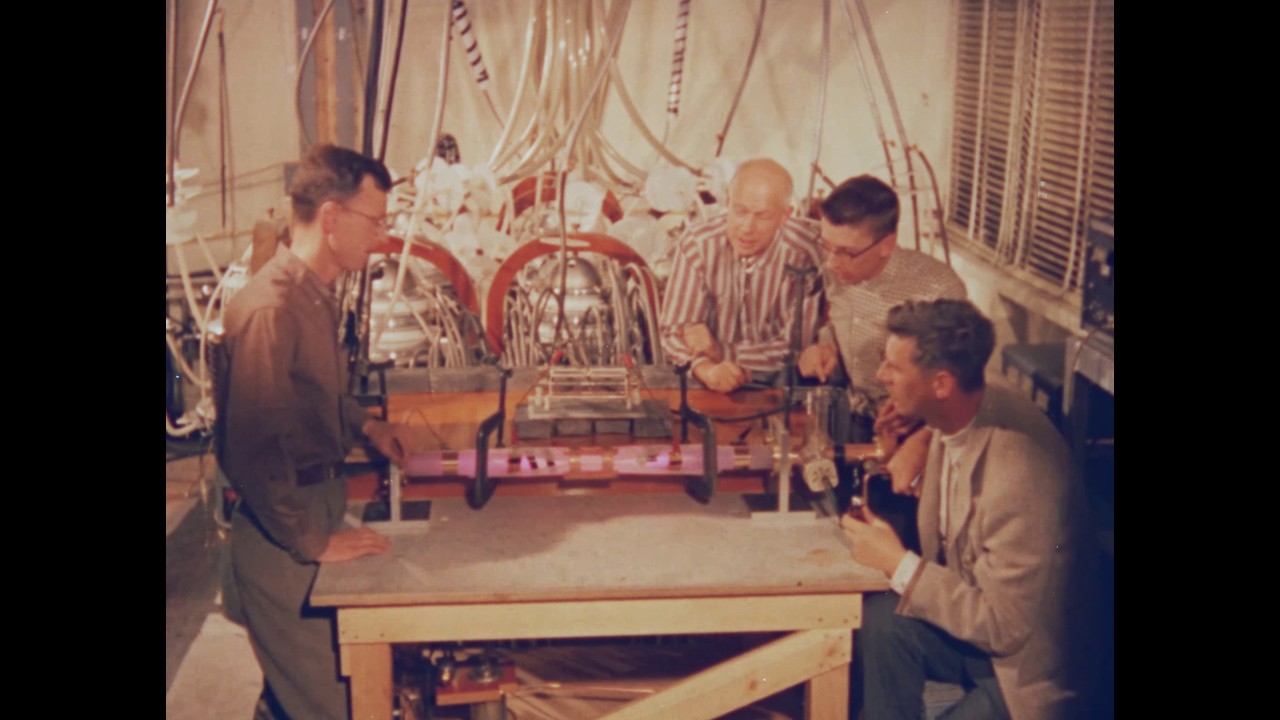
Research into Controlled Fusion (1958)
Keywords
Summary
187 words
Critical Evaluation
Value of the Information & Strength of the Argument
The value of this documentary lies in its authentic, first-hand depiction of fusion research at a pivotal moment. It demonstrates the scientific method in action: theory guiding experiment, systematic exploration of multiple confinement concepts, and honest reporting of both progress and obstacles. The argumentation is coherent and evidence-based: each device is described with its physical principles, operational parameters (e.g., currents, temperatures, magnetic field strengths), and the observed results. The narration logically connects the challenges of plasma stability and purity to the design choices of each experiment. While not claiming outright success, the film objectively presents the incremental advances and the remaining hurdles, making it a solid representation of scientific reporting.
Scientific Rigor, Source Quality, Title Accuracy
The film is a U.S. Atomic Energy Commission production, indicating official endorsement and likely internal review. It features contributions from leading scientists of the era (e.g., James Tuck, Lyman Spitzer, R.F. Post), giving it high credibility for its time. The production uses clear animations to explain complex physics, suggesting an emphasis on educational accuracy. The title ‘Research into Controlled Fusion (1958)’ precisely matches the content, as it systematically reviews the research programs and experimental devices. No external sources are cited, but the film itself serves as a primary source for historical studies of fusion development.
220 words
Title / Content Match
The title accurately describes the content: a documentary exploring the state of controlled fusion research in 1958, covering the major experimental devices and challenges.
Quality & Reliability
8/10
This is an official U.S. Atomic Energy Commission production from 1958, offering an authentic snapshot of fusion research of that era. The technical accuracy is high for its time, but advances since then have outdated some details. The film benefit from being a primary historical source, yet it is not peer-reviewed and reflects the limited understanding of plasma physics in the 1950s.
Chapters
- Introduction: Fuel in the Oceans and the Fourth Conquest of the Atom
- What Is a Plasma? The Deuterium Fusion Reactions
- Magnetic Confinement: The Magnetic Bottle, Leakage, and Instability
- Project Sherwood's Four Labs; Los Alamos and the Perhapsatron
- Columbus II and Columbus S4: Fast Pinch Experiments
- Ixion and Scylla: Rotating Plasma and Fast Compression
- UC Radiation Lab: Gamma Pinch, Homopolar, and Tubular Pinch
- The Magnetic Mirror Machine and "Table Top"
- "Toy Top": Multi-Stage Magnetic Compression
- "Felix": Injecting and Trapping High-Energy Ions
- Princeton's Project Matterhorn: The Stellarator
- Stellarator Instability, Shear Stabilization, and Ohmic Heating
- The Diverter and the Model C Stellarator
- Oak Ridge National Laboratory: The DCX Machine
- Inside DCX: Trapping the Ion Beam, Charge Exchange, and Burnout
- DCX in Operation and the State of Fusion Research, 1958
Contribution & Novelties
This film provides a unique, comprehensive overview of the early American fusion program, capturing the breadth of experimental approaches and the conceptual frameworks that shaped future research. It is invaluable for historians and scientists seeking to understand the foundational period of controlled fusion. The explanations of instability mechanisms, magnetic mirror confinement, and the Stellarator concept are particularly detailed and prescient.
Pour aller plus loin :
- Stellarator — This article explains the stellarator concept, first introduced in this film, and its evolution into modern devices like Wendelstein 7-X.
- Magnetic mirror — The mirror confinement approach featured in several machines here, though later abandoned for reactor use, remains a textbook topic in plasma physics.
- Z-pinch — The pinch-effect machines (Perhapsatron, Columbus) are foundational to this line of research, now applied in plasma confinement and fusion concepts like dense plasma focus.
138 words
Radar Profile
The scores indicate a well-balanced documentary, with high quantity and reliability, moderate technical depth and information quality. The profile suggests a content that is informative and historically accurate, but not extremely advanced in physics terminology, making it accessible to a general audience with some scientific background.