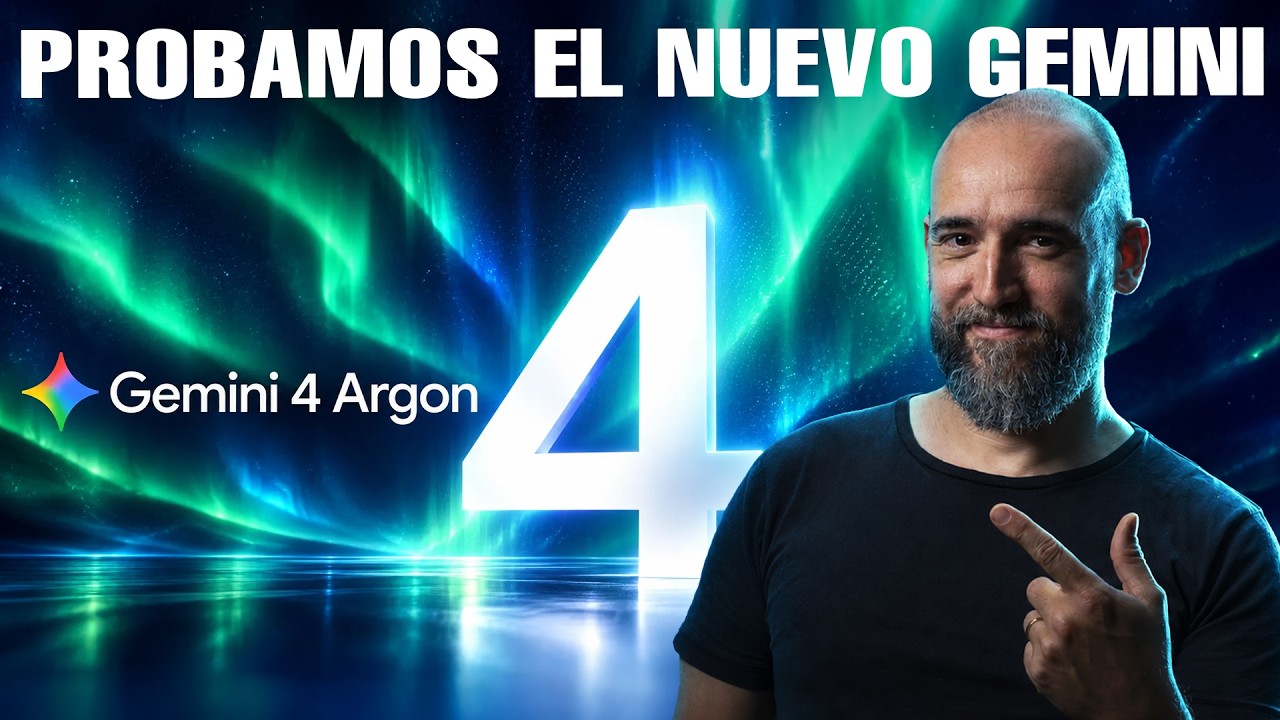
¡Ya disponible Gemini 4 Argon! Lo pongo a prueba
Gemini 4 Argon now available! I put it to the test
Keywords
Summary
243 words
Critical Evaluation
Value of the Information & Strength of the Argument
The video provides valuable insights into the launch of a major AI model, offering a clear breakdown of benchmarks, pricing structures, and practical usability. The argumentation is solid and reasonably self-aware; the author explicitly criticizes the use of anecdotal tests to measure intelligence, instead directing viewers to reputable scientific evaluation platforms like Artificial Analysis. He substantiates claims about speed and efficiency with personal observations, while acknowledging his bias towards competitor tools. The logical progression from discussing raw model capabilities (vertical) to its integration ecosystem (horizontal) structures the review effectively, presenting a balanced thesis: Gemini 4 Argon is a top-tier model regarding raw intelligence, but it suffers from a lag in facilitating real-world tasks through agentic interfaces. The analysis of Antigravity’s complexity as a barrier to mass adoption is particularly well argued, drawing a clear contrast with the unified approach of ChatGPT or Claude.
Scientific Rigor, Source Quality, Title Accuracy
The scientific rigor is satisfactory for a tech review. The primary technical source cited is Artificial Analysis, a widely recognized third-party benchmarking platform, which lends credibility to the performance claims. However, the author does not provide direct links to Google’s technical report or documentation within the description, instead linking to his own promotional content (courses, newsletters, books) and a subscription club. This mix of promotional content and informal tone slightly diminishes the perceived scientific objectivity, though it is common in the tech influencer space. The title is an exact match to the content, promise accurate. The creator’s explicit policy to prioritize scientific benchmarks over personal demos demonstrates a critical approach, but the reliance on leaked/early access features and speculative comments about future releases prevents full adherence to strict scientific methodology.
288 words
Title / Content Match
The title accurately reflects the core content: the author announces the release of Gemini 4 Argon and proceeds to test its capabilities, showcasing demos and a critical review.
Quality & Reliability
7/10
The review relies on third-party benchmarks (Artificial Analysis) and hands-on testing, providing a balanced assessment of strengths (speed, ecosystem, output length) and weaknesses (memory, agentic usability). However, reliance on promotional and personal experience limits deeper scientific rigor.
Chapters
- Introducción
- Gemini 4 ya está aquí: el nuevo modelo de Google
- Benchmarks: Gemini 4 frente a GPT-6, Claude y Meta
- Precio, eficiencia y relación calidad-precio
- La gran ventaja de Google: su ecosistema
- Hasta un millón de tokens de salida
- Demostraciones de Gemini 4 y sus capacidades
- La espectacular demo 3D de las pagodas
- Probamos la aplicación de Gemini para Mac
- El gran problema: no puede controlar tu ordenador
- Antigravity: la solución de Google para trabajar con agentes
- ¿Quiere Google convertirse en un agregador de modelos?
- El futuro de Gemini 4 y los próximos modelos Flash
Cited Sources
- Club de la IA — Membership platform for AI updates and community, promoted at the start of the description.
- IA Perfecta — Website listing various AI tools, referenced in the creator's promo block.
- Jon Hernández Education - ChatGPT Guide — Free guide offered as a promotional gift for using ChatGPT.
- Jon Hernández Education - NotebookLM Guide — Guide for NotebookLM, another Google AI tool, promoted in the description.
- Jon Hernández Education - Vibe Coding Guide — Guide for creating software without programming using AI, promoted under gifts.
- Jon Hernández Education - Image Guide — Guide for generating images with ChatGPT and Nano Banana, promoted.
- Book 'la hostIA que viene' — The author's book about the AI future, listed under community/news section.
- Newsletter IA — Newsletter with curated AI news, promoted for community engagement.
- WhatsApp Channel AI — WhatsApp channel about AI, listed under community links.
Contribution & Novelties
The video contributes a practical, user-centric evaluation of Gemini 4 Argon shortly after its release, immediately contextualizing its benchmark scores within the competitive landscape of other frontier models. It provides a hands-on look at the desktop application and the Antigravity agentic system, which offers specific insights into the current state of Google’s horizontal integration strategy. The critical takeaway is that even with raw computational power, the lack of seamless OS integration and memory remains a significant usability hurdle.
Pour aller plus loin :
- Google Gemini (Language Model) — Relevant background and architecture of the Gemini series.
- Artificial Analysis — The benchmarking platform used in the video to compare model intelligence and efficiency.
- Agentic AI — Concept discussed concerning Antigravity and the future of AI-driven computer control.
126 words
Radar Profile
The radar profile shows a balanced score across quantity and quality of information, with a slightly lower level of technical depth, indicating the content is informative for a general tech audience. The overall reliability is moderate, reflecting the use of credible benchmarks mixed with subjective first-hand testing.