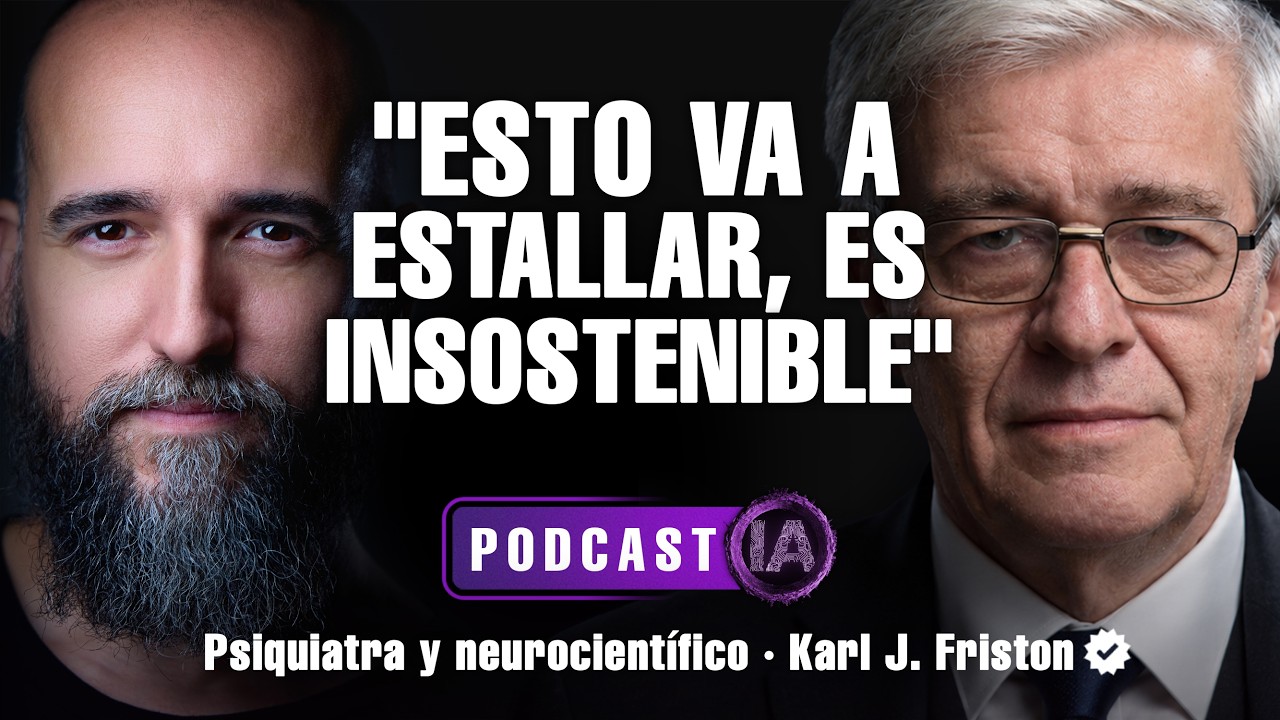
La inteligencia artificial va por el camino equivocado y pagaremos las consecuencias - Karl Friston
Artificial intelligence is going down the wrong path and we will pay the consequences - Karl Friston
Title history
- La inteligencia artificial va por el camino equivocado y pagaremos las consecuencias - Karl Friston — observed on 20261112-1909 UTC (YouTube)
Keywords
Summary
181 words
Critical Evaluation
Value of the Information & Strength of the Argument
The video’s value lies primarily in offering a high-level expert perspective from Karl Friston, a leading figure in theoretical neuroscience. His arguments are logically structured and deeply anchored in his research on the free energy principle and active inference. He provides a coherent critique of current AI by contrasting it with natural intelligence, highlighting that LLMs are not curious, do not quantify uncertainty, and do not actively engage with the world to resolve confusion. The argumentation is persuasive because it connects concrete AI limitations (e.g., energy inefficiency, lack of agency) to a unified scientific framework. However, it is important to note that this is an opinion-based interview rather than a peer-reviewed analysis; Friston acknowledges that alternative paths exist but are overshadowed by current hype. The reasoning is rigorous within his theoretical framework, but some conclusions, such as predictions about sentient robots, are speculative.
Scientific Rigor, Source Quality, Title Accuracy
The scientific rigor is high given Friston’s credentials and the coherence of his explanations. He references his own work and principles that have been published in reputable journals. The sources cited in the description include his academic page, the IWAI conference, and LinkedIn, which are relevant and trustworthy. The video does not provide direct citations to specific papers during the conversation, but the underlying science is well-established in the field of computational neuroscience. The title is somewhat sensationalist (‘going the wrong way and we will pay the consequences’) but adequately reflects the critical tone of the interview. The content does not systematically review opposing views, but it is honest about uncertainties. Overall, the rigor is solid for an expert discussion, though it would benefit from more explicit references to literature.
288 words
Title / Content Match
The title accurately reflects the video's critical stance on current AI development.
Quality & Reliability
8/10
Interview with Karl Friston, a leading neuroscientist, discussing AI from the perspective of the free energy principle. The discussion is informed and well-argued, though it reflects his personal views.
Chapters
- Tráiler
- Inteligencia artificial e inteligencia natural
- Las grandes diferencias entre la IA y la inteligencia humana
- Qué significa ser humano en un mundo con inteligencia artificial
- ¿Puede la IA desarrollar curiosidad?
- El principio de energía libre y la inferencia activa
- Qué necesita una IA para pensar y actuar por sí misma
- ¿Puede una inteligencia artificial ser consciente?
- Qué son realmente los modelos de mundo
- InfoJobs y viterbit: contratación con inteligencia artificial
- ¿Somos los humanos más parecidos a la IA de lo que creemos?
- Cuánto entendemos realmente sobre el cerebro humano
- Gemelos digitales: ¿podemos modelar una mente humana?
- El miedo a perder el control de la inteligencia artificial
- ¿Deberíamos frenar el desarrollo de la IA?
- El gran problema de los LLM: energía, recursos e ineficiencia
- Cómo la IA puede destruir nuestra curiosidad
- Rosellimac: cómo usar la IA de forma segura en tu empresa
- Delegación cognitiva: qué ocurre cuando dejamos de pensar por nosotros mismos
- Cómo construimos nuestro modelo del mundo desde que nacemos
- ¿Necesita una IA un cuerpo para ser realmente inteligente?
- Alineación: de dónde vienen nuestros valores y nuestra moral
- ¿Podemos preprogramar la moral de una inteligencia artificial?
- Selección natural, mercado y el riesgo de perder el control
- El futuro de la IA: robots sintientes dentro de 4 a 8 años
- Qué pasará con nuestro trabajo y propósito cuando la IA lo haga todo
Cited Sources
- Karl Friston - UCL — Guest's academic profile and research
- IWAI 2026 - International Conference on Active Inference — Conference where the podcast was recorded
- Active Inference LinkedIn — Conference LinkedIn page
Concurring Sources
- Wikipedia - Free energy principle — Supports Friston's explanation of self-organization and minimization of surprise.
- Wikipedia - Active inference — Supports Friston's discussion on agents acting to minimize expected free energy.
External References
Contribution & Novelties
The video offers a unique perspective by applying the free energy principle and active inference to critique current AI, emphasizing the lack of curiosity and uncertainty quantification in LLMs. Friston argues that AI should be based on self-organising principles to be more efficient and aligned with human intelligence.
Pour aller plus loin :
- Free energy principle — Foundational concept explaining how self-organising systems maintain their states.
- Active inference — Application of free energy principle to action and perception.
- Predictive coding — A theory of brain function related to error prediction minimisation.
91 words
Radar Profile
The scores indicate a high quality and quantity of information, with a strong technical level and reliability, resulting in an excellent overall rating. The profile suggests that the video is both informative and credible, though it relies more on expert opinion than on experimental data.