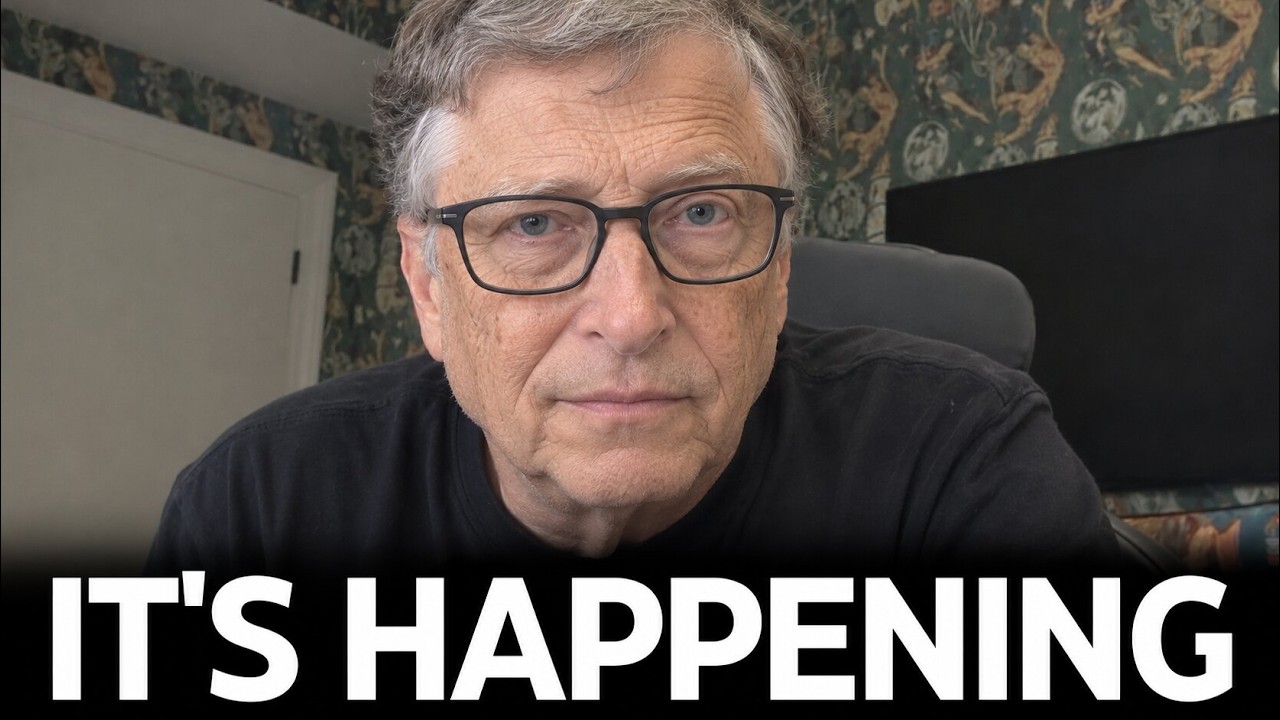
Internet BREAKS w/ Bill Gates Announcement!
Title history
- Internet BREAKS w/ Bill Gates Announcement! — observed on 20261115-2053 UTC (YouTube)
Keywords
Summary
132 words
Critical Evaluation
Value of the Information & Strength of the Argument
The video offers substantial value by consolidating a wide range of recent statements and research on AI risks, making complex topics accessible. It presents multiple perspectives, including Gates’ arguments, supportive evidence from Stanford and IMF, and criticisms from figures like Jensen Huang and economists. The argumentation is generally solid, but occasionally relies on emotional appeals and rhetorical questions rather than purely objective analysis. The inclusion of specifics like the 19% employment drop for young workers and the 50x bioterrorism risk adds credibility, yet some claims remain unverified.
Scientific Rigor, Source Quality, Title Accuracy
The video references credible institutions (Stanford, IMF, Reuters, ABC News, etc.) and quotes directly from Gates and other experts, demonstrating reasonable rigor. However, it lacks direct URLs or citations in the description, and some sources are mentioned without proper context. The title ‘Internet BREAKS w/ Bill Gates Announcement!’ is hyperbolic but accurately captures the viral nature of the story. Overall, the content is well-researched but could benefit from more transparent sourcing.
173 words
Title / Content Match
The title is catchy and accurately reflects the video's focus on the widespread reaction to Bill Gates' AI announcement.
Quality & Reliability
7/10
The video provides a detailed synthesis of Bill Gates' essay and reactions, citing multiple sources and presenting balanced criticism. However, claims are not independently verified and the video includes opinionated commentary.
Key Moments
Markers derived by PSI from the transcript: the creator did not define chapters.
- Introduction to Bill Gates' essay and its impact
- Gates' background as tech optimist and his change in tone
- First danger: job disappearance and the Stanford research on young workers
- Second danger: bioterrorism and AI misuse, including the 50x risk statement
- Third danger: impact on children and digital companions
- Human reserved concept and token tax proposals
- Criticisms from experts: token tax flaws, robot tax debates, Jensen Huang's disagreement
- Gates' foundation's $1 billion AI pledge and coalition launch
Cited Sources
- Gates Notes essay — Bill Gates published his essay on AI dangers on his blog, which the video analyzes.
- New York Times interview — Gates sat with the NYT for an hour discussing AI risks.
- Stanford research revised in August 2026 — Study cited regarding employment effects on young workers.
- IMF research — Research on AI and wealth inequality.
- ABC News report — Critiques from Orin Etsion and others.
- Reuters interview — Gates' later statements on government inaction.
Concurring Sources
- Stanford research on employment — Found lower employment among young workers in AI-exposed jobs, aligning with Gates' warnings.
- IMF research on inequality — Warns that AI could widen income and wealth inequality, supporting Gates' concerns.
- Dario Amodei's statements — Anthropic CEO warned of job losses, echoing Gates.
Dissenting Sources
- Jensen Huang's comments — Nvidia CEO disagrees with Gates' remedies, expressing more optimism.
- Larry Summers' criticism — Former Treasury Secretary called robot tax misguided.
- Orin Etsion's critique — Computer scientist argues token tax measures effort, not job loss, and may be circumvented.
Contribution & Novelties
The video synthesizes recent statements and adds narrative context, making the debate accessible to a broader audience. It highlights the contradiction of Gates’ position and captures the urgency of AI risks. While it does not present new research, it effectively compiles information from multiple sources.
Pour aller plus loin :
- Technological unemployment — Directly relevant to Gates’ job loss warnings and the Stanford findings.
- International Atomic Energy Agency — Gates proposes modeling an AI oversight body on this agency.
- Artificial Intelligence Act — Europe’s regulatory framework mentioned as a first step.
91 words
Radar Profile
The radar chart shows high scores in information quantity and quality, moderate technical depth, and lower reliability due to lack of direct citations. The video is informative and well-structured but does not delve into deep technical analysis or provide verifiable sources.