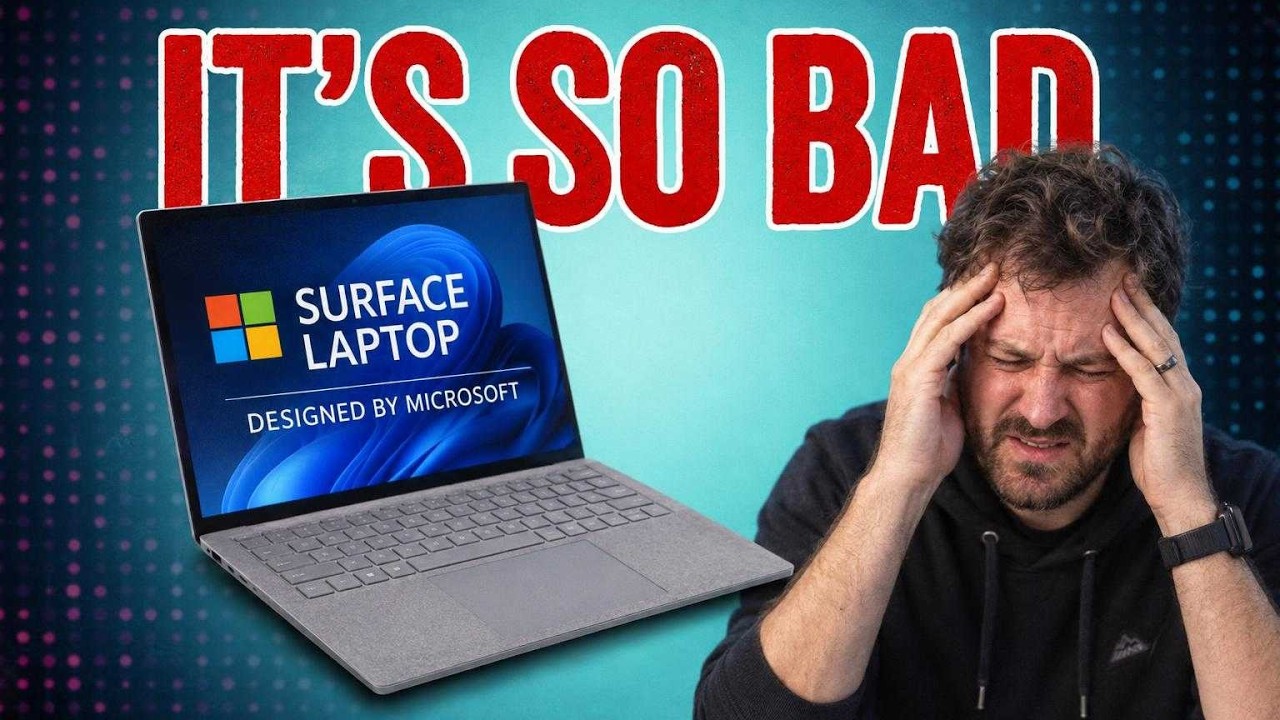
Microsoft Surface Laptops are unreviewable
Keywords
Summary
173 words
Critical Evaluation
Value of the Information & Strength of the Argument
The video’s value lies in its systematic deconstruction of the review process for Surface laptops, showing how each aspect—naming, configurations, pricing, and firmware—undermines the reliability of expert opinions. The argumentation is solid: it presents concrete examples from reputable sources like Notebook Check, PC World, Windows Central, and Tom’s Hardware, demonstrating that reviewers themselves struggle to deliver coherent verdicts. The creator does not simply dismiss Surface laptops; instead, they acknowledge the hardware can be good, but the inability to predict what you’re buying makes reviews practically useless. The logical progression from historical context to current issues is persuasive. The only minor weakness is that some claims rely on aggregated reports rather than direct testing, and the video’s own perspective is clearly critical, though it remains balanced by acknowledging valid reasons for Microsoft’s decisions.
Scientific Rigor, Source Quality, Title Accuracy
The video demonstrates rigorous use of sources: it cites a wide range of tech publications, including Ars Technica (referred to as ‘Artings’), Notebook Check, PC Mag, Linus Tech Tips, Windows Central, CNET, Techradar, Macworld, Tom’s Hardware, PC World, The Verge, Gizmodo, Digitech, Mac Rumors, iFixit, TechCrunch, The Register, and TrendForce. It also references specific reviewers and their findings, adding credibility. The title ‘Microsoft Surface Laptops are unreviewable’ is directly supported by the evidence presented; the video does not deviate from this thesis. The adéquation between title and content is strong, with no clickbait or misleading framing. No comments were provided for analysis, so no public sentiment can be discussed.
256 words
Title / Content Match
The title accurately captures the central thesis: that Microsoft Surface Laptops are difficult to review reliably due to frequent changes and configuration complexity. The content directly supports this claim with multiple examples.
Quality & Reliability
8/10
The video provides a well-researched and nuanced analysis, citing multiple tech publications and industry events. It balances praise and criticism, and acknowledges uncertainties. However, it is a YouTube video with limited views and no clear editorial oversight, and some claims are based on second-hand reports.
Key Moments
Markers derived by PSI from the transcript: the creator did not define chapters.
- Introduction: The central problem - a firmware update 6 days after the Ultra launch invalidates reviews.
- Naming confusion: multiple models and configurations, including different generations and chips.
- ARM and benchmarking issues: tests cannot run on ARM, leaving gaps in reviews.
- Price increases due to memory shortage, making old reviews obsolete.
- Surface Laptop Ultra launch: multiple configurations tested, leading to conflicting reviews.
- The firmware update that fixed issues, but cannot be uninstalled, erasing the problems reviewers found.
- Conclusion: What would fix the unreviewability, including simpler naming and more uniform configurations.
Cited Sources
- Ars Technica (Artings) — Reviewed the Surface Laptop 8th edition 13.8-inch configuration, found battery and performance details.
- Notebook Check — Called Surface Laptop 13 a very good everyday device; also criticized ARM-only consumer strategy.
- PC Mag — Reviewer Matthew Boozy couldn't run PC Mark 10 or Puget Systems benchmarks on ARM Surface; later gave Ultra a 4.0 at $4299.99.
- Linus Tech Tips — Measured about 9 hours battery on Surface Laptop Ultra, contrasting with Microsoft's 15-hour claim.
- Windows Central — Reviewers Rubino and Bowen noted slow restarts (later fixed), and reported 10-14 hours battery.
- CNET — Headline said the Ultra squanders its best feature; tested an 18-core unit at $3,700.
- Techradar — Called the Ultra a beast, just not at everything; noted flicker and crash reports from owners.
- Macworld — Shrugged and said Apple has nothing to worry about.
- Tom's Hardware — Openly enthusiastic about the Ultra; called it the most beautiful laptop Microsoft has made.
- PC World — Reviewer Mark Hackman had to install beta Premiere; noted 130W power draw while gaming and the K-shaped economy.
- The Verge — Tested the 128GB model, highlighting the wide range of configurations tested.
- Gizmodo — Raymond Wong tested a $6,000 machine and noted the base model only has 24GB.
- Digitech — Measured 19 hours 28 minutes battery in video test; entity not clearly identified.
- Mac Rumors — Noted that Surfaces now cost more than equivalent Macs after price hikes.
- iFixit — Gave the first Surface Laptop a 0/10 repairability score in 2017.
- TechCrunch — MG Siegler bought Surface RT himself after Microsoft refused review unit in 2012.
- The Register — Found entry-level Surface prices up by up to £220 in the UK, with no announcement.
- TrendForce — Estimated memory contract prices jumped 90-95% in Q1 2026.
Concurring Sources
- Notebook Check — Highlights both the quality of the device and the ARM compatibility issues, aligning with the thesis that reviews can't fully capture user experience.
- Windows Central — Reviews show inconsistent battery results and firmware-dependent performance, supporting the unreviewability claim.
- PC World — Mark Hackman's review notes the need for beta software and huge power draw, indicating testing difficulties.
Contribution & Novelties
The video offers a unique meta-analysis of the review ecosystem for a major tech product line, demonstrating how the fluid nature of hardware—via firmware updates, configuration sprawl, and price volatility—can undermine the traditional utility of expert reviews. It does not simply review a laptop; it reviews the review process itself, exposing systemic flaws that affect consumer trust. This is an original angle that goes beyond typical tech commentary.
Pour aller plus loin :
- Windows on ARM — Background on the ARM architecture choice and its compatibility challenges, directly relevant to the video’s core issue.
- Qualcomm Snapdragon — The chip family used in the Surface Laptops; understanding the different models helps grasp the configuration problem.
- Firmware — The video’s central element: how firmware updates can silently alter device behavior, making reviews time-sensitive.
- Consumer electronics pricing and memory market — The video’s discussion of memory shortages and price hikes links to broader market dynamics affecting laptop costs.
155 words
Radar Profile
The radar profile shows strong scores in quantity and quality of information, with a slightly lower technical level and reliability. This indicates a well-sourced, dense argument that is accessible to a general tech-savvy audience, while maintaining a critical and balanced tone. The fiabilite_globale score of 8 reflects the reliance on multiple reputable sources, though the YouTube format and lack of direct experimentation prevent a perfect score.