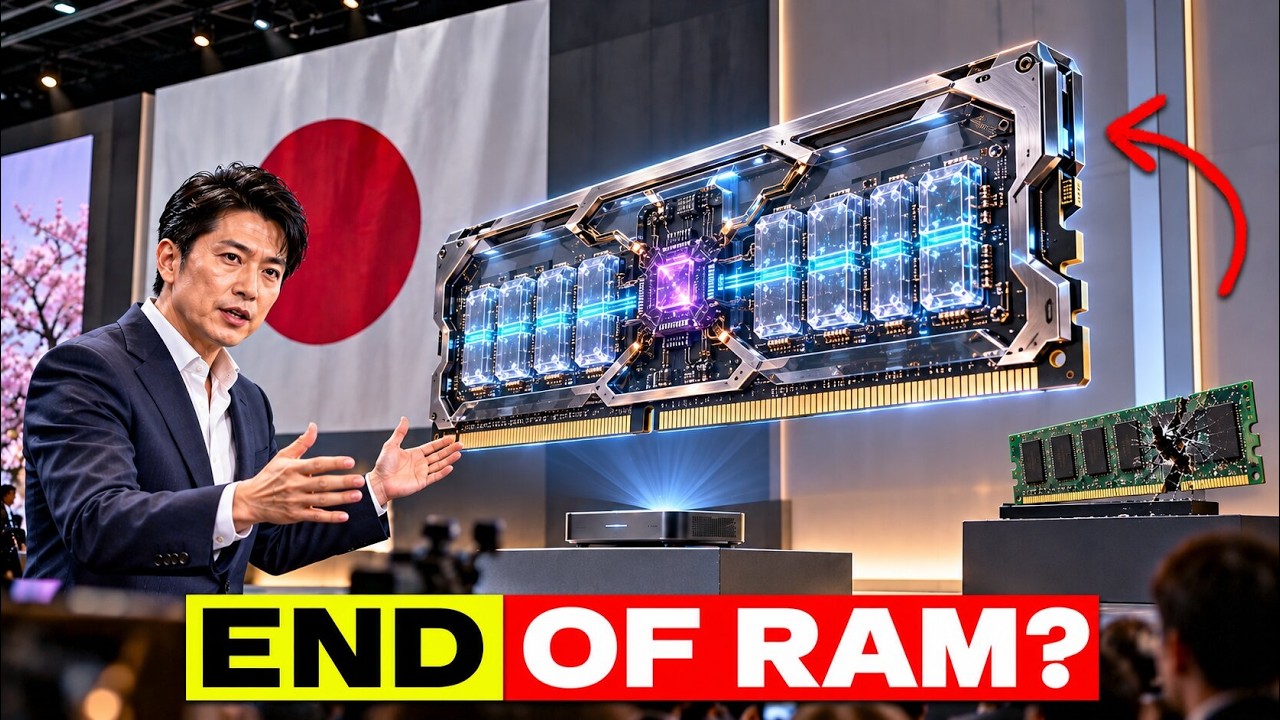
Japan’s Latest Technology Could Replace RAM Forever
Title history
- Japan’s Latest Technology Could Replace RAM Forever — observed on 20261117-0234 UTC (YouTube)
Keywords
Summary
174 words
Critical Evaluation
Value of the Information & Strength of the Argument
The video delivers substantial value by synthesizing technical, historical, and market data. It quantifies the RAM shortage, cites industry projections (e.g., TrendForce price increases), and provides concrete performance metrics for each new technology. The argumentation is structured logically, moving from the crisis to specific Japanese initiatives, while honestly addressing limitations and risks. The use of quotes from executives like Wallace Kou and analysts like Jim Handy adds credibility. The narrative avoids overhyping, presenting both potential and pitfalls. However, some claims (e.g., 97% power reduction, 39x faster startup) come directly from company/university press releases without independent verification, and the video does not delve deeply into competing technologies beyond Korea and the US.
Scientific Rigor, Source Quality, Title Accuracy
The video demonstrates solid scientific rigor by referencing specific conferences (A-SSCC, IEDM), peer-reviewed publications (Nature Communications), and corporate announcements. It mentions NIST collaboration and government funding. The historical narrative is well-documented, citing specific events like Elpida’s bankruptcy and Micron’s acquisition. The title accurately reflects the content, focusing on Japan’s potential to disrupt memory technology. The video does not oversell: it explicitly compares to Optane and notes that all technologies are early-stage. It distinguishes between ‘alternative’ and ‘replacement’ carefully. The main weakness is that many figures originate from promotional materials, and the video does not independently test or validate them. Public comments were not provided, so no audience feedback analysis is possible.
237 words
Title / Content Match
The title accurately reflects the content: the video explores several Japanese technologies aimed at replacing or augmenting conventional RAM, with a focus on feasibility and market context.
Quality & Reliability
8/10
The video provides specific quantitative data, quotes from industry leaders, and references to recent publications and corporate announcements. It acknowledges uncertainties and historical failures, offering a balanced and well-researched perspective.
Key Moments
Markers derived by PSI from the transcript: the creator did not define chapters.
- Introduction: 65ms boot chip without RAM in Sendai
- The RAM crisis: price surge, AI demand, and shortage impact
- History: Japan's 80% market share in 1980s, decline, Elpida bankruptcy
- Tohoku University's spintronics and the 32MB MRAM chip
- Kioxia's oxide semiconductor transistor with ultralow leakage
- SoftBank's Z-angle memory: vertical stacking for heat dissipation
- The graveyard of miracle memories: Optane failure and challenges
- Conclusion: RAM replacement will be incremental, Japan's strategy
Cited Sources
- TrendForce DRAM price forecast — Cited for projected contract price increases of 58-63% in Q2 2026
- Tohoku University announcement — World-first 16nm AI chip with 32MB MRAM, presented at A-SSCC 2026
- Kioxia/Nanya Technology IEDM 2024 paper — Oxide semiconductor transistor with leakage below 1e-18 A per cell
- SoftBank/Sai Memory press release — Partnership with Intel for Z-angle memory, targeting HBM replacement
- Nature Communications paper (Fukami group) — Spintronic device mimicking synaptic weights (February 2025)
- Intel Optane discontinuation — Historical example of failed universal memory attempt
Contribution & Novelties
This video provides a comprehensive, up-to-date overview of three distinct Japanese memory technologies (MRAM, oxide-semiconductor RAM, and Z-angle 3D stacking) and places them in the context of a severe global RAM shortage. It synthesizes technical details with market analysis and historical perspective, making complex semiconductor concepts accessible. The novel contribution is the framing of Japan’s comeback not as a single breakthrough but as a multi-pronged assault on RAM’s weaknesses (leakage, heat, volatility). The video also critically evaluates the technologies against the Optane failure, avoiding hype.
Pour aller plus loin :
- Magnetoresistive RAM (MRAM) — Overview of MRAM technology, including spintronics-based memory that is non-volatile and fast.
- Spintronics — The field of using electron spin for data storage and logic, fundamental to Sendai’s approach.
- High Bandwidth Memory (HBM) — Context for Z-angle memory’s target: the stacked DRAM used in AI accelerators.
- Intel Optane — The 3D XPoint technology that failed to replace RAM, cited in the video as a cautionary tale.
160 words
Radar Profile
The radar profile shows high scores in information quantity and quality, moderate technical depth, and good reliability. The video is strong on data and sources, with a slight dip in technical level due to some simplified explanations. The reliability is solid but not perfect because it relies on press releases and unverified claims.