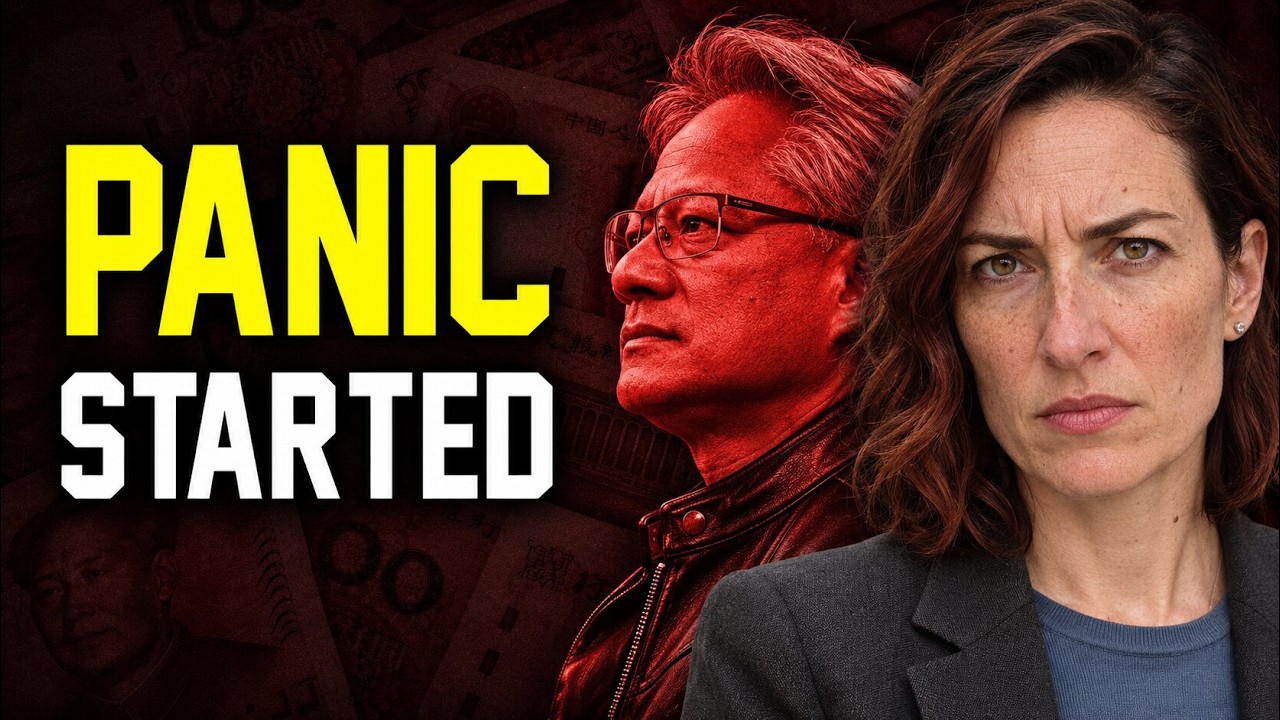
The Hidden Cost of Jensen Huang’s Exit
Title history
- The Hidden Cost of Jensen Huang’s Exit — observed on 20261121-0139 UTC (YouTube)
Keywords
Summary
153 words
Critical Evaluation
Value of the Information & Strength of the Argument
The video provides a comprehensive and well-structured analysis of the multifaceted consequences of a founder’s exit from a major corporation. Its value lies in connecting financial, human, and political dimensions, using concrete data points (e.g., 42,000 employees, 60 direct reports, market cap changes) and named sources. The argumentation is solid, building a coherent narrative that each ‘bill’ compounds the overall cost. It also includes contrarian views (e.g., Jim Cramer’s Apple comparison) to balance the analysis. However, some claims are speculative, such as the exact probability of Huang’s return, and the tone occasionally veers into dramatic rhetoric, which may detract from its objectivity.
Scientific Rigor, Source Quality, Title Accuracy
The video demonstrates strong source discipline, citing reputable outlets like Reuters, Financial Times, The Information, and named analysts like Dan Ives and Morningstar. It distinguishes between confirmed facts and allegations, and explicitly notes when information is unverified. The title is highly aligned with the content, as the video repeatedly returns to the concept of hidden costs. The rigour is undermined slightly by the lack of direct URLs (none provided in the description), but the named sources are sufficiently recognizable. The inclusion of multiple perspectives (e.g., Bessent vs. engineers) enhances its credibility, though the video’s own conclusions are interpretative.
215 words
Title / Content Match
The title accurately reflects the video's core thesis: examining non-obvious consequences of Jensen Huang's resignation beyond the stock price drop, covering employee retention, geopolitical influence, and succession gaps.
Quality & Reliability
7/10
The video synthesizes multiple reputable sources (Reuters, Financial Times, Morningstar, etc.) and cites named analysts and officials. It clearly distinguishes confirmed facts from hypotheses, though it includes speculative scenarios and editorial commentary. The factual elements appear accurately reported, but the framing is intentionally dramatic.
Key Moments
Markers derived by PSI from the transcript: the creator did not define chapters.
- Introduction to the 1,600 comments demand for Jensen Huang's return.
- Market reaction: stock drop, Dan Ives' 25-30% valuation loss estimate, and concentration risk in index funds.
- Impact on employees: golden handcuffs weakening, potential exodus of talent, and loss of Huang's mentoring culture.
- Political dimension: Huang's role in export controls, Scott Bessent's criticism, and implications for China chip sales.
- Succession planning gap: no clear heir, board's search, and candidates like Renee Haas and Lisa Su.
- Possibility of Huang's return: Polymarket odds, Elon Musk's petition, and Trump's comments.
- Upcoming earnings call as a test, and the long-term question of whether Nvidia can thrive without its founder.
Cited Sources
- Bernstein analyst (unnamed) — Quoted saying 'Jensen Huang is Nvidia and Nvidia is Jensen Huang.'
- Scott Galloway (marketing professor) — Comment on AI depending on a leather jacket.
- Steven Witt (author) — Admitted uncertainty about Nvidia's value without Huang on television.
- Dan Ives (analyst) — Estimated 25-30% worth of Nvidia tied to Huang; commented on China sales being done.
- Jim Cramer — Compared to Apple after Steve Jobs' death.
- Morningstar analysts — Warned of less dealmaking and more regulation.
- ABC News — Discussed concentration risk in retirement funds.
- Reuters — Reported 600,000 China-bound chips stuck in Hong Kong.
- The Information — Reported Megaspeed shipped $7.5B of Nvidia chips to China.
- Financial Times — Reported board approached Renee Haas; Huang discussing return.
- New York Times — Reported Huang's lack of succession planning.
- Scott Bessent (Treasury Secretary) — Criticized Nvidia's compliance culture and called for outsider CEO.
- Elizabeth Warren — Stated Huang and directors owe Congress answers.
- Jason Schloesser (Georgetown professor) — Warned of talent exodus after succession decision.
- Jeffrey Sonnenfeld (Yale) — Called lack of succession 'ridiculous'.
- Peter Szorowski (Georgetown) — Said board was asleep at the wheel.
- Charles Elson (governance expert) — Stressed need for succession planning.
- Brian Burke (board advisor) — Described cult-like culture.
- Colette Kress — Interim CEO, background as CFO.
- Harvey Jones — Board chair stating no disruption.
- Ken Mahoney (investor) — No business depends solely on one person.
Concurring Sources
- Dan Ives (analyst) — His valuation loss estimate aligns with the video's thesis on market impact.
- Morningstar analysts — Their warnings on reduced dealmaking and regulation support the video's argument.
- Jeffrey Sonnenfeld — Critique of succession planning reinforces the video's point on governance failure.
Dissenting Sources
- Jim Cramer — Compares to Apple after Steve Jobs, suggesting the company can thrive—contradicting the video's emphasis on severe hidden costs.
- Ken Mahoney (investor) — Stated no business depends entirely on one person, offering a more optimistic view than the video's thesis.
- Board chair Harvey Jones — Affirms operations will continue without disruption, contrasting with the video's narrative of systemic risk.
Contribution & Novelties
The video innovatively frames a corporate scandal’s impact through three distinct ‘bills’ (money, people, power), highlighting often overlooked consequences such as concentration risk for ordinary retirement savers, the weakening of golden handcuffs on employees, and the loss of a key voice in international trade policy. It connects personal failing to national security concerns and illustrates how a flat management structure built around a single leader creates unique vulnerabilities.
Pour aller plus loin :
- Golden handcuffs — Directly relevant to employee retention mechanisms discussed.
- Succession planning — Discusses the governance gap the video highlights.
- Concentration risk — Explains the index fund vulnerability mentioned in the video.
- Jensen Huang — Context on the person and company history.
115 words
Radar Profile
The radar profile shows high scores in quantity and quality of information, with moderate scores in technical depth and reliability. This indicates a content-rich video that is well-sourced but remains accessible to a non-expert audience, with a slight over-reliance on editorial interpretation.