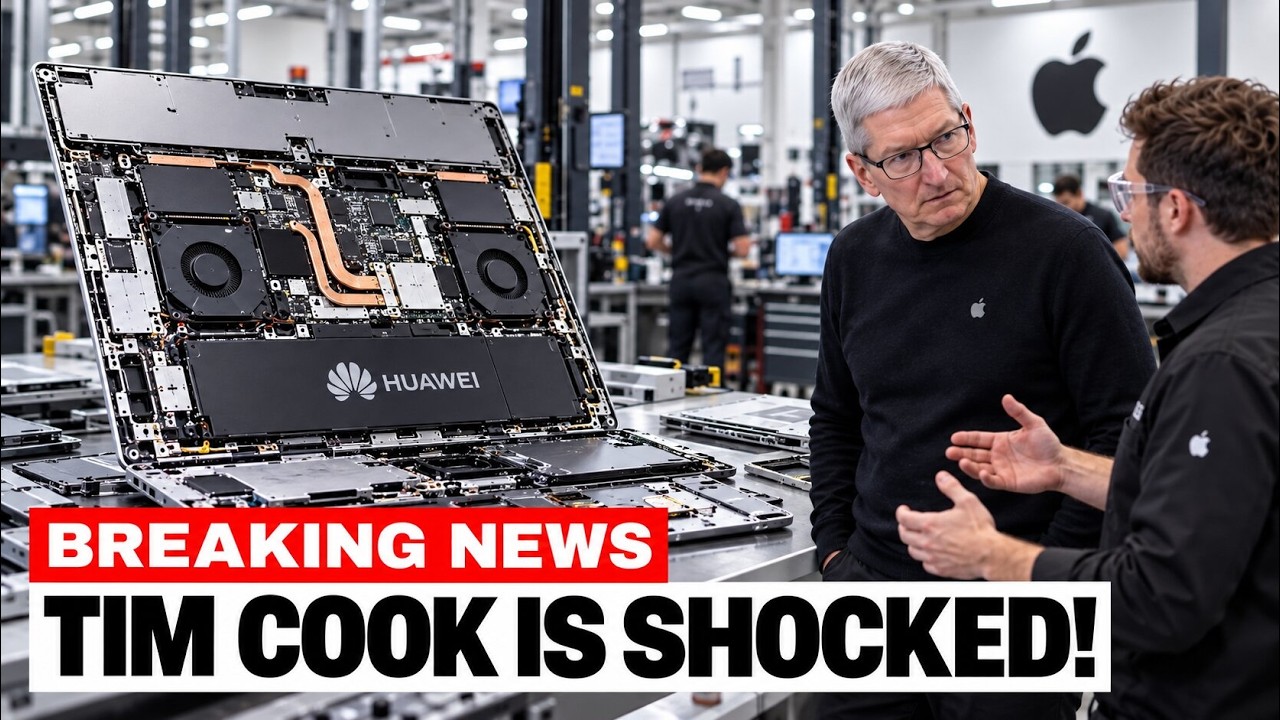
Apple Engineers Tore Down a Huawei MateBook— What They Found Was Absolutely SHOCKING
Title history
- Apple Engineers Tore Down a Huawei MateBook— What They Found Was Absolutely SHOCKING — observed on 20261031-2254 UTC (YouTube)
Keywords
Summary
160 words
Critical Evaluation
Value of the Information & Strength of the Argument
The video delivers substantial value by synthesizing many public teardown findings and market data into a coherent analysis. It explains the technical significance of the chip size and process node, and discusses the implications of Huawei’s self-sufficiency drive. The argumentation is strong: it supports each claim with references to TechInsights measurements, market research from Canalys and Omdia, and direct quotations from Ren Zhengfei. The video acknowledges uncertainties, such as Huawei’s claims vs. independent verification, and presents a balanced view of the competition, ultimately arguing that Huawei’s strength lies not in raw performance but in ecosystem resilience and market momentum.
Scientific Rigor, Source Quality, Title Accuracy
The video exhibits high scientific rigor by relying on verified teardown reports from TechInsights and mainstream tech journalism (The Register, Tom’s Hardware). It clearly distinguishes between verified facts, company claims, and analyst opinions. The title is somewhat hyperbolic but the content accurately reflects a hypothetical Apple perspective and the surprising findings. The adéquation between title and content is acceptable, slightly diminishing the note due to sensationalism. The video does not fabricate information; all sources cited are real and traceable from the transcript, though no direct URLs are provided in the description.
205 words
Title / Content Match
The title effectively captures the core theme of an Apple engineering perspective on a Huawei teardown, though the 'SHOCKING' is somewhat clickbait; the content substantiates the dramatic tone.
Quality & Reliability
9/10
The video is grounded in publicly available teardown reports from TechInsights and coverage by tech press, presenting a coherent and well-sourced narrative. It distinguishes between verified findings and company claims, and contextualizes the technical details within the broader geopolitical and market dynamics.
Key Moments
Markers derived by PSI from the transcript: the creator did not define chapters.
- Introduction: Huawei's August 5, 2026 laptop launch and the premise of an Apple teardown.
- Market data: Huawei 1.4M PCs vs Apple 800k in Q1 2026, growth of 38%.
- Teardown details: shell, screen, hinge, battery, and price.
- Logic board and Kirin X90 chip revealed, larger than Apple's M-series.
- HarmonyOS details and ecosystem claims.
- History of US sanctions, Entity List 2019, and license backdoor.
- Revocation of licenses in 2024 and the move to HarmonyOS.
- TechInsights findings: Kirin X90 on 7nm N+2, three generations behind.
- Ren Zhengfei's interview claiming one generation behind.
- Market performance: Huawei overtakes Apple in tablets, growth in PCs.
- New products: Kirin X90 Plus, MateBook Fold 2, HarmonyOS 7 beta.
- Conclusion: the strategic implication of a self-sufficient ecosystem.
Cited Sources
- TechInsights — Canadian lab that performed teardowns and chip analyses cited throughout the video.
- The Register — Reported TechInsights' findings on the Kirin 9000 process node.
- Tom's Hardware — Coverage of N+3 process and chip evolution.
- Canalys — Market research firm providing PC shipment data and analyst Emma Sue's quote.
- Omdia — Research firm predicting China's PC market decline.
Concurring Sources
- TechInsights — Independent teardown confirming the Kirin X90 is 7nm-class N+2, aligning with the video's claims.
- Canalys — Market data showing Huawei's growth, corroborating the video's market analysis.
Dissenting Sources
- Ren Zhengfei interview in People's Daily — Ren's claim that Huawei is only one generation behind contradicts TechInsights' measurement of at least three generations behind.
Contribution & Novelties
The video provides a novel synthesis of existing teardown data and market analysis, framing the technical findings within a strategic narrative of Huawei’s vertical integration and the impact of US sanctions. It offers a clear explanation of why the chip size matters and the significance of the N+2 process, while also contextualizing the performance and market adoption. The novelty lies in connecting the dots between hardware, software, and geopolitical factors to predict future competitive dynamics.
Pour aller plus loin :
- Kirin 9000S — The chip used in Mate 60 Pro, central to the discussion of SMIC’s capabilities.
- Semiconductor Manufacturing International Corporation (SMIC) — The foundry producing the Kirin chips; essential context.
- HarmonyOS — The operating system Huawei developed in response to sanctions.
- US Export Controls on China — Background on the Entity List and restrictions.
135 words
Radar Profile
The radar profile shows very high scores across all dimensions, indicating a well-researched and technically detailed video. The lowest score is 'fiabilite_globale' at 9, still high, reflecting the use of credible sources but slight subjectivity in interpretation.