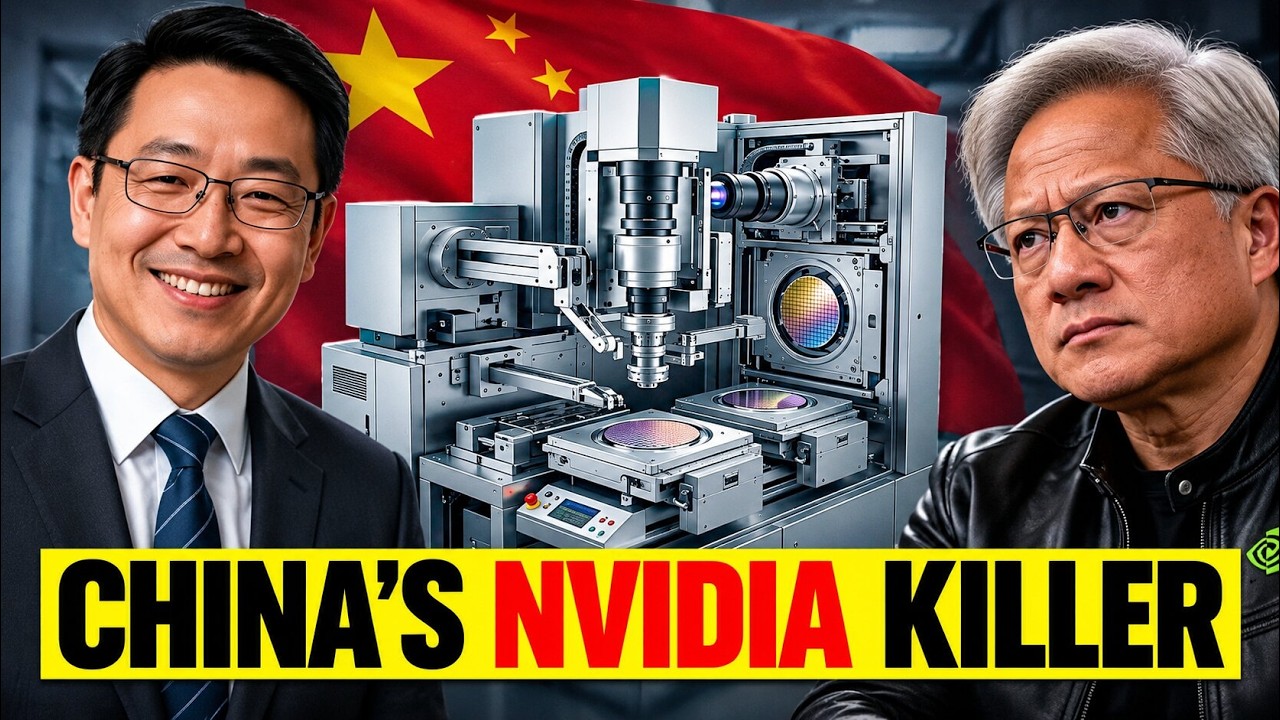
China Just Built What Nvidia Feared Most
Title history
- China Just Built What Nvidia Feared Most — observed on 20261109-1007 UTC (YouTube)
Keywords
Summary
107 words
Critical Evaluation
Value of the Information & Strength of the Argument
The video provides valuable information by assembling recent events and data points into a coherent narrative, explaining the strategic implications of China’s push for chip independence. The argumentation is solid, using specific numbers, quotes from executives, and references to analyst reports. The video makes a compelling case that the export controls have accelerated China’s drive to build its own ecosystem, and that the long-term threat to Nvidia is not a single chip but the emergence of a parallel software and developer environment. However, some claims are speculative and not independently verified, and the video may overstate the immediate impact.
Scientific Rigor, Source Quality, Title Accuracy
The video cites a range of sources including Nvidia’s annual report, IDC data, Reuters, Bernstein, TrendForce, and quotes from Jensen Huang and Eric Xu. These are credible sources for the most part, though the video does not provide direct links. The theory that China’s ecosystem could challenge Nvidia is supported by evidence, but the video also acknowledges counterpoints like SMIC’s yield issues and memory constraints. The title accurately matches the content, as the video indeed argues that China has built something that Nvidia fears. No comments were provided, so public reception cannot be assessed.
208 words
Title / Content Match
The title accurately reflects the content, which focuses on China's development of an Nvidia-independent AI ecosystem.
Quality & Reliability
7/10
The video presents a well-sourced analysis with specific data and quotes, but some claims are unverified and it includes speculative projections.
Key Moments
Markers derived by PSI from the transcript: the creator did not define chapters.
- Introduction of anonymous model Owl Alpha on OpenRouter
- Meituan reveals ownership and open-sources Long Cat 2.0
- Nvidia's annual report and Jensen Huang's comments on China market
- Huawei's supernode and growth of domestic chip market
- DeepSeek's open-source CUDA replacement for Ascend
- Challenges: SMIC yields, EUV lithography, memory shortage
- Future projections and conclusion on export controls
Cited Sources
- Nvidia Annual Report — Nvidia's own filing to US regulators acknowledging foreclosure from China market
- IDC Data on AI accelerators — Market share statistics for China's AI chip shipments
- Reuters Report on Huawei and Nvidia — Reporting on chip shipments and market dynamics
- Bernstein Analysis — Projections for China's AI chip market share
- TrendForce Forecast — Prediction of domestic chip makers capturing 56% of China's AI chip market in 2026
Contribution & Novelties
The video synthesizes recent developments in China’s AI chip industry, presenting a unified picture of how domestic hardware, software, and models are converging to challenge Nvidia’s dominance. It highlights the significance of Meituan’s Owl Alpha and DeepSeek’s open-source contributions, which are not widely covered elsewhere. The analysis of Nvidia’s own admission of foreclosure in China adds a crucial perspective.
Pour aller plus loin :
- CUDA — The proprietary software layer that Nvidia uses to lock in developers; the video discusses its potential replacement.
- Huawei Ascend — Huawei’s AI chip series that is gaining market share in China.
- DeepSeek — The AI lab that released open-source models and CUDA alternatives for Chinese hardware.
- High Bandwidth Memory — A critical component for AI accelerators; the video notes supply constraints.
127 words
Radar Profile
The radar profile shows a video strong on information quantity and quality, indicating a data-rich analysis. The moderate scores on technical depth and global reliability suggest that while the content is accessible, it may simplify some technical aspects and rely on unverified claims.