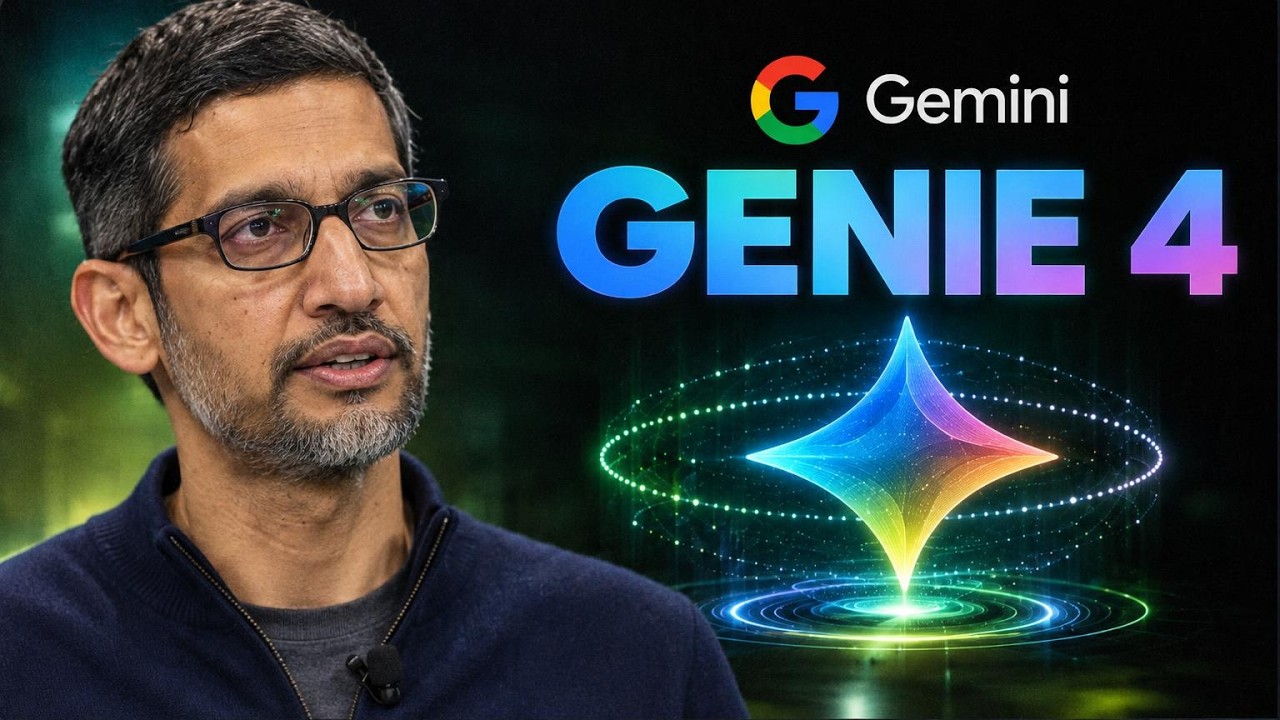
Google's Genie 4 Ignites a Terrifying AI Theory
Title history
- Google's Genie 4 Ignites a Terrifying AI Theory — observed on 20261121-1609 UTC (YouTube)
Keywords
Summary
172 words
Critical Evaluation
Value of the Information & Strength of the Argument
The video provides significant value by connecting a technical AI advancement to deep philosophical and economic debates. It effectively argues that the ability to generate consistent, interactive worlds challenges assumptions about reality. The argumentation is solid, using concrete examples (e.g., stock market reactions, Waymo’s use, Sema’s learning) to substantiate claims. The inclusion of opposing views (e.g., Yann LeCun, Gödel-based paper) adds balance, though the presenter’s enthusiasm for the simulation theory sometimes leans toward speculation. The step-by-step progression from Genie 2 to Genie 4 illustrates a rapid evolution, reinforcing the central thesis.
Scientific Rigor, Source Quality, Title Accuracy
The video demonstrates reasonable scientific rigor by citing multiple academic papers (Bostrom, Wolpert, Faizal), industry reports (TechCrunch, The Batch), and expert opinions (Hassabis, LeCun, Sweeney). Sources are diverse and often credible. The title’s severe tone (‘Terrifying AI Theory’) is somewhat clickbait but aligns with the video’s focus on the unsettling implications. The content generally matches the title, though some sections overstate speculative possibilities. The presenter mentions the lack of a technical report for Genie 4 and acknowledges limitations, showing critical awareness. Public comments were not provided, so no analysis was possible.
197 words
Title / Content Match
The title is somewhat sensationalist but accurately reflects the central theme: Genie 4 reignites the simulation hypothesis debate. It matches the content well.
Quality & Reliability
7/10
The video presents a broad and well-structured overview, citing academic papers, industry reports, and expert opinions. However, it blends factual reporting with speculative interpretation, and some claims rely on secondary reporting without primary verification. The discussion of the simulation hypothesis is thorough but includes subjective commentary.
Key Moments
Markers derived by PSI from the transcript: the creator did not define chapters.
- Introduction to Genie 4's capability and the simulation hypothesis
- Explanation of Genie 4's four advances: realism, sound, people, control
- Recap of Genie 2 and Genie 3 development history and impact
- Introduction of simulation theory and Nick Bostrom's argument
- Economic disruption: gaming stocks fall after Project Genie prototype
- Applications in AI agents, Waymo self-driving, and robotics
- Counterarguments, limitations of Genie 4, and concluding reflections
Cited Sources
- Are You Living in a Computer Simulation? (2003) — Nick Bostrom's foundational paper on the simulation hypothesis mentioned in the video
- David Wolpert's simulation framework — Reference to Wolpert's mathematical framework for universe simulation
- Gödel in the Universe: The Impossibility of Simulating Reality — Paper by Mir Faizal and colleagues arguing against simulation using Gödel's incompleteness theorems
- TechCrunch coverage of Genie 4 — Reported details on Genie 4's capabilities and consistency limit
- The Batch newsletter — Critique of Genie 4 launch lacking quantitative evaluation
Concurring Sources
- DeepMind's world model research — Official research page showcasing world models and Genie series
- Tesla AI Day on world simulation — Mention of Tesla's use of simulated environments for training, aligning with the video's theme
Dissenting Sources
- Yann LeCun's critique of generative models
- Gödel-based impossibility paper
Contribution & Novelties
The video uniquely connects a cutting-edge AI product to long-standing philosophical and scientific debates, offering a balanced perspective that includes both proponents and skeptics. It illustrates the practical implications of world models in industry, from gaming to autonomous driving, and raises ethical questions about AI agents raised in simulated environments.
Pour aller plus loin :
- Simulation hypothesis on Wikipedia — Context for Bostrom’s argument and its variations.
- Prediction machine theory and the brain — Anil Seth’s concept that brain perception is a controlled hallucination.
- Joint Embedding Predictive Architecture (JEPA) — Yann LeCun’s alternative to generative world models.
97 words
Radar Profile
The radar profile shows a balanced video with high quantitative information and moderate technical depth. It scores well on information quantity and quality, but lower on reliability due to speculative elements. The technical level is adequate for a general audience, with a noticeable tilt toward philosophical discussion.