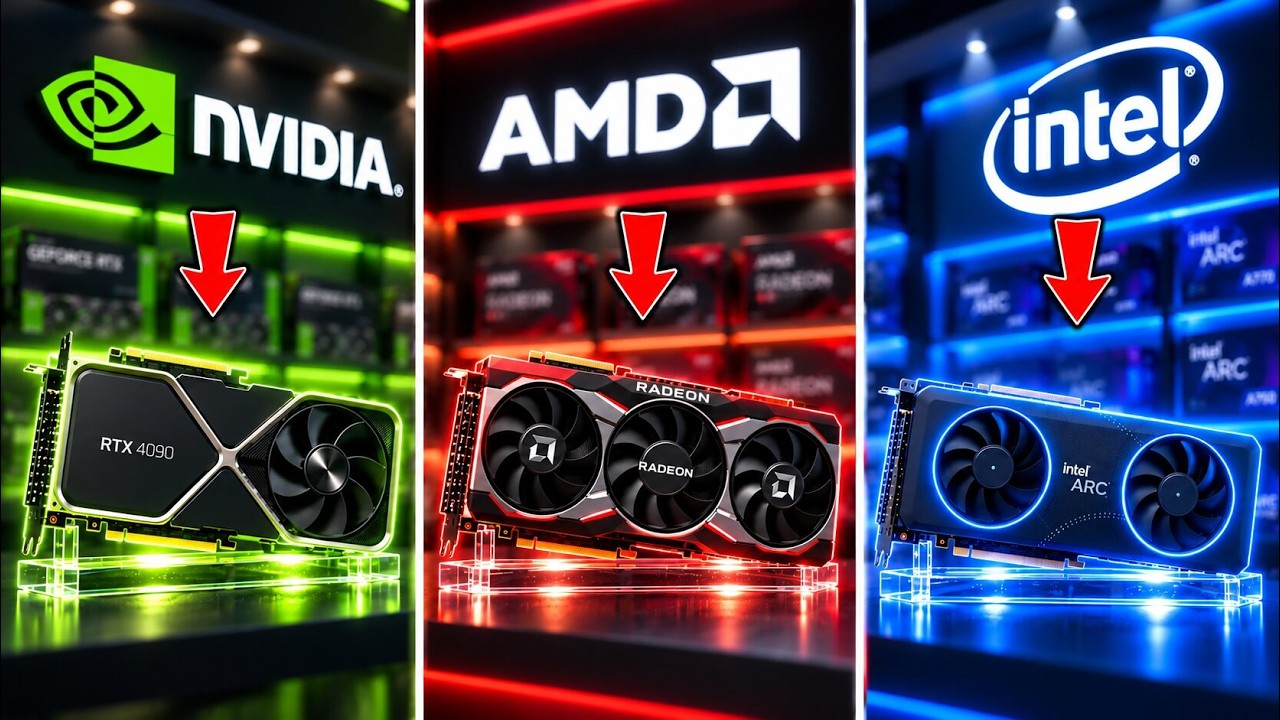
We Tested The Same GPU From NVIDIA, AMD & Intel — One Clear Winner!
Title history
- We Tested The Same GPU From NVIDIA, AMD & Intel — One Clear Winner! — observed on 20261108-1223 UTC (YouTube)
Keywords
Summary
211 words
Critical Evaluation
Value of the Information & Strength of the Argument
The video provides a thorough and well-structured argumentation, based on aggregated data from independent test labs. It carefully weighs performance metrics, memory capacity, features, driver maturity, and street prices, presenting a clear case for the AMD card while honestly acknowledging NVIDIA’s strengths in ray tracing and upscaling. The argumentation is balanced, citing both favorable and unfavorable results, and addresses counterpoints such as Noob Feed’s findings that favor NVIDIA in certain price scenarios. The use of specific percentages and game-by-game breakdowns strengthens the credibility. The emphasis on VRAM as a decisive factor is well-supported by experiments like TechSpot’s comparison of 8GB vs 16GB AMD cards, showing massive performance differences. However, the reliance on third-party data means the video does not offer original testing, which limits its uniqueness but not its value as a synthesis.
Scientific Rigor, Source Quality, Title Accuracy
The video demonstrates strong scientific rigor by relying on reputable technical outlets with repeatable methodologies. It cites specific numbers, game titles, and resolution settings, attributing data to sources like TechSpot, Tom’s Hardware, and PC Gamer. However, no direct links are provided in the description, making it harder to verify the original reports. The title overstates the video’s own testing, as it only aggregates existing data, which could mislead viewers expecting hands-on benchmarks. Despite this, the content is honest about its nature, explicitly stating ‘we lined up the results from the toughest independent test labs.’ The analysis of comment trends is omitted due to lack of data, but the video encourages viewer engagement without presenting audience feedback.
264 words
Title / Content Match
The title implies original testing, but the video synthesizes existing benchmark data from multiple labs. Slight discrepancy, but content matches the spirit of comparative analysis.
Quality & Reliability
8/10
Aggregates results from multiple reputable tech outlets (TechSpot, Tom's Hardware, PC Gamer, Hardware Unboxed, ComputerBase) with specific data and sources. Acknowledges limitations and provides balanced view, but relies on third-party testing rather than original experiments.
Key Moments
Markers derived by PSI from the transcript: the creator did not define chapters.
- Introduction of the three GPUs and the premise of the comparison.
- Round 1: Raw speed comparisons across multiple resolutions and games.
- Round 2: The critical role of VRAM capacity and its impact on modern games.
- Round 3: Features - ray tracing performance and DLSS/FSR image quality.
- Round 4: Driver maturity, Intel's comeback, and current street prices.
- Final verdict, buying recommendations, and concluding thoughts.
Cited Sources
- TechSpot — Provided benchmarks for 18 games, generational comparisons, and memory experiments.
- Tom's Hardware — Tested performance across resolutions and highlighted 8GB limitations.
- Hardware Unboxed — Witnessed performance differences between 8GB and 16GB RTX 5060 Ti and reported NVIDIA's review restrictions.
- PC Gamer — Current street prices, buying guides, and cost-per-frame analyses.
- ComputerBase — Blind test on DLSS 4.5 vs FSR4 vs native rendering.
- John Petrie Research — Market share and shipment data for desktop graphics cards.
- Noob Feed — Comparison where 8GB RTX 5060 was better overall than 16GB RX 9060 XT at higher cost.
Concurring Sources
- TechSpot — Agrees with Tom's Hardware on AMD's performance lead and 8GB VRAM inadequacy.
- Tom's Hardware — Consistent data on resolution scaling and memory bottlenecks.
- Hardware Unboxed — Confirms NVIDIA's deliberate limitation of 8GB models and performance impact.
- PC Gamer — Aligned on the RX 9060 XT as best value pick.
Dissenting Sources
- Noob Feed — Found the 8GB RTX 5060 to be a better overall choice than the 16GB RX 9060 XT when the AMD card was priced $130 higher, arguing that 8GB can still suffice for many games.
Contribution & Novelties
The video synthesizes a wide range of current benchmark data into a cohesive, decision-focused comparison, emphasizing the often-overlooked importance of VRAM capacity and real-world street prices. It distinguishes itself by aggregating data from multiple sources and offering clear buying advice based on user profiles. The novelty lies in the practical guidance for budget buyers in a volatile market.
Pour aller plus loin :
- Video random-access memory (VRAM) — Core concept influencing performance and longevity.
- PCI Express — Interface bandwidth affecting data transfer and performance on older motherboards.
- Deep Learning Super Sampling (DLSS) — NVIDIA’s AI upscaling technology, key differentiator.
- FidelityFX Super Resolution (FSR) — AMD’s alternative, now machine-learning based.
109 words
Radar Profile
The radar shows a balanced profile with high scores in information quantity and quality, reflecting the video's comprehensive synthesis of third-party benchmarks. Technical depth is solid but accessible, and global reliability is strong due to extensive sourcing. The breadth of data and clear argumentation compensate for the lack of original testing, resulting in a robust evaluation.