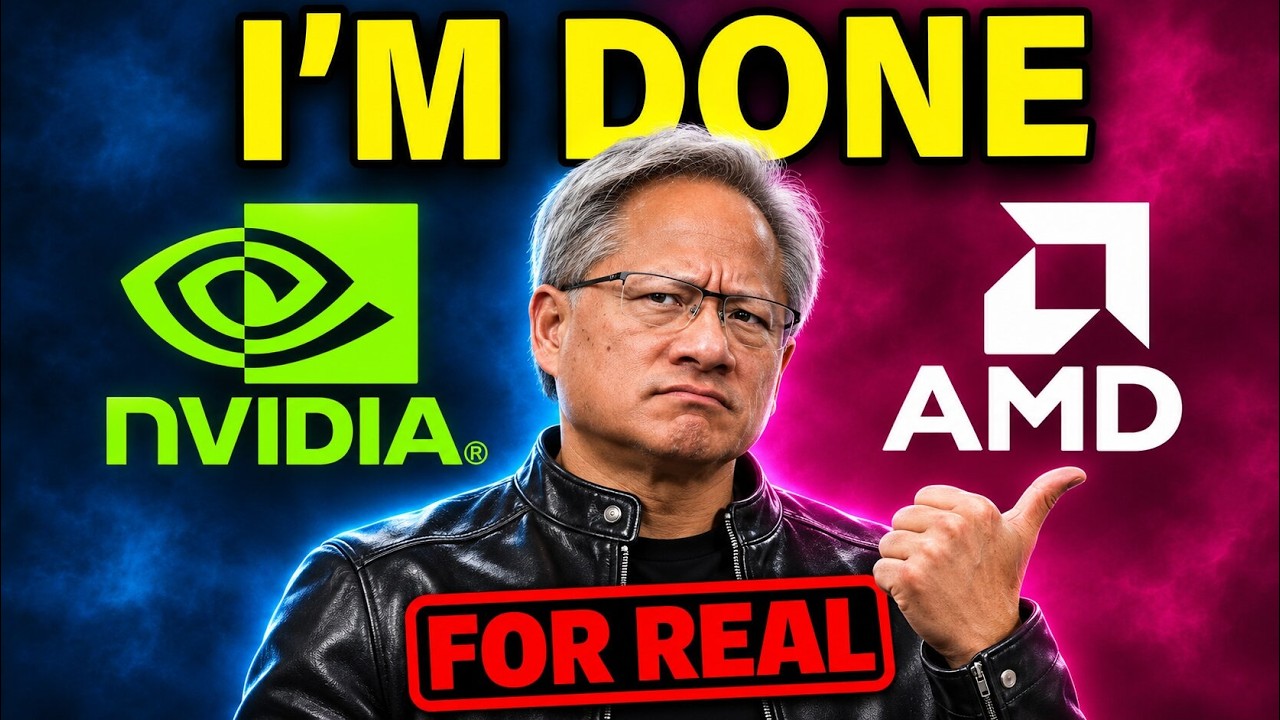
I’m Actually Leaving Nvidia Now
Title history
- I’m Actually Leaving Nvidia Now — observed on 20261117-1339 UTC (YouTube)
Keywords
Summary
139 words
Critical Evaluation
Value of the Information & Strength of the Argument
The information is valuable for anyone interested in PC gaming and Nvidia’s market strategy. The argumentation is well-structured, proceeding chronologically and building a case for the company’s shift. The author supports claims with specific numbers, quotes from industry analysts, and references to events. However, some conclusions are interpretive, and the personal perspective may bias the presentation. The argument that Nvidia is ‘quietly leaving gamers’ is persuasive, but it relies on circumstantial evidence.
Scientific Rigor, Source Quality, Title Accuracy
The video cites multiple credible sources, including The Information, Micron announcements, Bernstein Research quotes via CNBC, Tom’s Hardware, Capcom statements, GamersNexus for connector issues, and Gartner predictions. Many are properly attributed, but some are referenced vaguely (e.g., ‘reports out of Taiwan’). The title is fully adequate, as the video directly addresses the decision to leave Nvidia. The overall rigor is high for a video essay, though it mixes factual reporting with opinion.
159 words
Title / Content Match
The title perfectly reflects the content: the author explains his decision to leave Nvidia after analyzing the company's shift away from gaming.
Quality & Reliability
8/10
The video is well-researched, citing specific reports, analysts, and concrete data points. It distinguishes between facts and opinions, and acknowledges uncertainty. However, it is a personal commentary and some claims rely on unverified or speculative information.
Key Moments
Markers derived by PSI from the transcript: the creator did not define chapters.
- Introduction: The RTX 5090 disappears and the author announces his exit from Nvidia.
- Historical bond: Gamers saved Nvidia in 1999 with the GeForce 256.
- Memory shortage: Micron halts consumer Crucial line; production cuts of GeForce cards.
- GeForce Now hourly caps and price increases for partners.
- DLSS5 controversy and Jensen Huang's dismissive response.
- Q1 FY2027 earnings: gaming line removed from reporting; data center dominance.
- Multiple price hikes and RTX 5090 connector melting incidents.
- Alternatives: AMD and Intel raise prices too; Steam Machine offers an Nvidia-free path.
- Future outlook: No new GPUs until 2027/2028; memory shortage persists.
- Conclusion: Three decisions for leaving Nvidia; the emotional significance.
Cited Sources
- The Information report on Nvidia shelving RTX 50 Super — Mentioned in January when Nvidia didn't show new cards at CES.
- Micron announcement to discontinue Crucial brand — Cited to illustrate the focus on AI memory.
- Stacy Rasgon (Bernstein Research) comments on CNBC — Quoted on memory prioritization for AI.
- Tom's Hardware interview with Jensen Huang — Public backlash against DLSS5 and Huang's 'completely wrong' response.
- Economic Daily News price hike report — Third price hike of 2026 affecting entire GeForce lineup.
- Hardware Unboxed and Reddit reports of melted RTX 5090 connectors — Examples of quality issues.
- Gartner prediction on PC prices and shipments — Used to quantify the impact of memory shortage.
- Valve's Steam Machine launch and Eurogamer interview — Presented as a non-Nvidia gaming alternative.
- Overclock 3D analysis of price trends — Comparison of AMD and Nvidia price increases.
- Steam hardware survey data — Shows RTX 3060 as most popular card and AMD gains.
Concurring Sources
- Steam hardware survey — Supports the claim of gamers holding onto older cards (RTX 3060).
- Gartner predictions — Confirms the memory shortage's broad impact on PC pricing.
- Analyst Stacy Rasgon's CNBC comments — Agrees that gaming is no longer Nvidia's priority.
Dissenting Sources
- Nvidia official statement via Jeff Fisher — Nvidia insists the RTX 5090 is not discontinued and that gamers are important, contradicting the narrative of abandonment.
Contribution & Novelties
The video offers a cohesive narrative synthesizing multiple 2026 events into an argument about Nvidia’s strategic shift away from gaming. It frames common complaints into a personal decision-making framework. The innovative aspect is the three-part advice on how to leave Nvidia without feeling loss.
Pour aller plus loin :
- High Bandwidth Memory — Key component in the memory shortage affecting GPUs.
- Nvidia GeForce — Background on Nvidia’s gaming brand history.
- SteamOS — Valve’s Linux-based system that allows gaming without Nvidia.
- Deep Learning Super Sampling (DLSS) — The AI upscaling technology at the center of the controversy.
96 words
Radar Profile
The radar profile shows high scores in information quantity and technical level, reflecting the video's data-rich content. Quality and reliability are slightly lower due to opinion and speculative elements. The overall shape suggests a well-argued but subjective analysis rather than pure journalism.