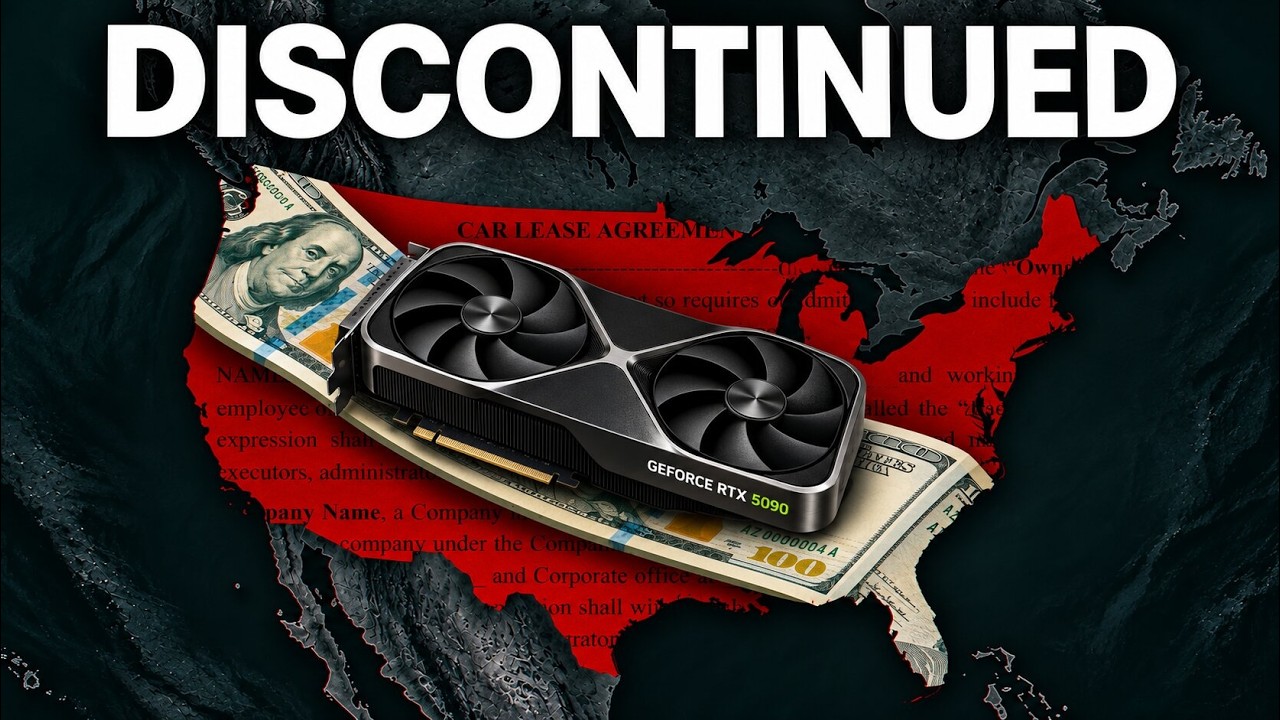
America Can't Afford a Nvidia 5090 Anymore
Title history
- America Can't Afford a Nvidia 5090 Anymore — observed on 20261113-0255 UTC (YouTube)
Keywords
Summary
169 words
Critical Evaluation
Value of the Information & Strength of the Argument
The video delivers strong analytical value by weaving together multiple credible data sources — official price listings, retail tracking, wage statistics, revenue breakdowns, memory contract prices, and market surveys — into a coherent explanation of why high-end GPUs have become unaffordable. The argumentation is structured causally: starting with the observable symptom (price inflation), then systematically unpacking root causes (Nvidia’s data-center pivot, memory scarcity, supply rationing, Chinese demand), and finally examining consequences (panic buying, cloud gaming adoption, market contraction). The time-based framing — converting card prices into weeks of median American earnings — is a particularly effective argumentative device that grounds the abstract price surge in visceral human terms. Some reasoning chains rely on anonymous leaker reports and industry sources that cannot be fully verified, which slightly weakens the strength of the causal claims.
Scientific Rigor, Source Quality, Title Accuracy
The video demonstrates reasonable scientific rigor by citing specific named sources for most key claims: BLS for wage data, TrendForce for memory chip price increases, Steam’s survey for GPU usage distribution, and Jon Peddie Research for market share and shipment statistics. However, rigor is uneven — some supply-chain claims rely on unnamed Taiwanese industry sites (Board Channels, Bench Life) and popular leakers, and the video itself acknowledges that controversial evidence (the pallet photos of 5090s in China) was likely AI-generated. The article also makes speculative projections (tariff impact suggesting price doubling) clearly labeled as projections rather than facts. The title aligns well with the content — the video spends substantial time examining American affordability specifically, although it also ranges into international markets and the broader global dynamics, which enriches rather than contradicts the stated topic.
283 words
Title / Content Match
The title accurately captures the video's central thesis: Americans can no longer afford the RTX 5090. The content thoroughly explores price inflation, wage comparisons, and structural causes, making the title well-aligned with a high-quality treatment of the topic.
Quality & Reliability
7/10
The video cites specific named sources (BLS, TrendForce, Steam survey, Jon Peddie Research) for most key data points, giving it credible grounding. However, some supply-chain claims rely on unnamed industry leakers and Taiwanese forum reports, and the video openly acknowledges that controversial photographic evidence was likely AI-generated. Speculative projections (e.g., tariff worst-case pricing) are clearly labeled as projections, which is good practice, but the uneven verification standards for various claims bring the overall reliability assessment to 7/10.
Key Moments
Markers derived by PSI from the transcript: the creator did not define chapters.
- The RTX 5090 officially costs $1,999 but is out of stock everywhere; actual prices reach $4,999–$6,389.
- Price history through 2026: cheapest new 5090 climbs from $4,999 to $6,389 in two weeks.
- International comparison: Germany sees a 73% price jump in 8 months; 3D Center tracks 132% increase for the 5090.
- Nvidia's official price remains unchanged — a reporter finds no formal notice behind higher listings.
- Affordability analysis: a 5090 at today's prices costs more than 5 weeks of median American weekly earnings.
- Nvidia's gaming revenue drops to 8% of the company; data centers account for 91.5%.
- Memory shortage explained: HBM demand for AI servers squeezes supply; Micron exits the consumer market.
- Nvidia cuts RTX 50 series supply by 30–40%; Jensen Huang says scarcity is 'fantastic'.
- China buying gaming cards for AI despite export ban; over a million cards acquired during 2026.
- Gamers turn to cloud gaming (GeForce Now) as an alternative; hardware upgrades postponed by 43% of survey respondents.
Cited Sources
- Tom's Hardware price tracking — Used to track retail prices of RTX 5090 across 2026.
- Bureau of Labor Statistics (BLS) earnings data — Median weekly earnings figures for full-time American workers, Q3 2026.
- Steam Hardware Survey (Valve) — Shows RTX 5090 at 0.41% of gaming systems; RTX 3060 at 3.99%.
- 3D Center (German price tracker) — Tracked RTX 50 family price increases in Germany, including 132% for the 5090.
- TrendForce — Data on memory contract price increases of 93-98% in Q1 2026.
- Micron (company announcement) — Announcement of exit from consumer memory market (Crucial brand) in December 2025.
- Financial Times — Reporting on Chinese tech companies buying over a million Nvidia gaming and workstation cards in 2026.
- Gizmodo — Nvidia's statement to Gizmodo about shipping every GeForce model and blaming memory supply.
- Jon Peddie Research — Market share data (Nvidia 94% of add-in board market) and shipment statistics.
- Politico — Reporting on potential new semiconductor tariffs in late August 2026.
Concurring Sources
- Nvidia FY2026 earnings release — Confirms the revenue breakdown cited in the video: data centers over 90% of revenue, gaming down to 8%.
- BLS earnings data — Supports the video's wage stagnation claims with official US government statistics.
Dissenting Sources
- Nvidia official statement (via Gizmodo) — Nvidia claims it is shipping all GeForce models and attributes shortfalls solely to memory supply, offering a narrower explanation than the video's multi-factor analysis.
Contribution & Novelties
The video’s original contribution lies in synthesizing widely scattered data points — retail price tracking, earnings statistics, revenue breakdowns, memory contract pricing, and supply chain reports — into a single coherent narrative about why high-end gaming GPUs have become unaffordable. It frames the 5090’s price surge not as an anomaly but as the leading indicator of a structural shift in the semiconductor industry, where AI demand is reshaping production priorities. The time-based affordability analysis (comparing card prices to median weekly earnings) is a compelling framing that grounds the abstract price inflation in concrete worker realities.
Pour aller plus loin :
- High Bandwidth Memory — The core technology behind the memory shortage, and the key factor driving memory prices skyward.
- CUDA — Nvidia’s software platform that anchors its data-center dominance and underpins the strategic pivot described.
- Taiwan Semiconductor Manufacturing Company (TSMC) — The wafer supplier that Nvidia says needs to double capacity to keep up with AI demand; central to the supply constraints.
162 words
Radar Profile
The radar profile shows a high information quantity score (9/10) balanced by moderate quality and reliability scores (7/6/6). This suggests the video excels at volume and breadth of data but is somewhat weaker on verification standards, particularly for speculative claims and unconfirmed reports.