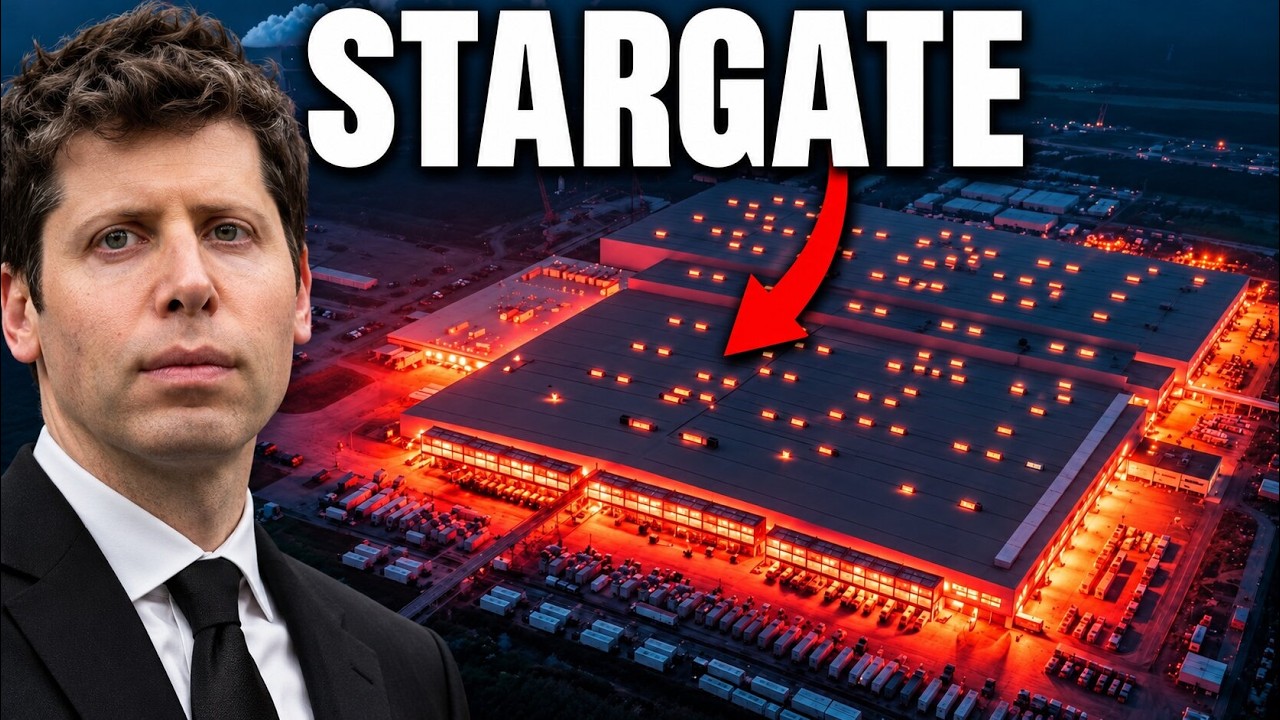
OpenAI’s Stargate Data Center Has a Massive Problem
Title history
- OpenAI’s Stargate Data Center Has a Massive Problem — observed on 20261114-1338 UTC (YouTube)
Keywords
Summary
182 words
Critical Evaluation
Value of the Information & Strength of the Argument
The video provides substantial value by connecting technical, financial, and social threads into a coherent analysis. It argues persuasively that the Stargate project exemplifies a systemic overreach, where promises of future benefits justify current costs borne by local communities and small investors. The argumentation is solid, using concrete data points and cited reports to support claims, such as the 200 MW operational vs. planned multi-GW, the 50% rent increase, and the $96 billion in partner debt. It also incorporates expert opinions from economists like Daron Acemoglu and analysts like Sebastian Mallaby, strengthening the case for a bubble or structural risk. While the video is clearly critical, it acknowledges counterarguments—such as the historical precedent of overbuilt railroads—ensuring a balanced yet pointed analysis.
Scientific Rigor, Source Quality, Title Accuracy
The video demonstrates strong scientific rigor by referencing authoritative sources: Financial Times, Time magazine, Floodlight, CNBC, and academic experts. However, some claims rely on anonymous whistleblowers and single-source reports, which introduces a degree of uncertainty. The title is a faithful reflection of the content, accurately framing the investigation. The video consistently addresses the title’s ‘massive problem’ across all aspects: technical, financial, and social. There is no notable divergence between title and content. The description of the video also aligns, as it begins with the same narrative. The lack of a formal bibliography in the video itself is mitigated by the spoken references, but a viewer seeking primary sources would need to follow up independently.
250 words
Title / Content Match
The title accurately reflects the content: the video extensively details the operational, financial, and social problems plaguing OpenAI's Stargate data center project, from construction delays to community backlash and debt concerns.
Quality & Reliability
7/10
The video is a well-researched investigative report that draws on multiple reputable sources (Financial Times, Time, Floodlight, CNBC) and includes on-the-ground interviews, but relies on some anonymous anecdotes and speculative projections about future outcomes.
Key Moments
Markers derived by PSI from the transcript: the creator did not define chapters.
- Introduction to Lexi Smith's perspective and the scale of the Stargate problem.
- January 2025 White House announcement: $500B and 10GW promise with Altman, Ellison, and Son.
- Expansion deals with Oracle ($300B contract) and Nvidia's $100B investment, but only 200MW operational.
- Winter failures and building delays; safety incidents including deaths and injuries reported in 911 logs.
- Housing crisis: rent up 50%, homeless shelters strained, workers living in cars, and students without housing.
- Power and environmental issues: gas turbines, emissions, and the strain on Texas grid with reference to 2021 winter storm.
- Financial analysis: OpenAI losses, circular financing, partner debt, and credit market concerns.
- Local opposition: Saline Township vote, Michigan freeze, Port Washington, and Project Jupiter lawsuits.
- OpenAI's defense, the bubble argument, and the conclusion about shared risks.
Cited Sources
- Financial Times reporting on Stargate and OpenAI finance — Cited for details on OpenAI's compute commitments, partner debt, and changes in Stargate ownership.
- Time magazine investigation on worker safety at Stargate — Mentioned for anonymous worker testimonies about heat, working hours, and safety violations.
- Floodlight investigation on permits and emissions — Used for evidence of minor permits for turbines and potential greenhouse gas emissions from gas plants.
- CNBC report on Oracle's losses — Cited for Oracle's expected losses and stock plunge due to OpenAI exposure.
- HSBC estimate of rental costs — Cited for potential $620B annual rental costs ballooning to $1.4T by 2033.
- Interview with Daron Acemoglu (MIT) — Expert comment on circular financing and potential house of cards.
- Sebastian Mallaby (Council on Foreign Relations) commentary — Citation for the argument that OpenAI itself is a bubble, not AI broadly.
Concurring Sources
- Financial Times reporting — Supports the narrative of OpenAI's financial challenges and shift away from owning Stargate.
- Floodlight investigation — Agrees on environmental concerns and permit issues.
- Time magazine investigation — Confirms the worker safety issues described in the video.
Dissenting Sources
- OpenAI official statements — OpenAI claims safety is a core value and that compute commitments are secured, contrasting with the video's evidence of failures and local backlash.
- Oracle and DPR Construction statements — These companies deny allegations of negligence and claim safety records are better than industry norms, challenging the video's portrayal of unsafe conditions.
Contribution & Novelties
The video provides a distinctive contribution by synthesizing scattered reports into a cohesive narrative that emphasizes the human and financial costs of AI infrastructure. It goes beyond technical details to examine the power dynamics between a loss-making startup and its creditors, and the ways local communities become involuntary risk-bearers. The original angle lies in framing Stargate as a case study of ‘risk distribution’ in modern financialized tech projects.
Pour aller plus loin :
- Economic bubble — First-hand examples of historical bubbles help contextualize the arguments about OpenAI’s potential bubble.
- 2021 Texas power crisis — Essential background on the fragility of the Texas grid that is stressed further by data centers.
- Data center — Overview of data center operations and the typical lifecycle of equipment, relevant to the rapid obsolescence of chips.
131 words
Radar Profile
The radar profile shows high scores in quantity of information and adequacy to title, reflecting the video's dense and well-aligned content. Lower scores in technical depth and reliability indicate that while the video is engaging, it lacks deep technical analysis and relies partly on unverified sources.