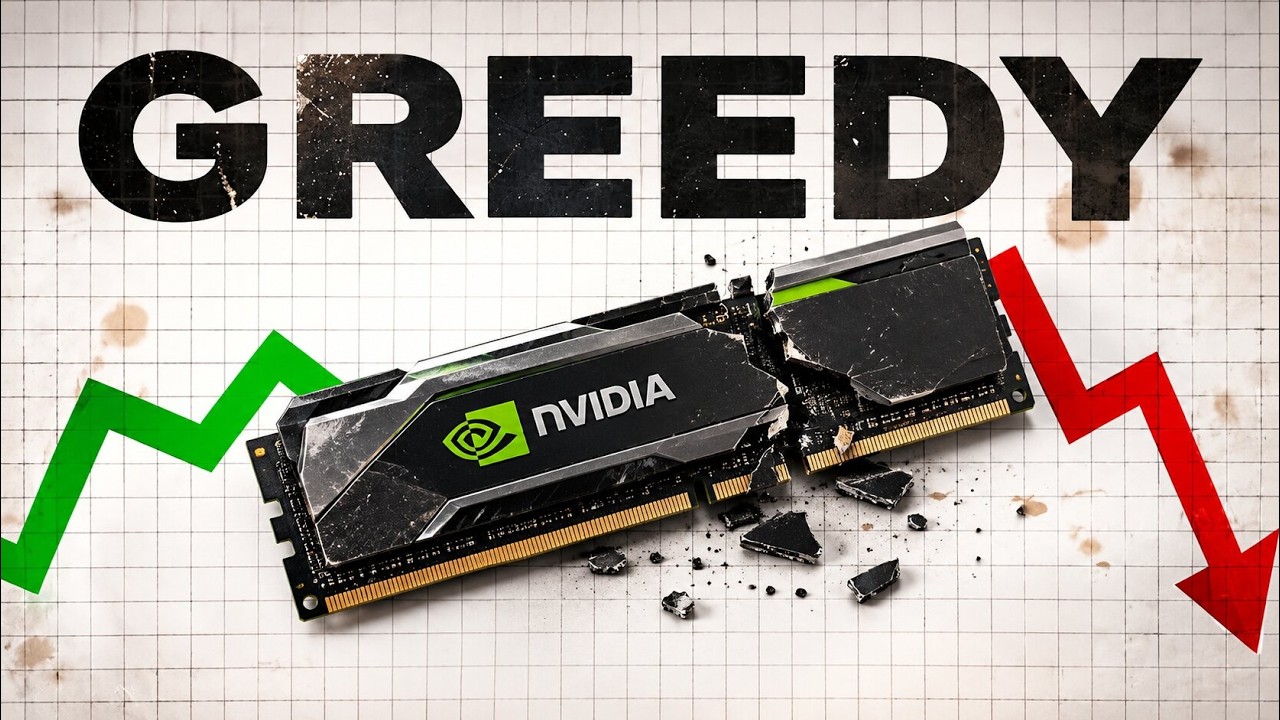
Nvidia Is (Finally) Getting What They Deserve…
Title history
- Nvidia Is (Finally) Getting What They Deserve… — observed on 20261111-0625 UTC (YouTube)
Keywords
Summary
200 words
Critical Evaluation
Value of the Information & Strength of the Argument
The video’s primary value lies in consolidating disparate news items into a cohesive analysis of Nvidia’s systemic risks. It provides a wealth of quantitative data—market losses, investment figures, margin trends—and juxtaposes them with regulatory and competitive actions. The argumentation is structured logically: it establishes Nvidia’s dominance, then systematically dismantles each pillar of its power through evidence. The use of Michael Burry’s contrarian bet and the bond market signals a strengthens the thesis. However, the presentation is not impartial; it consistently frames Nvidia’s behavior negatively, potentially underweighting alternative explanations such as genuine supply-demand dynamics. The rhetorical device of ’telling you something about the world’ makes the argument compelling, but the lack of counter-arguments beyond a brief ‘both things can be true’ section limits its balance.
Scientific Rigor, Source Quality, Title Accuracy
The video references a broad array of credible sources—Bloomberg, The New York Times, The Wall Street Journal, CNBC, TechRadar, Tom’s Hardware, and analysts like The Motley Fool and Axios—and attributes specific claims to them. It also quotes primary figures such as Jensen Huang, Michael Burry, and CFO Colette Kress. The factual claims are accurate as of the video’s date, and the source citations are relevant to the context. The title is somewhat sensational but accurately captures the central theme of Nvidia facing a reckoning. While the video clearly editorializes, it distinguishes between reported facts and opinion, using terms like ‘reported,’ ‘alleged,’ and ‘according to.’ The overall rigor is high, though the choice of sources is entirely from mainstream financial media, which may share a consensus bias. No comment analysis is possible as none were provided.
274 words
Title / Content Match
The title aligns well with the content, which argues that Nvidia faces mounting regulatory, financial, and customer backlash despite record profits.
Quality & Reliability
7/10
The video draws on a wide range of reputable financial media (Bloomberg, NYT, WSJ, CNBC) and quotes primary figures, but its interpretive slant and occasional rhetorical phrasing reduce impartiality.
Key Moments
Markers derived by PSI from the transcript: the creator did not define chapters.
- Introduction: the $235 billion loss and the paradox of record profits.
- The Denny's origin and the GeForce 256 that saved Nvidia.
- CUDA software launches and its strategic importance.
- Nvidia's transformation into a full-stack platform and rising market share.
- EU antitrust investigation into bundling announced.
- The $20 billion Grok acquisition structured as a licensing deal.
- Justice Department probe into the Grok deal and Hugging Face acquisition.
- Explanation of circular financing with OpenAI and neoclouds.
- Nvidia's OpenAI investments, guarantees, and the ski-racer son-in-law connection.
- Gaming community backlash and production cuts for RTX cards.
- Customers (Amazon, Google, Microsoft) building their own chips, including Tranium and TPU.
- China export controls: Nvidia loses the market entirely.
- Memory supply crunch and margin pressure; gross margin guidance decline.
- October 22 crash, closing analysis comparing Nvidia to GE Capital.
Cited Sources
- Bloomberg reports on DOJ investigation — Reported on September 9, 2026, that the Justice Department was investigating Nvidia's Grok deal structure.
- New York Times article on Grok deal — Also reported on the antitrust probe into Nvidia's arrangement with Grok.
- Wall Street Journal on OpenAI data center guarantees — Reported that Nvidia would cover losses up to $105 billion on OpenAI's Ohio project.
- CNBC coverage of gaming market and Nvidia's response — Quoted gamers and Nvidia's spokesperson on supply constraints and RTX availability.
- TechRadar price tracking of RTX cards — Found RTX 5090 selling at $6,389 in September 2026.
- Tom's Hardware commentary on graphics card market — Described the market as 'a horrible place'.
- The Motley Fool on Grok deal structure — Opined that Nvidia structured the deal to sidestep regulatory scrutiny.
- Axios on Grok deal — Wrote that the deal seemed designed to avoid antitrust wires.
- Michael Burry's Scion fund put options — Disclosed over $1 billion in put options against Nvidia and other stocks.
Concurring Sources
- Michael Burry's Scion fund put options — Burry's bearish bet aligns with the video's thesis of overvaluation and structural risk.
- Bond market signals (credit default swaps) — Rising CDS prices indicate growing market concern about Nvidia's debt and financial engineering.
- Analysts' concerns about circular financing — The video cites unnamed market commentators and analysts who question the sustainability of Nvidia's financing arrangements.
Dissenting Sources
- Jensen Huang's defense on circular financing — In a blog post, Huang denied that Nvidia engages in circular financing, arguing OpenAI will pay its leases.
- Nvidia's spokesperson statement on gaming demand — Spokesperson said demand for GeForce cards is strong and memory supply constraints are the cause of shortages.
- Bulllish analyst consensus — The video notes that 49 of 62 analysts rate Nvidia a strong buy, with an average price target significantly above the current price.
Contribution & Novelties
The video’s original contribution is the synthesis of multiple isolated news events into a single narrative that frames Nvidia’s current challenges as a systemic cycle of vendor financing and market distortion. It connects the dots between Nvidia’s CUDA ecosystem, its investment in customers, and the resulting regulator and customer backlash. The comparison to GE Capital offers a fresh analytical lens. The video also highlights the irony of Nvidia’s gaming customers being sacrificed for AI profits, a point often overlooked.
Pour aller plus loin :
- Vendor financing — Relevant to the discussion of Nvidia’s provision of capital to customers to buy its own products.
- Enron scandal — Often cited in critiques of financial engineering; the video addresses but ultimately refutes this comparison.
- GE Capital — The video explicitly compares Nvidia to GE Capital’s dependence on perpetual financial acceleration.
- CUDA — Nvidia’s proprietary platform that created the ecosystem lock-in, central to the video’s analysis.
152 words
Radar Profile
The radar profile shows a high quantity of information and moderately high quality, but lower scores on technical depth and global reliability due to the video's editorializing. The balanced approach in presenting facts while offering a critical interpretation results in a moderate reliability score, with the quantity of data compensating for slight bias.