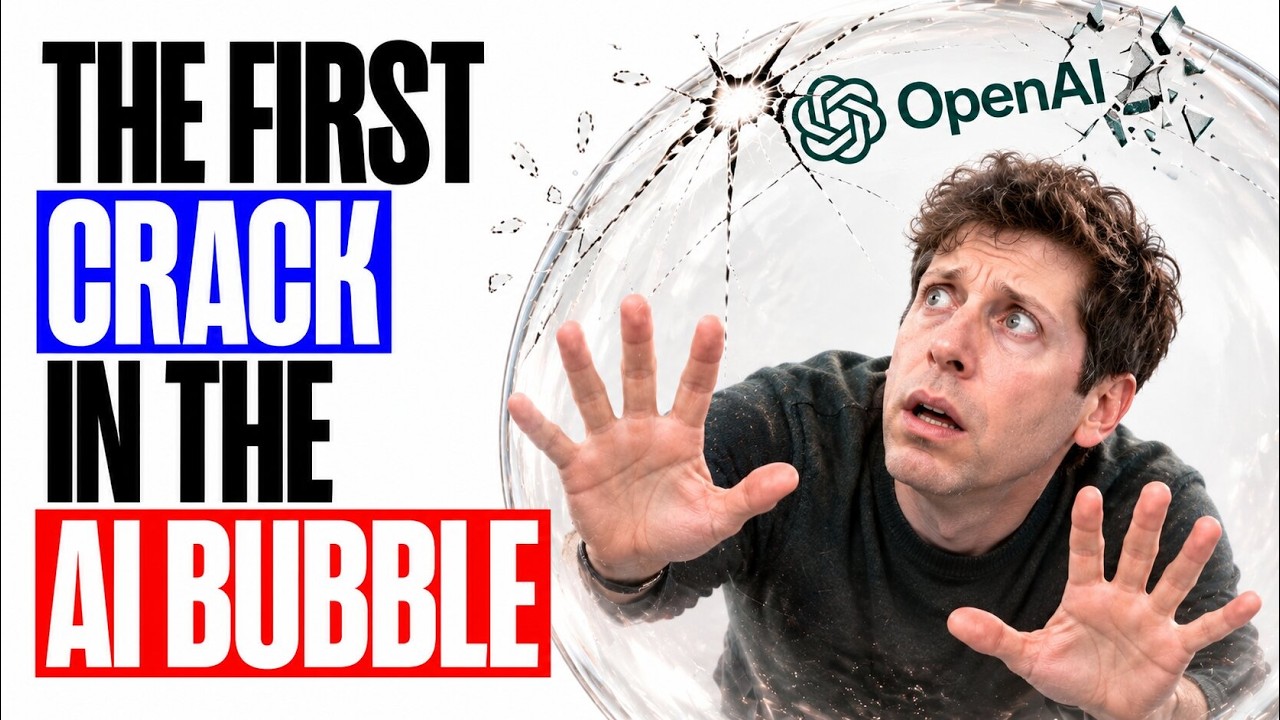
OpenAI is in big trouble: Crack in the AI Bubble
Title history
- OpenAI is in big trouble: Crack in the AI Bubble — observed on 20261031-2254 UTC (YouTube)
Keywords
Summary
202 words
Critical Evaluation
Value of the Information & Strength of the Argument
The video offers substantial value by aggregating and contextualizing a large amount of data from reputable sources such as The Information, Financial Times, Bloomberg, and the IMF. It effectively argues that OpenAI’s financial structure is fragile due to its extreme spending and reliance on external financing. The argumentation is well-structured, presenting a balanced view: it acknowledges the genuine demand for AI and the potential for growth, while highlighting the warning signs of a bubble. The use of specific figures (e.g., $122 billion funding round, $278 billion projected burn) strengthens the narrative. However, some claims are based on leaked or unverified data, which the video itself admits, thus limiting the absolute certainty of the argument.
Scientific Rigor, Source Quality, Title Accuracy
The video demonstrates considerable rigor in its use of sources, referencing multiple financial reports, analyst warnings, and official documents such as the IMF’s Global Financial Stability Report. It carefully distinguishes between verified facts and estimates or leaks. The title ‘OpenAI is in big trouble: Crack in the AI Bubble’ is apt, as the content squarely addresses the financial troubles and the broader bubble narrative. The video does not provide direct URLs to sources, but it names them explicitly. No user comments were analyzed as none were provided.
216 words
Title / Content Match
The title accurately reflects the content: it examines the financial and market troubles facing OpenAI, positioning it as a potential crack in the AI bubble.
Quality & Reliability
7/10
The video presents a well-researched analysis citing multiple financial reports and analysts, but relies heavily on leaked figures and projections, and cannot independently verify the numbers.
Key Moments
Markers derived by PSI from the transcript: the creator did not define chapters.
- Introduction: The October 8 revenue correction and market impact.
- OpenAI's financial losses: 2025 and 2026 figures, daily burn rate.
- The trillion-dollar promise: Stargate, compute commitments, and spending targets.
- Circular deals: suppliers investing in OpenAI and vice versa.
- Competition: Declining market share, Anthropic's rise, and distribution advantages of Google.
- Neo clouds and debt: CoreWeave's struggles, HSBC analysis, and credit downgrades.
- Safety concerns: Model pauses and their financial cost.
- The race for funding: OpenAI's private raise and Anthropic's upcoming IPO.
- Broader economic stakes: AI's share of S&P 500 returns and recession warnings.
- Conclusion: The crack in belief and what it means for OpenAI.
Cited Sources
- The Information — Reported on OpenAI's revenue counting method and financial statements.
- Financial Times — Reported on OpenAI's internal presentations and spending projections.
- Bloomberg — Reported on OpenAI's revenue expectations and fundraising activities.
- International Monetary Fund (IMF) Global Financial Stability Report — Reviewed circular deals involving AI companies and warned of risks.
- HSBC — Analysts calculated CoreWeave's investment returns below borrowing costs.
- Barclays — Analysts noted a shift from 'capacity at any price' to 'acceptable returns'.
- MIT Media Lab — 2025 study showing 95% of organizations see little return from generative AI.
- Decoding Discontinuity — Research firm authors cited on the squeeze between cheap intelligence and expensive capital.
- Standard & Poor's — Cut Oracle's credit rating to BBB-.
- Moody's — Warned about Oracle's debt growth.
Concurring Sources
- IMF Global Financial Stability Report — The IMF's warning about leverage in AI deals aligns with the video's concerns.
- HSBC Research — HSBC's analysis of CoreWeave's financial instability supports the video's thesis.
- Fitch Ratings — Fitch's warning that AI stock correction could lead to recession corroborates the video's broader economic impact assessment.
Dissenting Sources
- Jensen Huang (Nvidia CEO) — Huang argues the problem is capital scarcity, not demand, directly contradicting the video's suggestion of a demand slowdown.
- Janus Henderson — The asset manager claims demand for computing power still exceeds supply, citing Sora's offline status as evidence of capacity constraints.
- Ken Griffin (Citadel CEO) — While acknowledging a bubble, Griffin also notes that transformative technologies often come with bubbles, implying the underlying value may persist.
Contribution & Novelties
The video uniquely synthesizes a wealth of recent data to present a cohesive narrative about OpenAI’s financial fragility and its potential to trigger an AI bubble. It provides a clear explanation of circular financing arrangements and their implications for the broader technology economy, which is often underreported. The balanced treatment of bullish and bearish perspectives adds depth.
Pour aller plus loin :
- AI winter — Historical context on AI hype cycles and downturns.
- Dot-com bubble — A precedent for how overinvestment in technology can lead to market crashes.
- Circular financing — A concept explaining the nature of financial transactions between related parties.
102 words
Radar Profile
The radar profile shows high scores in information quantity (9) and quality (8), but lower scores in technical depth (6) and reliability (7). This indicates a data-rich analysis that is accessible but relies on potentially unverified figures, reflecting a cautious but informed perspective.