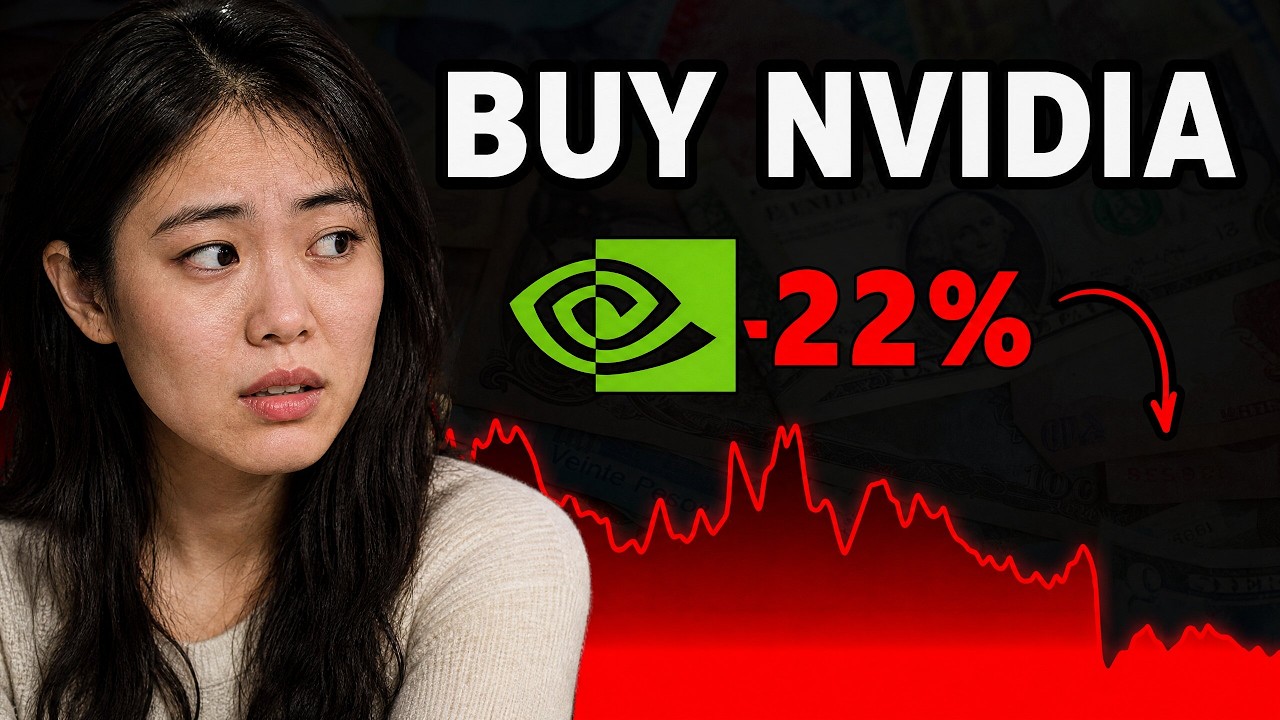
Nvidia Stock Is Crashing - Here's Why The Market Hated Earnings
Title history
- Nvidia Stock Is Crashing - Here's Why The Market Hated Earnings — observed on 20261120-1939 UTC (YouTube)
Keywords
Summary
158 words
Critical Evaluation
Value of the Information & Strength of the Argument
The video provides substantial value by synthesizing a wide range of public financial data and news reports into a coherent narrative explaining the stock crash. It offers multiple perspectives, including historical patterns of post-earnings declines, margin guidance, supplier leverage, and the role of political events. The argumentation is well-structured, moving from the earnings beat to the fine print of the report, then to competitive and geopolitical factors. The reasoning is logical and supported by specific figures and quotes, making it a credible analysis for investors and interested viewers. The video also contextualizes the crash within a broader market skepticism about AI spending, providing a nuanced view beyond simple cause-effect explanations.
Scientific Rigor, Source Quality, Title Accuracy
The video demonstrates rigorous sourcing by referencing reputable outlets such as Bloomberg, The Wall Street Journal, Reuters, and research firms like SemiAnalysis and IDC. It also cites analyst reports and specific financial metrics, though it does not include direct links in the description. The information is presented with appropriate caveats, such as noting that some reports are ‘widely circulated’ or ‘critics call’. The title accurately captures the video’s scope and content, as it directly addresses the market’s reaction to earnings and the underlying reasons. No major discrepancies between the title and content are apparent.
219 words
Title / Content Match
The title accurately reflects the content: the video explains the reasons behind Nvidia's stock decline despite record earnings, covering market expectations, margin pressure, supply commitments, financing concerns, political events, and the CEO scandal.
Quality & Reliability
7/10
The video cites multiple reputable financial news sources and provides detailed financial figures, including exact revenue and margin numbers. However, as an independent YouTube analysis, it lacks formal peer review and may present interpretive bias in its assessment of market reactions and corporate decisions.
Key Moments
Markers derived by PSI from the transcript: the creator did not define chapters.
- Introduction: record earnings of $96.2 billion but stock drops 3% in after-hours.
- Historical pattern of post-earnings declines despite beating estimates for 15 consecutive quarters.
- Margin guidance decline to 71-72% due to high bandwidth memory shortage and pricing.
- Supply commitments jump to $279 billion, raising concerns about balance sheet obligations.
- Circular financing with NeoCloud operators like CoreWeave and Nscale, including $18.5 billion in guarantees.
- Competition from custom AI chips by Broadcom and Google, with Omdia expecting custom chips to outnumber GPUs by 2028.
- China market challenges: H200 shipments under 1% of data center revenue, 600,000 chips stuck in Hong Kong.
- Midterm election impact and interest rate hikes trigger a sharp selloff, with Nvidia falling 9.26% on Nov 5.
- Jensen Huang resigns amid foreign intelligence scandal and internal investigation, stock drops further.
- Conclusion: Nvidia trades at historically low P/E ratios, but upcoming earnings report carries high uncertainty.
Cited Sources
- Bloomberg — Reported on Nvidia's possible $250 billion guarantee for OpenAI and the CEO scandal.
- The Wall Street Journal — Covered the slowed OpenAI data center agreement and the board's preparation to oust Jensen Huang.
- Reuters — Reported on H200 chips in storage in Hong Kong and analyst comments on governance.
- SemiAnalysis — Research firm cited for analysis of circular financing and AI debt estimates.
- IDC — Provided data on Nvidia's 81% share of the AI chip market.
- Omdia — Forecast that custom AI chips will outnumber general-purpose GPUs by 2028.
- Morgan Stanley — Named Nvidia a top pick but later removed it after the stock declined.
- Forbes — Estimated billionaire executives' wealth losses, with Jensen Huang suffering the largest.
Contribution & Novelties
The video’s original contribution lies in weaving together multiple underreported factors—margin compression from memory costs, supply commitments, circular financing, and political events—into a coherent explanation for Nvidia’s unusual stock behavior. It challenges the common narrative that earnings beats should drive stock prices, emphasizing the market’s focus on guidance and balance sheet risks. The analysis also highlights the strategic role of the CEO in the company’s valuation, evidenced by the measurable impact of Jensen Huang’s resignation.
Pour aller plus loin :
- Nvidia (Wikipedia) — Background on the company’s history and products.
- Price–earnings ratio (Wikipedia) — Explains the valuation metric discussed in the video.
- Gross margin (Wikipedia) — Definition and significance in financial analysis.
- Share buyback (Wikipedia) — Context for Nvidia’s cash return strategy.
122 words
Radar Profile
The radar profile shows very high information quantity and quality, with moderate technical depth and reliability. This indicates a data-rich analysis that is accessible to a broad audience, though it relies on secondary sources rather than original research. The moderate reliability score reflects the inherent subjectivity in financial commentary.