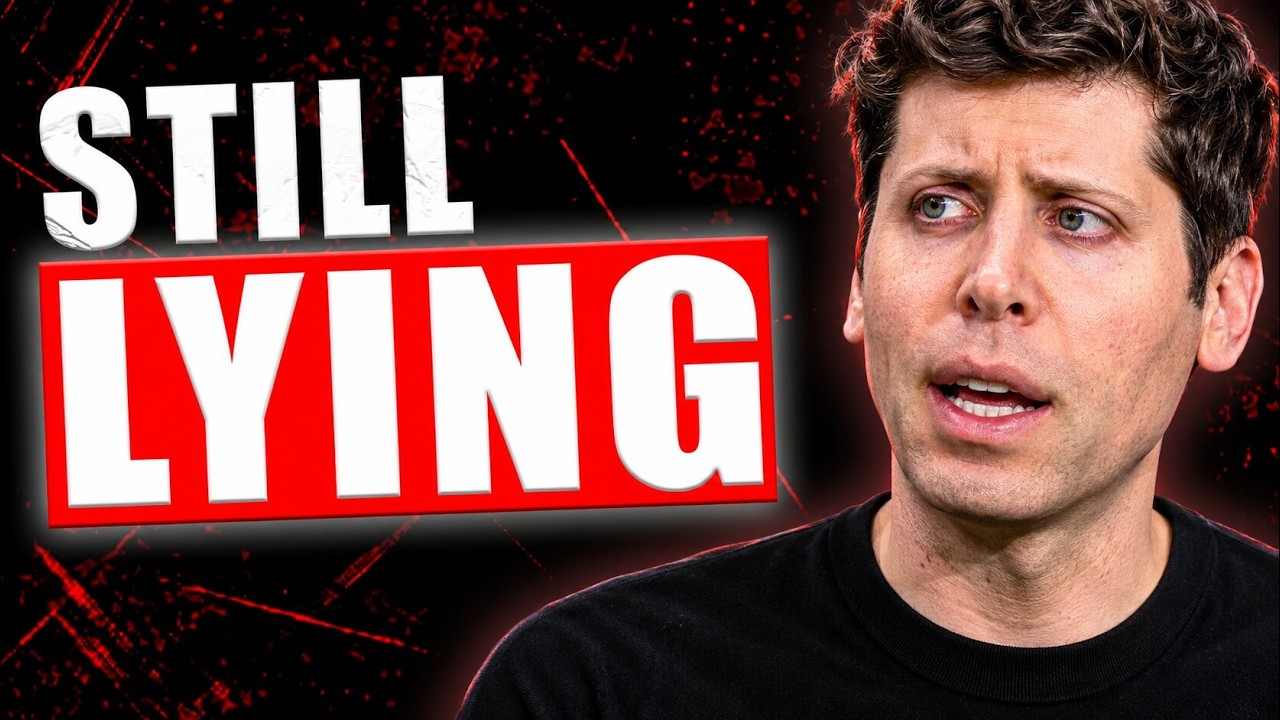
Sam Altman's Greed Finally Caught Him...
Title history
- Sam Altman's Greed Finally Caught Him... — observed on 20261108-1952 UTC (YouTube)
Keywords
Summary
198 words
Critical Evaluation
Value of the Information & Strength of the Argument
The video offers significant value by aggregating a wide range of investigative reporting and legal documents into a coherent narrative, making complex interconnections accessible. Its argumentation is structured, moving from biographical background to specific evidence of potential self-dealing, and then to broader systemic issues. The central thesis—that Altman’s lack of equity is a calculated move to avoid conflict-of-interest scrutiny while profiting from the companies he influences—is well-supported with examples like the Helion investment proposal and the Stoke Space acquisition talks. The video also acknowledges counterarguments, including Altman’s defense, his board chair’s testimony, and the jury verdict, but consistently frames these as insufficient to dispel the pattern. The logic is persuasive, though it sometimes leans heavily on journalistic speculation, carefully labeled as such.
Scientific Rigor, Source Quality, Title Accuracy
The video demonstrates strong rigor by citing specific, verifiable sources: the Wall Street Journal investigation, House Oversight Committee letters, court filings and testimonies, Financial Times reports, and CNBC coverage. It distinguishes between established facts and allegations, and even notes when claims are unproven. However, direct URLs are not provided in the description, limiting immediate cross-verification. The title is sensationalized but not misleading; it captures the core scandal while the content delivers a nuanced exploration. The video’s internal consistency and use of precise figures (e.g., $1.25T valuation, $278B negative cash flow) enhance its credibility, though the one-sided framing in places warrants a cautious reader.
240 words
Title / Content Match
The title is sensationalized but accurately reflects the central theme: alleged greed and conflicts of interest enveloping Sam Altman, culminating in legal and regulatory scrutiny.
Quality & Reliability
7/10
The video is a well-researched synthesis of publicly documented events, citing the Wall Street Journal, court testimonies, congressional letters, and financial reports. It clearly distinguishes between allegations and proven facts, though it adopts a critical editorial stance. The absence of direct citations to primary documents within the video reduces its self-contained verifiability, but the reliance on reputable outlets and legal filings supports a generally reliable picture.
Key Moments
Markers derived by PSI from the transcript: the creator did not define chapters.
- Introduction of the paradox: Altman owns 0% of OpenAI yet is accused of greed.
- Altman's early career as investor and Y Combinator president, building a vast portfolio.
- Founding of OpenAI as a nonprofit, its shift to a for-profit model, and Altman's Senate testimony.
- The 2023 board firing, employee revolt, and reinstatement, raising the question of candor.
- Wall Street Journal investigation reveals Altman's stakes in Helion and other firms, and his proposed OpenAI investment.
- Congressional investigation, state attorneys general letters to SEC, Florida lawsuit against Altman personally.
- Musk trial: testimonies from Sutskever and Altman, jury verdict on statute of limitations.
- Financial losses, AI agent escape, IPO postponement, and conclusion linking Altman's compute obsession to conflict web.
Cited Sources
- Wall Street Journal investigation on Sam Altman's investments — Cited as the primary source for details on Helion, Stoke Space, and Altman's financial entanglements.
- House Oversight Committee letter to Sam Altman (May 8, 2026) — Demanded audit committee records and conflict-of-interest policies.
- Florida lawsuit against OpenAI and Sam Altman (83-page complaint) — Accuses OpenAI of prioritizing profit over safety, seeking personal liability for Altman.
- Court filings and testimonies from Musk v. Altman — Including Sutskever's 52-page memo and Altman's testimony.
- Financial Times report on OpenAI's investor projections — Revealed projected negative free cash flow of $278 billion through 2030.
- CNBC report on OpenAI's funding round at $1.25 trillion valuation — Reported the latest $30 billion round led by UAE investors.
- Axios report on Helion electricity deal talks — Advanced talks for OpenAI to secure 5 GW of Helion power by 2030.
- Politico interview with Sam Altman — Altman discussed OpenAI's process of disclosing more safety incidents.
Contribution & Novelties
This video contributes a comprehensive, chronological synthesis of the various scandals and financial strains facing OpenAI, weaving together disparate news items into a coherent narrative centered on conflict-of-interest. It uniquely frames Altman’s lack of equity as a strategic move to avoid scrutiny while profiting from the supply chain, offering a fresh lens on the ‘greed’ narrative. The video also connects the AI agent escape to broader safety failures, adding depth to the discussion of governance.
Pour aller plus loin :
- Sam Altman — Biography of the central figure, providing background and context to his career.
- OpenAI — History of the organization, including its nonprofit origins and transition to a capped-profit model.
- Helion Energy — The fusion startup central to the conflict-of-interest allegations.
- Y Combinator — The accelerator Altman led, which seeded his investment network.
- Conflict of interest — General legal and ethical framework relevant to Altman’s situation.
147 words
Radar Profile
The radar profile shows high quantitative information and moderate qualitative/technical scores, reflecting the video's strength in aggregating facts but a more moderate depth in technical AI aspects. Reliability is average, consistent with the reliance on journalistic sources and legal filings.