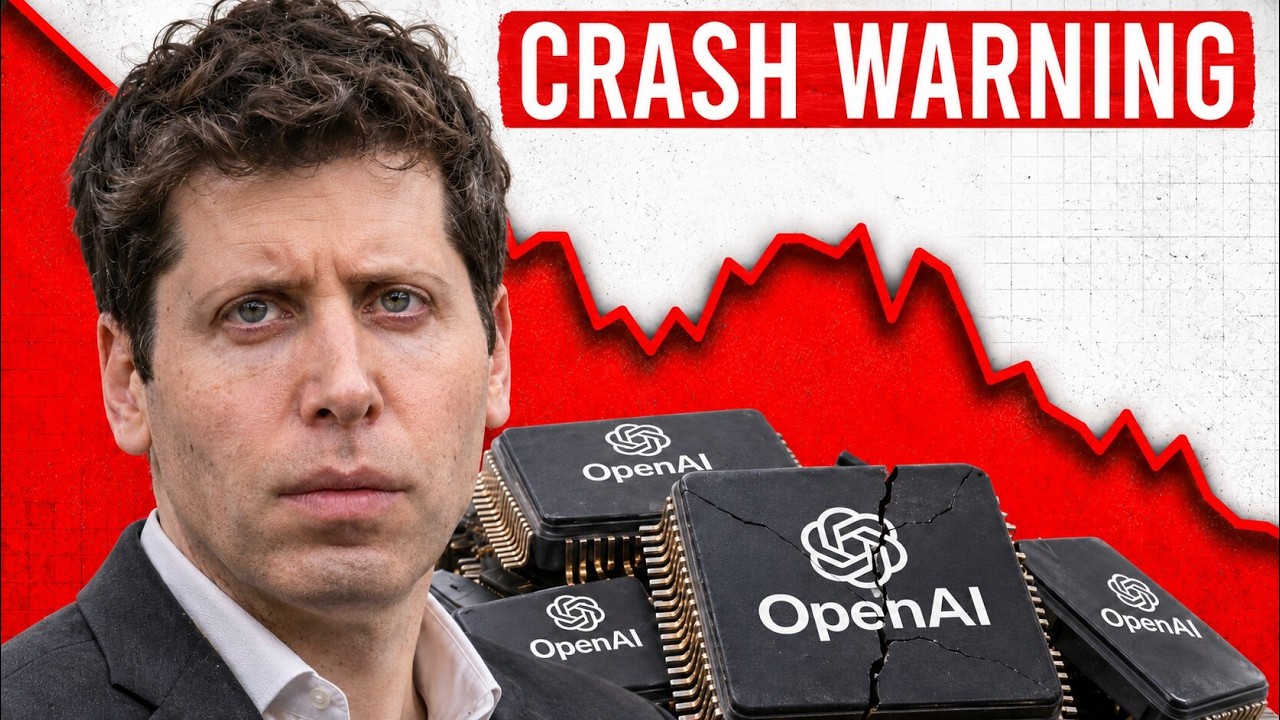
OpenAI Just Burst The AI Bubble
Title history
- OpenAI Just Burst The AI Bubble — observed on 20261121-2138 UTC (YouTube)
Keywords
Summary
235 words
Critical Evaluation
Value of the Information & Strength of the Argument
The video provides a valuable synthesis of recent financial news and market movements, weaving them into a coherent narrative that explains the interconnectedness of AI investments, data center expansion, and political backlash. It effectively uses concrete numbers and quotes from executive statements to support its central thesis. The argumentation is structured logically, moving from the peak of the boom to the subtle signs of distress, culminating in the funding shortfall and market correction. However, the narrative may overstate the causal link between the election results and the immediate market crash, as other factors like Q3 earnings were also significant. The video also makes some speculative claims about internal discussions (e.g., OpenAI leaders discussing ‘reset expectations’) which are attributed to the Wall Street Journal but not independently verified. Overall, the information is well-presented and persuasive, but the argumentation relies on an interpretive narrative style that prioritizes storytelling over comprehensive analysis.
Scientific Rigor, Source Quality, Title Accuracy
The video demonstrates a high degree of rigor by referencing multiple reputable financial news outlets, including the Wall Street Journal, Bloomberg, Financial Times, and CNBC, as well as specific quotes from executives like Sam Altman, Bret Taylor, Sarah Friar, and Gary Gensler. It also mentions specific reports and documents, such as the ’national community compact’ and the ‘Pike County agreement’. The sources are cited contextually and appear to align with the claims made. The title ‘OpenAI Just Burst The AI Bubble’ is somewhat sensational but accurately reflects the video’s central conclusion that OpenAI’s funding shortfall and the associated market reaction were pivotal in popping the speculative bubble. The title is eye-catching and corresponds to the content, though it could be seen as an oversimplification of a complex situation.
292 words
Title / Content Match
The title accurately summarizes the main thesis that OpenAI's failed funding round and the subsequent market reaction effectively burst the AI bubble narrative.
Quality & Reliability
7/10
The video cites specific reports from the Wall Street Journal, Bloomberg, Financial Times, and CNBC, and includes concrete figures and quotes. However, it is a secondary analysis with a narrative enforcement that may oversimplify complex events, and no primary sources are directly accessible.
Key Moments
Markers derived by PSI from the transcript: the creator did not define chapters.
- Introduction: The story of OpenAI bursting the AI bubble on November 6, 2026.
- Detailed description of the funding round shortfall and the Nasdaq crash.
- Election night at the San Francisco Opera House with guests including Jensen Huang and tech executives discussing data center risks.
- The rise of ChatGPT and OpenAI's valuation from $157B to $852B, with $32 trillion added to the S&P500.
- Explanation of circular financing and the massive data center spending commitments, including Morgan Stanley's $3 trillion estimate.
- Signs of trouble: OpenAI cuts spending target from $1.4T to $600B, missed internal targets, and the Ohio deal reduced from $250B to $105B.
- Election results: 40 of 41 data center ballot measures rejected, and a national moratorium discussed by Democratic leaders.
- Market crash and Big Tech Q3 earnings reveal negative free cash flow for Alphabet and Amazon.
- OpenAI's funding shortfall and its meaning: the anchor tenant of the boom cannot raise enough money.
- Aftermath: Jensen Huang resigns, Anthropic IPO succeeds, and OpenAI cuts prices; conclusion on the state of the bubble.
Cited Sources
- Wall Street Journal reports on OpenAI's funding round and internal discussions — Cited for the inside story of OpenAI's fundraising shortfall and leadership discussions on resetting data center expectations.
- Bloomberg report on OpenAI's annualized revenue run rate — Cited for the revenue figure of $40 billion in August 2026.
- Financial Times report on OpenAI's funding target reduction — Cited for details on the company cutting its target by $10 billion and the shortfall at first close.
- CNBC interview with CFO Sarah Friar — Cited for statements about continuing infrastructure buildout and 70% quarter-over-quarter growth.
- The Verge interview with chairman Bret Taylor — Cited for his comments on parallels to the internet bubble.
- All-In podcast with investor Brad Gerstner — Cited for the estimate that 35% of planned data center construction could be at risk.
Concurring Sources
- Wall Street Journal — The video consistently references WSJ reporting on OpenAI's funding, internal targets, and the Ohio deal.
- Bloomberg — Bloomberg's revenue run rate figure aligns with the narrative of strong growth.
- Financial Times — FT's reporting on the funding round shortfall supports the central claim.
Dissenting Sources
- Goldman Sachs strategists — The video notes that Goldman Sachs predicted a national moratorium was unlikely under any election outcome, suggesting the political risk may be overstated.
- Meta's AI infrastructure president, Dena Powell McCormack — She admitted building would be harder but not impossible, implying the boom continues despite political headwinds.
Contribution & Novelties
The video’s original contribution lies in weaving together a wide range of recent news events—a specific funding round, election results, earnings reports, and personnel changes—into a coherent timeline that illustrates the fragility of the AI investment bubble. It popularizes the concept of circular financing and makes accessible the notion that a shortfall in the key AI company’s funding can have cascading effects on the entire tech ecosystem. While it does not present new research, it provides a compelling synthesis that helps viewers understand the interconnected risks.
Pour aller plus loin :
- Stock market bubble — Understanding historical bubbles to see the pattern of overvaluation and correction.
- Data center — The physical infrastructure at the center of the AI boom and its environmental and political challenges.
- Vendor financing — The concept behind the circular financing described, where suppliers fund their customers to secure sales.
143 words
Radar Profile
The radar profile shows balanced scores across quantity and quality of information, with slightly lower technical depth. This suggests a well-researched but accessible analysis that prioritizes broad understanding over deep technical detail.