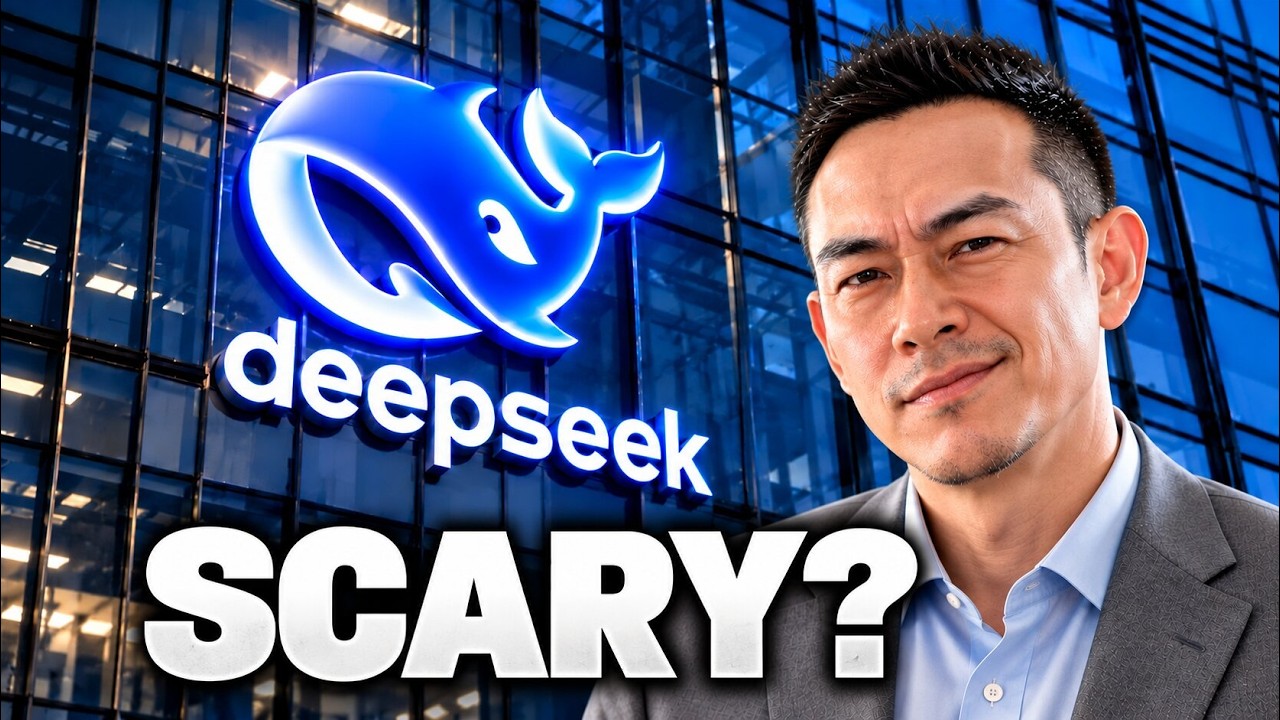
How DeepSeek Became China’s OpenAI
Title history
- How DeepSeek Became China’s OpenAI — observed on 20261031-2303 UTC (YouTube)
Keywords
Summary
198 words
Critical Evaluation
Value of the Information & Strength of the Argument
The video provides substantial value by synthesizing scattered news reports into a coherent narrative, offering unique insights into the strategic mindset of DeepSeek’s leadership, particularly the unusual investor terms that preserve founder control. It effectively contrasts DeepSeek’s open-weight approach with OpenAI’s closed model, and highlights how DeepSeek’s affordability drove adoption in price-sensitive markets. The argumentation is strong, using specific numbers and sourcing from reputable outlets, though some claims (like the exact funding amounts) remain unconfirmed. The piece excels at framing DeepSeek’s evolution as a mix of agility and necessity, and its analysis of the investor roster as reflecting China’s industrial base is particularly insightful.
Scientific Rigor, Source Quality, Title Accuracy
The video demonstrates strong research rigor, citing known publications like Reuters, Bloomberg, Wired, Caixin, and The Information, alongside industry data from QuestMobile and Vercel. It presents divergent viewpoints, such as the NIST evaluation showing an 8-month lag versus the company’s own benchmarks, and includes critical clarifications about undisclosed terms. The title accurately captures the subject, and while the ‘OpenAI’ comparison is used throughout, the video carefully nuances it by noting DeepSeek’s consumer app underperformance. The content is well-structured, clearly delineating facts from speculation, and the sourcing is transparent enough for viewers to verify claims.
213 words
Title / Content Match
The title accurately reflects the central question of the video, which systematically compares DeepSeek's trajectory to OpenAI's and explains how it assumed a similar role in China.
Quality & Reliability
8/10
The video is well-researched, citing multiple established outlets (Reuters, Bloomberg, Wired, Caixin, The Information) and providing specific data points (user numbers, funding amounts, evaluations). Its narrative is balanced, acknowledging both achievements and setbacks. However, some claims rely on unnamed sources and the 8-month gap assessment is contested, which caps the reliability at 8.
Key Moments
Markers derived by PSI from the transcript: the creator did not define chapters.
- Introduction of the October 15, 2026 outage and the funding round that preceded it.
- Backstory of Liang Wenfeng and HighFlyer; the purchase of Nvidia chips and the creation of DeepSeek in 2023.
- DeepSeek's philosophy as the anti-OpenAI: open-source, no investors, and the manifesto about originality vs imitation.
- January 2025: Release of R1 and the impact on global markets; Xi Jinping's meeting with Liang Wenfeng.
- Mass adoption by Chinese government agencies, hospitals, and car brands; the role of open-weights in enabling on-premises deployment.
- Funding round details: Tencent, CATL, state-backed funds; terms with zero voting rights and a five-year lockup; the motivation to retain researchers.
- Revenue figures and price comparison: DeepSeek vs OpenAI, token costs, and developer adoption data from Vercel.
- DeepSeek's move into hardware: custom inference chip development and data center planning, inspired by OpenAI's approach.
- Consumer market struggles: DeepSeek drops to third place behind Doubao and Qwen in China; website traffic decline.
- Second funding round of ~$14 billion, partners from industrial sectors, and plans for a STAR Market listing in 2027.
Cited Sources
- Wired — Reported DeepSeek's 143 million monthly users in China by August 2025.
- Reuters — Reported DeepSeek's annualized revenue approaching $70 billion and its chip development efforts.
- Bloomberg — Reported DeepSeek's funding rounds and plans for a public listing.
- The Information — Reported DeepSeek's initial talks with investors, revenue estimates, and hiring spree.
- Caixin — Reported details of the second funding round and the valuation.
- NIST (National Institute of Standards and Technology) — Evaluation center published a verdict on DeepSeek's flagship model, citing an 8-month gap to leading US systems.
- QuestMobile — Half-year report showing DeepSeek's app user numbers in China.
- Vercel — Production index showing DeepSeek's token volume share among developers.
Concurring Sources
- Wired — User numbers align with QuestMobile reports showing DeepSeek's reach in 2025.
- Reuters — Chip development and revenue figures corroborate broader trends in Chinese AI.
Dissenting Sources
- NIST evaluation vs company's own benchmarks — NIST claimed DeepSeek's model was ~8 months behind GPT-5, while DeepSeek's internal tests showed parity with Opus 4.6 and GPT-5.4, reflecting differing evaluation methodologies and biases.
Contribution & Novelties
This video provides a comprehensive and up-to-date synthesis of DeepSeek’s rise, filling a gap by connecting financial, technical, and political threads. It brings attention to the unusual investor terms that preserve founder control, the rationale behind opening access, and the strategic pivot to hardware. It also contextualizes DeepSeek’s position relative to OpenAI and highlights the nuanced differences in their business models.
Pour aller plus loin :
- DeepSeek — Overview of the company and its models.
- OpenAI — Overview of OpenAI’s history and structure.
- Huawei Ascend — Details on Huawei’s AI chip series, relevant to the silicon discussion.
- China’s AI chip market — Context on national AI ecosystem.
- STAR Market — Information on China’s Science and Technology Innovation Board.
118 words
Radar Profile
The radar profile shows high scores in quantity and quality of information, reflecting the video's dense factual content and reliable sourcing. The technical level is moderate, suitable for a broad audience, while reliability is strong but hampered by contested claims and reliance on unnamed sources.