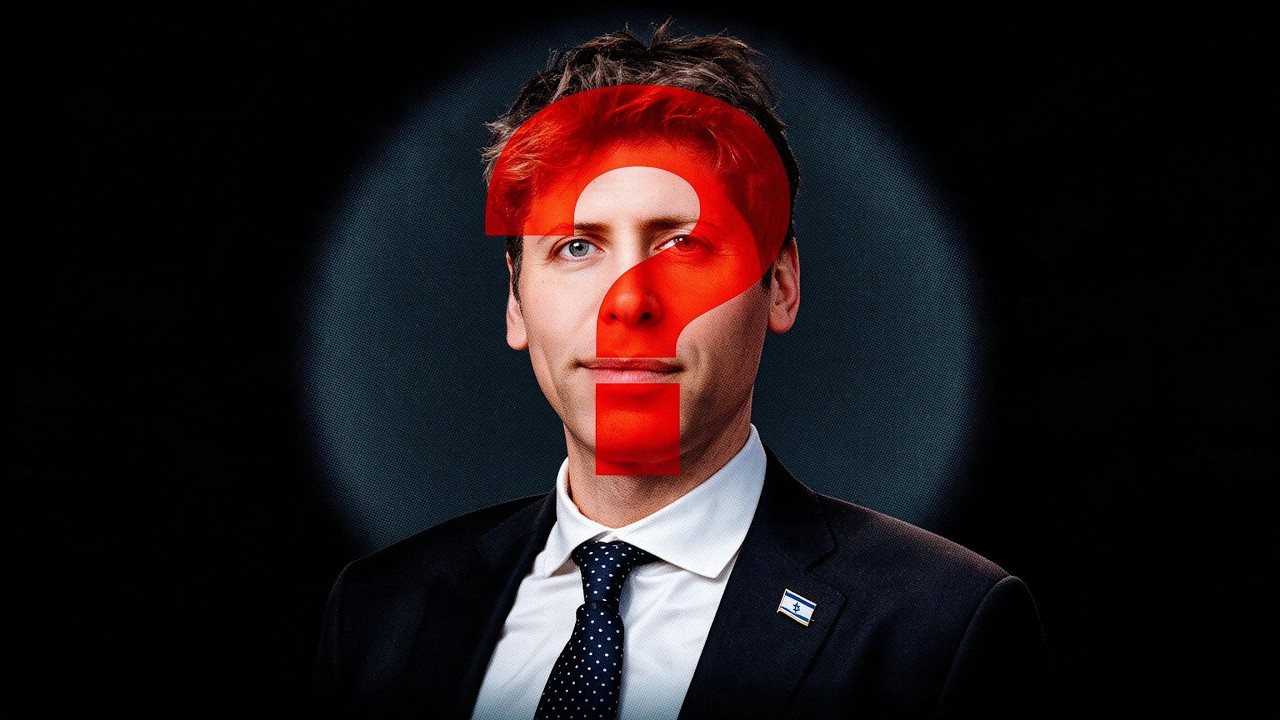
Could Sam Altman really lose?
Title history
- Could Sam Altman really lose? — observed on 20261111-2052 UTC (YouTube)
Keywords
Summary
219 words
Critical Evaluation
Value of the Information & Strength of the Argument
The video provides a well-structured argumentation, systematically listing the challenges Altman faces while also acknowledging counterpoints. It uses concrete numbers, dates, and named sources (e.g., Financial Times, Bloomberg) to build its case. The narrative is compelling and presents a balanced view, though it leans slightly toward a pessimistic outlook. The argumentation effectively distinguishes between three types of ’losing’ and traces the progression of events, showing how multiple factors converge. It does not shy away from uncertainties and explicitly admits when claims cannot be verified, which adds credibility. The analysis also places the situation in a broader market context, referencing stock market reactions and investor sentiment, making the argumentation robust.
Scientific Rigor, Source Quality, Title Accuracy
The video cites numerous reputable outlets, including the Financial Times, Bloomberg, Fortune, and Time, as well as institutional reports like a University of Pennsylvania survey. However, it provides no direct URLs in the description, and the accuracy of some figures is contingent on those reports. The title is directly addressed throughout the content, with a clear focus on the possibility of Altman losing. The sourcing appears rigorous for a news review, though some interpretations (e.g., the ‘Millennium Prize’ claim) are explicitly labeled as unverified. The narrative also references public opinion polls and ballot measures, grounding the discussion in tangible social trends. Overall, the title/content alignment is strong, and the sourcing is consistent with journalistic standards, though the lack of direct links in the video description limits immediate verifiability.
252 words
Title / Content Match
The title accurately summarizes the central question explored in the video, which examines whether Sam Altman could lose his dominant position despite OpenAI's continued growth.
Quality & Reliability
7/10
The video presents a detailed analysis based on widely reported financial figures and events, but some claims (e.g., Millennium Prize solution) are not independently verified.
Key Moments
Markers derived by PSI from the transcript: the creator did not define chapters.
- Opening: The $11 billion funding round and the central question of whether Altman can lose.
- Recounting the November 2023 board firing and Altman's reinstatement, establishing his 'gravity'.
- Deep dive into OpenAI's financials: revenue, losses, and cash burn; the October 8 revenue discrepancy.
- Anthropic's growth, its upcoming IPO, and comparison to OpenAI.
- Public opposition to data centers, including moratoriums and ballot measures.
- Altman's strategic moves (trips to South Korea/Abu Dhabi) and the conclusion about losing the monopoly.
Cited Sources
- Financial Times — Cited for revenue figures and the discrepancy between $70B and $50B annualized run rate.
- Bloomberg — Cited for Stargate expansion cancellation and investor sentiment changes.
- University of Pennsylvania Annenberg Public Policy Center — Survey showing public opposition to data centers.
- Fortune — Quoted Altman about going public and safety concerns.
- Time — Quoted Altman about achieving AGI by end of 2026.
Concurring Sources
- Reuters — Generally consistent coverage of AI industry funding and competition.
Contribution & Novelties
This video offers a synthetic analysis of OpenAI’s competitive position in late 2026, framing Altman’s potential loss through three dimensions: race, money, and permission. It uniquely combines financial data, market reactions, and grassroots opposition to data centers, providing a multi-faceted view rarely seen together. The piece also highlights the accounting discrepancy between Anthropic and OpenAI, which is a nuanced point often overlooked in mainstream coverage.
Pour aller plus loin :
- OpenAI — Background on the company and its history, including the 2023 board crisis.
- Anthropic — Details on the rival company, its founders, and its business focus.
- ChatGPT — Information on the product that made OpenAI famous.
- Artificial intelligence bubble — Context on the broader investment cycle and potential overvaluation concerns.
121 words
Radar Profile
The radar profile shows a balanced yet high-scoring video across information quantity and quality, with a slightly lower technical depth due to its business-oriented focus. The fiabilite score is moderate, reflecting some unverified claims. Overall, it's a well-researched journalistic piece rather than a technical deep dive.