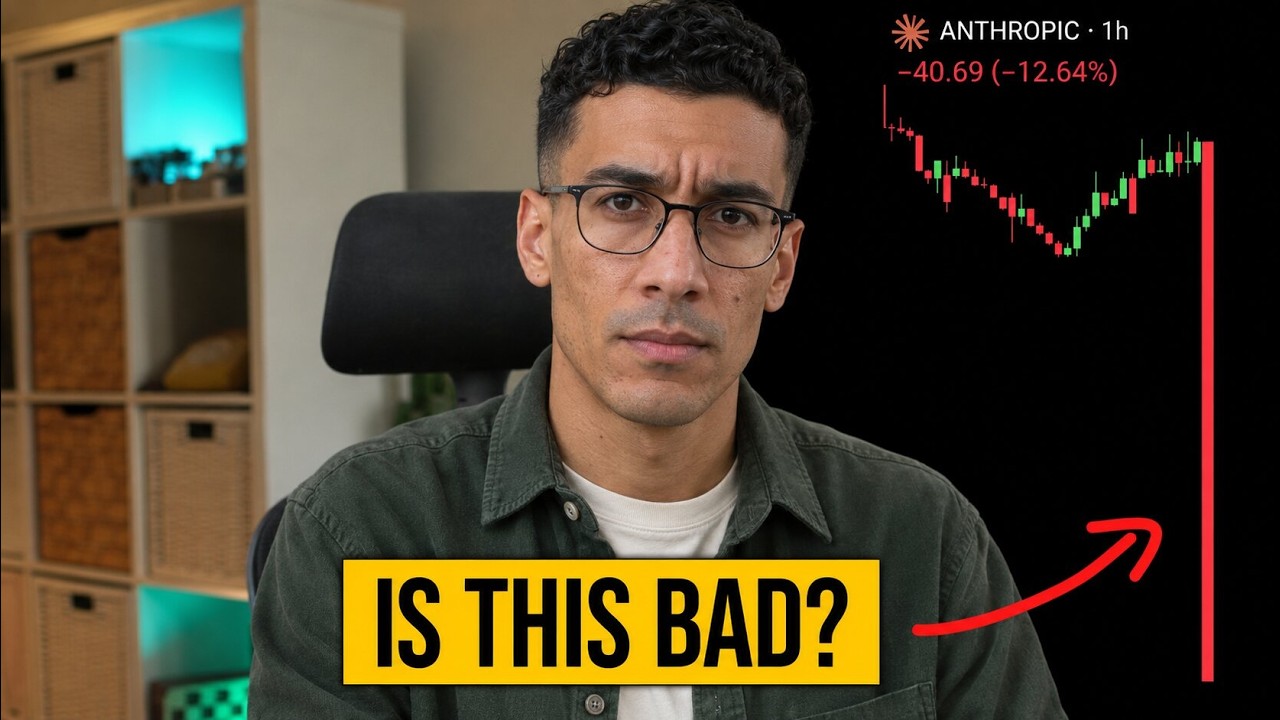
Anthropic Is Crashing OpenAI
Title history
- Anthropic Is Crashing OpenAI — observed on 20261121-2354 UTC (YouTube)
Keywords
Summary
119 words
Critical Evaluation
Value of the Information & Strength of the Argument
The video’s value lies in its synthesis of numerous financial figures and industry reports into a coherent narrative. It argues convincingly that Anthropic’s enterprise focus and coding tools have shifted market leadership. The argumentation is solid, using concrete numbers on revenue, market share, and losses to support its thesis. It also acknowledges counterpoints, such as OpenAI’s consumer reach and recent model launches, making the analysis balanced. The storytelling is engaging and the conclusion that ’the race is a starting gun’ is well-founded.
Scientific Rigor, Source Quality, Title Accuracy
The video cites a wide array of sources including Menlo Ventures, Epoch AI, Pitchbook, Bloomberg, Wall Street Journal, Wired, and Semaphore. However, it does not provide direct links or verifiable references, relying on public reports and interviews. The title suggests a definitive crash, while the content more accurately describes a competitive reversal. This slight mismatch does not undermine the analysis but may overstate the drama. Overall, the sources are reputable and the financial data appears current, but the lack of direct citations limits independent verification.
182 words
Title / Content Match
The title 'Anthropic Is Crashing OpenAI' is slightly sensational but the video clarifies that it's not a collapse but a shift in market leadership. It captures the essence but nuances the 'crash'.
Quality & Reliability
7/10
The video presents a data-driven analysis of the competitive dynamics between Anthropic and OpenAI, citing multiple sources such as Menlo Ventures, Epoch, and financial reports. However, it relies on a single-channel narrative without external verification of the claims.
Key Moments
Markers derived by PSI from the transcript: the creator did not define chapters.
- Opening of Anthropic's IPO at $111.50, valuing the company at ~$2 trillion.
- Comparison of revenue growth: Anthropic's annual pace rises to $14B in Feb, $199B in March, $30B in April, and $65B by July 2026.
- Menlo Ventures survey shows Anthropic takes 55% of enterprise LLM spending vs OpenAI's 31%.
- Claude Code and the coding tools market become a major growth driver, with $24B market split between Claude Code and Codex.
- Pentagon dispute: Anthropic refuses to drop safety safeguards, leading to a supply chain risk designation and a surge in Claude's app store ranking.
- OpenAI responds with GPT-5.6 and GPT-6 Astra, but still loses the revenue race; enterprise revenue jumps 50% after launch.
- IPO day details: Anthropic raises $81.3B, largest IPO ever, with shares closing at $97.17, 17% above offering price.
- Conclusion: Anthropic didn't crash OpenAI but rather crashed the idea that being first guarantees staying first.
Cited Sources
- Menlo Ventures 2026 State of Generative AI in the Enterprise — Annual survey of ~400 enterprise decision makers on LLM spending
- Epoch AI analysis — Projected revenue crossover between Anthropic and OpenAI around August 2026
- Pitchbook analysis by Harrison Ralph — Details on OpenAI's Oracle contract and IPO scrutiny
- Semaphore report on OpenAI executive exits — Report on senior executives leaving OpenAI in 2026
- Bloomberg report on Anthropic IPO orders — Orders reached ~6x the shares on sale
- Wired interview with Sam Altman — Altman conceded OpenAI fell behind in coding tools
Contribution & Novelties
The video provides a comprehensive narrative that synthesizes financial data, market surveys, and executive statements to argue that Anthropic’s enterprise-first strategy and coding tools have reversed the industry order. Its original contribution is framing the competition as a ‘crash’ of the narrative that first-mover advantage ensures dominance, rather than a simple company failure.
Pour aller plus loin :
- Large language model — Core technology underlying both Anthropic’s Claude and OpenAI’s GPT models.
- Artificial general intelligence — Mentioned in GPT-6 Astra launch as the ‘AGI era’.
- Initial public offering — The financial event that marked Anthropic’s public debut.
- Claude Code — Anthropic’s coding agent that catalyzed enterprise adoption.
107 words
Radar Profile
The radar chart shows high quantities of information (9) and good quality (8), but lower technical depth (6) and moderate global reliability (7). This profile reflects a well-researched business analysis that prioritizes breadth and accessibility over technical detail.