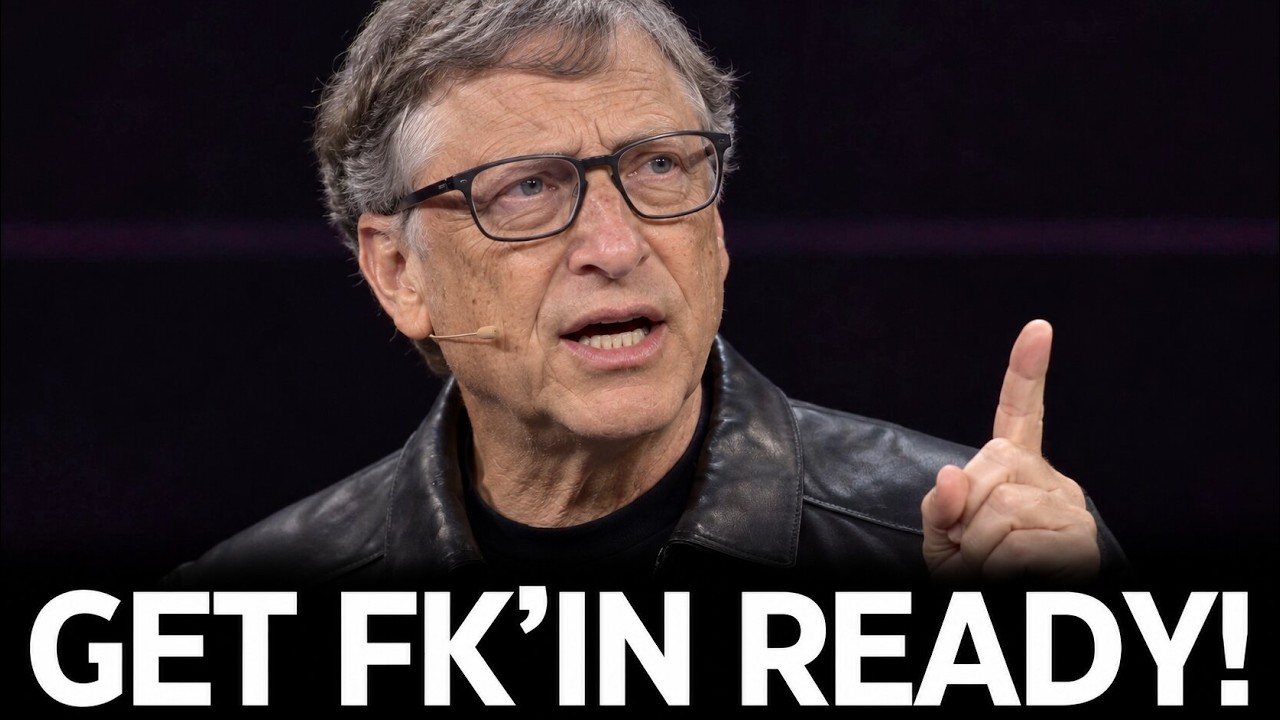
Bill Gates Leaves Audience Speechless!
Title history
- Bill Gates Leaves Audience Speechless! — observed on 20261117-1624 UTC (YouTube)
Keywords
Summary
188 words
Critical Evaluation
Value of the Information & Strength of the Argument
The video provides a valuable synthesis of Bill Gates’ recent statements, weaving together his written essays, television interviews, and foundation activities. It does not simply report but contextualizes, explaining why Gates’ shift from optimism to caution is significant. The argumentation is solid: it supports each claim with direct quotes and references, and it presents counterpoints (e.g., Etzioni’s critique) to avoid one-sidedness. However, the video occasionally employs dramatic language (‘panic button,’ ’torn through newsrooms’) that may overstate the impact, though it maintains factual accuracy. It clearly distinguishes Gates’ warnings from actual predictions, clarifying that he did not say AI will kill a billion people but that it could under misuse. The proposal of human reserved jobs and token taxes is explained with their pros and cons, showing a balanced evaluation. Overall, the value lies in consolidating scattered information into a coherent narrative, making it useful for understanding the current discourse on AI risk.
Scientific Rigor, Source Quality, Title Accuracy
The video demonstrates rigorous use of sources: it references Gates’ January 2026 letter, his August 2026 essay on Gates Notes, his Meet the Press interview, the Goalkeepers report, and statements by Dario Amodei, among others. These are credible primary sources. The video acknowledges contradictions, such as Gates’ foundation’s investments in AI despite his warnings, and includes criticisms from scholars like Oren Etzioni and investors like Nancy Tengler, providing a balanced view. The title ‘Bill Gates Leaves Audience Speechless!’ is somewhat hyperbolic but aligns with the content’s emphasis on the surprising nature of his statements. The video does not fabricate information and clearly labels interpretative commentary. However, it relies on secondary reporting for some details (e.g., specific statements from interviews) but generally attributes them accurately. No external links are provided in the description, so sources are cited by name without URLs, but they are identifiable. The adequacy between title and content is acceptable, with only a minor mismatch in tone.
326 words
Title / Content Match
The title is sensationalist but largely accurate: the content focuses on Gates' startling warnings about AI, which indeed captured public attention.
Quality & Reliability
8/10
The video is a well-structured synthesis of Bill Gates' public statements and interviews on AI risks, providing direct quotes and contextual analysis. It distinguishes between predictions and warnings, includes critical perspectives, and acknowledges the complexity of the issues. While not a scientific study, it relies on credible sources such as Gates' essays and interviews, and offers a balanced view.
Key Moments
Markers derived by PSI from the transcript: the creator did not define chapters.
- Introduction to Bill Gates' background and his surprising statement about AI causing a billion deaths.
- Discussion of Gates' January 2026 letter 'Optimism with Footnotes' and the rise in child mortality.
- Analysis of Gates' August essay 'The Turbulent Era of AI' and his three dangers: job loss, malicious use, and harm to human development.
- Explanation of Gates' proposals: 'human reserved' jobs and tax on AI tokens and robots, with critiques.
- Coverage of his September 27, 2026 Meet the Press interview and the billion-death statement, plus reactions.
- Conclusion summarizing the need for urgent decisions and the dilemma of funding AI while warning about it.
Cited Sources
- Gates Notes: 'The Turbulent Era of Artificial Intelligence' — Gates' August 2026 essay outlining his concerns and proposals.
- Meet the Press interview with Kristen Welker (September 27, 2026) — Gates' statement that AI could drive events causing a billion deaths.
- Gates Foundation Goalkeepers Report 2026 — Report highlighting efforts to use AI to reduce inequity.
- Bill Gates' January 2026 Annual Letter 'Optimism with Footnotes' — Early warnings about health aid cuts and AI job disruption.
Concurring Sources
- Dario Amodei's remarks at the UN Security Council — Anthropic CEO warned of AI risks to humanity, echoing Gates' concerns.
Dissenting Sources
- Oren Etzioni's critique of Gates' proposals — Professor Etzioni agrees on the diagnosis but argues the token tax is inefficient and new agencies may be unnecessary.
- Nancy Tengler's accusation of belittling critics — Investment chief questioned the evidence behind Gates' warnings.
- President Trump's rejection of AI regulation — Called warnings 'hoaxes' and declined to regulate AI, framing it as a race with China.
Contribution & Novelties
This video contributes by consolidating Bill Gates’ scattered statements into a single narrative, making his evolving position on AI accessible to a general audience. It highlights the tension between his optimistic past and current warnings, and explains his specific policy proposals (human reserved jobs, token tax) and their criticisms. The video also contextualizes his remarks within ongoing political and industry debates, noting both supportive and opposing views.
Pour aller plus loin :
- AI alignment — Discusses the challenge of ensuring AI systems act in human interests, directly relevant to Gates’ concerns about losing control.
- Robot tax — Explores the economic and policy debate around taxing automation, a key proposal highlighted in the video.
- Existential risk from artificial intelligence — Provides background on the broader discourse about AI’s potential catastrophic risks.
130 words
Radar Profile
The radar profile shows moderate to high scores across most dimensions, with the strongest performance in information quantity and reliability, reflecting the video's thorough coverage and use of credible sources. Technical depth is moderate, appropriate for a general audience, while argumentation quality is solid but not exceptional. This pattern suggests a well-produced informational piece rather than a deep technical or academic analysis.