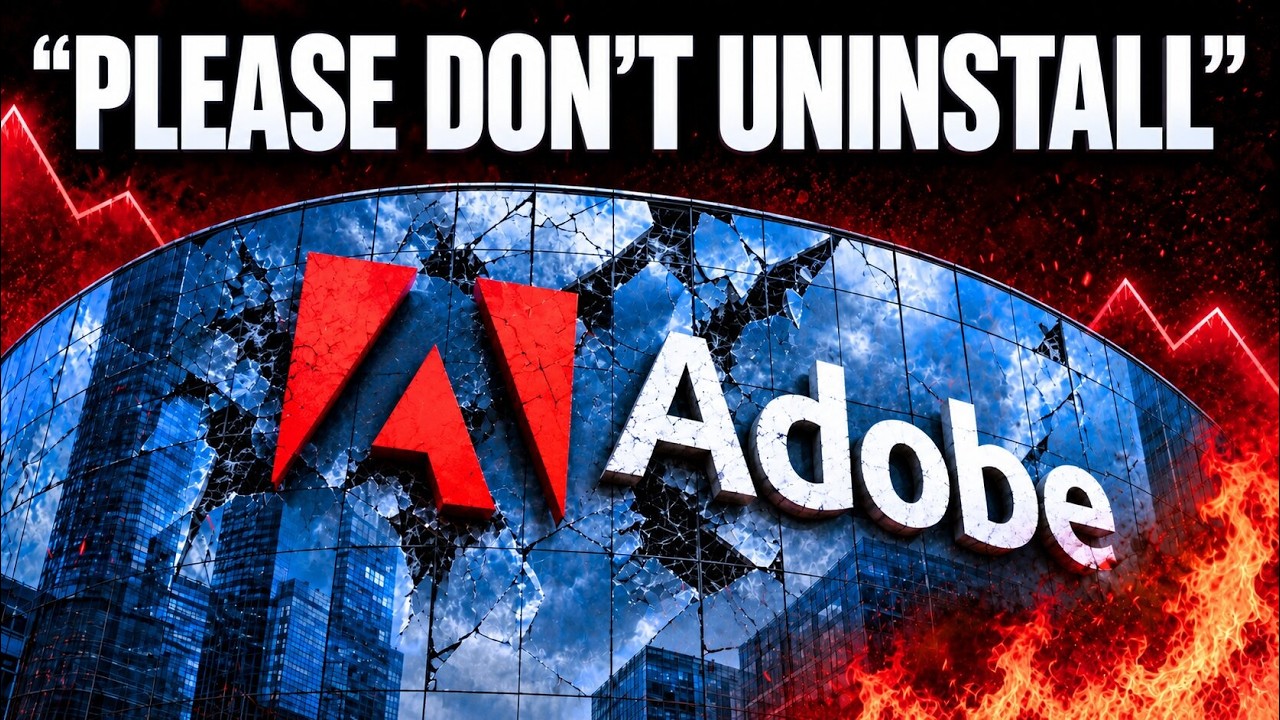
The Deserved Death of Adobe
Title history
- The Deserved Death of Adobe — observed on 20261031-2314 UTC (YouTube)
Keywords
Summary
176 words
Critical Evaluation
Value of the Information & Strength of the Argument
The video provides a compelling narrative supported by specific data points—financial figures, dates, named executives, and regulatory actions—that give it substantial informational value. The argumentation is well-structured, tracing Adobe’s historical pricing, the FTC lawsuit, the Figma saga, and the AI-driven competitive pressure. It effectively uses cause-and-effect to explain the stock decline despite strong fundamentals. However, the argument is one-sided, emphasizing negative aspects while downplaying Adobe’s resilience (e.g., massive cash flow, buybacks, and user growth). The lack of contrasting perspectives or expert interviews weakens the objectivity, though the rhetorical style is persuasive and coherent.
Scientific Rigor, Source Quality, Title Accuracy
The video demonstrates moderate scientific rigor: it references official documents (FTC complaint, CMA investigation), but provides no direct URLs or citations, making verification difficult. The narrative relies heavily on quantitative data (revenues, user counts) and quoted statements, but these are presented without source links. The title-content alignment is strong—the title’s provocative phrasing is supported by the video’s critical analysis of Adobe’s practices and market decline. The video could improve by including explicit references to primary sources. As for public comments, none were provided, so no analysis of audience sentiment is possible.
199 words
Title / Content Match
The title is catchy and provocative, summarizing the central thesis of a declining company despite record profits. It accurately reflects the video's critical tone and focus on Adobe's perceived failures.
Quality & Reliability
7/10
The video presents a well-structured narrative with specific financial figures, legal dates, and quotes from regulatory documents. However, it adopts a strongly opinionated tone and lacks explicit citation URLs, reducing verifiability. The factual claims appear consistent with known events, but the interpretative framing is subjective.