The Home Battery I’d Buy Today
Title history
- The Home Battery I’d Buy Today — observed on 20261117-1426 UTC (YouTube)
Keywords
Summary
129 words
Critical Evaluation
Value of the Information & Strength of the Argument
The video provides substantial value through its clear categorization of battery types and the four-jobs framework, making complex comparisons accessible. The argumentation is solid, supported by concrete examples, cost breakdowns, and real-world testing. The presenter includes transparent assumptions in savings calculations, and acknowledges limitations such as the impact of net metering. The personal bias is disclosed, and the analysis is grounded in data from the Brattle Group and utility program payments. The logical flow from criteria to evaluation to recommendation is coherent.
Scientific Rigor, Source Quality, Title Accuracy
The video references a script with citations at undecided.tech, and mentions specific data sources like the Brattle Group for VPP costs. The presenter also cites personal data from his ConnectedSolutions payments. The sponsorship segments (approximately 30 seconds for Micro Center at the start and about 2 minutes for Incogni around the middle) are disclosed. The title accurately represents the content, as the presenter ultimately recommends a system. The video does not engage in scientific rigor in the formal sense but uses a systematic evaluation approach. The source quality is decent, but the reliance on product marketing data and personal experience slightly limits objectivity.
200 words
Title / Content Match
The title accurately reflects the content, as the presenter ultimately gives his personal recommendation based on the comparative analysis.
Quality & Reliability
8/10
The video provides a thorough comparison of home battery systems with detailed cost analysis, technical specifications, and a real-world installation test. The presenter discloses affiliations and sponsorships, and provides a script with citations. However, the content is primarily based on personal experience and product data, with some calculations that are clearly explained. The reliability is high but not without potential bias due to sponsorships.
Key Moments
Markers derived by PSI from the transcript: the creator did not define chapters.
- Introduction and overview of four battery categories.
- Grading criteria: the four jobs a home battery can do.
- Analysis of installed whole-home systems, costs and benefits.
- Discussion of DIY battery options with cost comparison.
- Plug-in modular batteries explained, including Pila example.
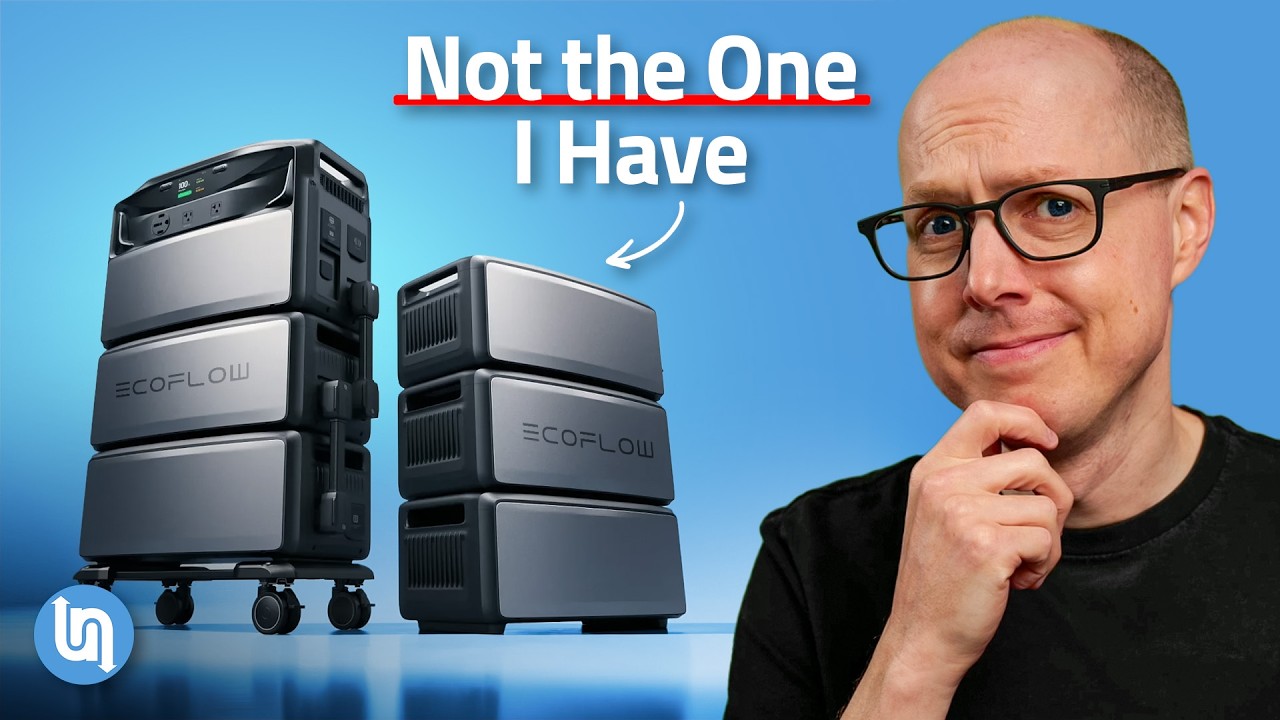
- EcoFlow TITAN installation and features, including test.
- Savings calculations and payback analysis.
- Final recommendation based on different user scenarios.
Cited Sources
- Script and citations for this video — The presenter's script with detailed citations and references.
- Tesla Solar Roof vs Solar Panels: Which is Worth It? — Related video from the same channel on solar technologies.
External References
Contribution & Novelties
The video brings a systematic comparison framework (four jobs) to evaluate home batteries, and provides real-world installation and testing of a modular system. It emphasizes the importance of net metering policies and time-of-use rates in determining battery value. The clear cost breakdown per kWh across categories is useful for consumers. To go further, one could explore the technical details of battery chemistry, grid interconnection policies, and emerging VPP models.
Pour aller plus loin :
- Time-of-use rates — Relevant to understanding how batteries save money.
- Net metering — Key policy affecting battery economics.
- Virtual power plant — Related to grid programs discussion.
- Lithium iron phosphate battery — Chemistry used in LFP batteries like TITAN.
113 words
Radar Profile
The radar profile shows high scores in quantity of information, quality, technical level, and reliability, indicating a well-rounded and informative video. The strengths are in depth and clarity, with some potential bias from sponsorships.