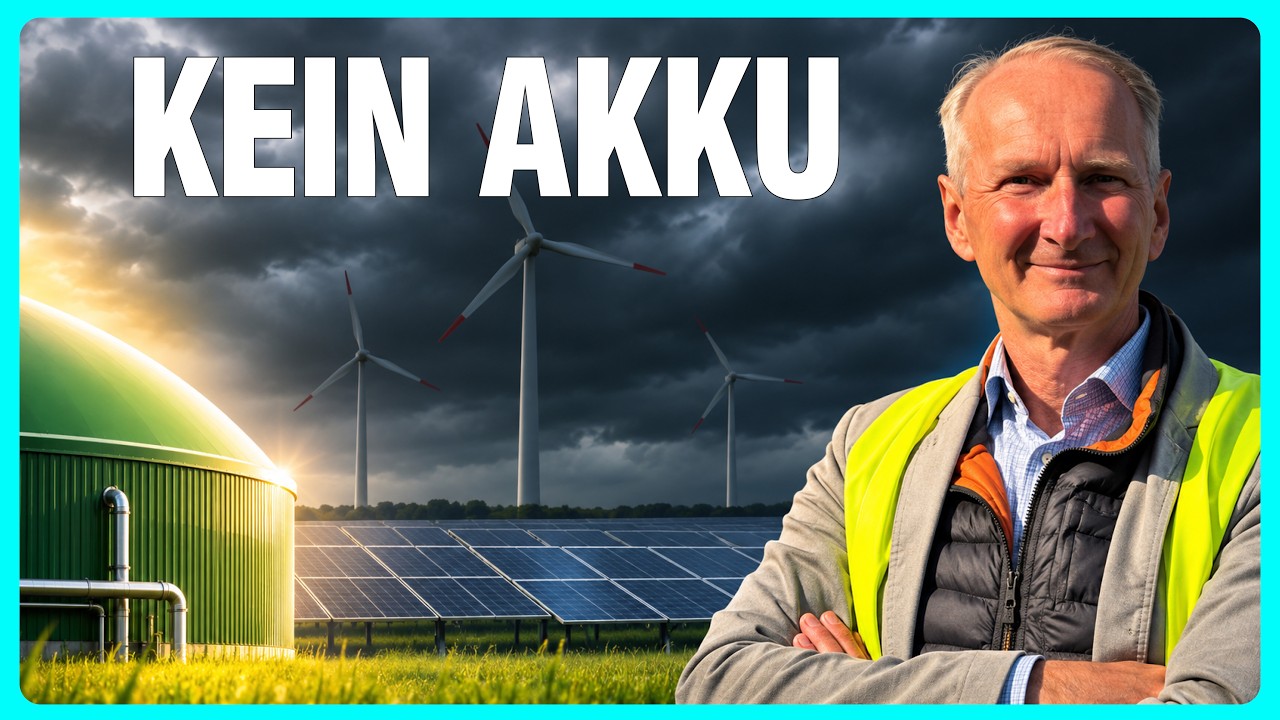
„Strompreis: Biogas immer günstiger als grüner Wasserstoff“ - Prof. Daniela Thrän & Christian Saul
"Electricity price: biogas always cheaper than green hydrogen" - Prof. Daniela Thrän & Christian Saul
Keywords
Summary
273 words
Critical Evaluation
Value of the Information & Strength of the Argument
The value of the episode lies in its concrete framing of biogas as a dispatchable complement to wind and solar. It gives operational detail—gas storage, motor overcapacity, silage storage, fermenter flexibility—that is often missing from high-level energy-transition debates. It also keeps two perspectives in tension: a systems-modelling view that favours larger plants based on residues and wastes, and an operator view that defends existing agricultural plants, energy crops and higher capacity payments. This disagreement is useful because it exposes the political and distributional choices hidden behind the phrase ‘flexible biogas’. The argumentation is strongest when it separates residue-based from crop-based biogas and when it scales the claimed contribution to the duration of the Dunkelflaute. It is weaker when cost competitiveness is illustrated by spot-market anecdotes, personal profitability history and round figures for capacity payments rather than a transparent cost stack. The claims about Danish biogas, methane avoidance and soil carbon are plausible but are asserted rather than demonstrated. Overall, the discussion is informative and appropriately conditional, but it remains an expert conversation rather than a systematic assessment.
Scientific Rigor, Source Quality, Title Accuracy
The episode’s source base is oral and institutional rather than documentary. The guests are named with relevant affiliations—University of Leipzig and the Helmholtz Centre for Environmental Research for Thrän, ARA Biogas and Klima-Union Schleswig-Holstein for Saul—which gives the discussion identifiable expertise. However, the transcript and the non-sponsor description link provide no peer-reviewed papers, data annex, legal text or methodological note for the figures on plant numbers, capacity, flexibility, substrate potentials, capacity payments or cost comparisons. The LinkedIn link identifies the podcast but is not a scientific reference. The title is more categorical than the content: ‘Biogas always cheaper than green hydrogen’ is not demonstrated as a general claim. The discussion supports a narrower proposition—that biogas can be cheaper in specific high-price, residual-load or gap-filling segments—and even there the comparison depends on assumptions about substrates, plant scale, motor overcapacity and support design. The title therefore captures a central theme but overstates its universality.
344 words
Title / Content Match
The title announces a direct price comparison between biogas and green hydrogen. The episode does address this comparison, but only conditionally and without a systematic cost analysis, so the title is somewhat more categorical than the content.
Quality & Reliability
7/10
The discussion is informed by a professor with relevant institutional affiliations and by a biogas-plant operator, and it presents caveats and disagreements. However, no peer-reviewed references, data sources or methodological details are supplied, so the reliability is moderate rather than high.
Key Moments
Markers derived by PSI from the transcript: the creator did not define chapters.
- Introduction and framing of biogas as a possible flexibility provider during periods without wind or sun.
- Daniela Thrän explains anaerobic digestion, biogas composition and the digestate by-product.
- Key figures: about 9,000 biogas plants, 6.8 GW of capacity and roughly two-thirds already flexible.
- Comparison with Denmark, decentralised German agriculture and the limits of residue-based biogas.
- Sponsored segment of roughly two minutes; the discussion resumes afterwards.
- Cost debate: current feed-in remuneration of about 20 ct/kWh, spot-market prices and capacity payments of roughly €100–130/kW.
- Plant tour: silage storage, gas buffering for hours or days, and the seasonal storage role of biomass.
- Longer Dunkelflaute, motor overbuilding and the comparison with green hydrogen costs.
- Policy wishes: lower feed-in tariffs, minimum remuneration for flexible supply and up to tenfold motor overcapacity.
- Environmental critique: methane emissions, drained peatlands, biodiversity, nitrogen-intensive agriculture and the case for residues.
Cited Sources
- Prof. Dr. Daniela Thrän — University of Leipzig / Helmholtz Centre for Environmental Research — Guest affiliation and scientific perspective cited in the episode; no publication or data link is supplied in the description.
- Christian Saul — ARA Biogas GmbH / Klima-Union Schleswig-Holstein — Practitioner perspective cited in the episode; no publication or data link is supplied in the description.
- German Renewable Energy Sources Act (EEG) — Regulatory framework discussed throughout the episode; no legal text is linked in the description.
- Geladen — Batteriepodcast (LinkedIn page) — Only non-sponsor link in the description; it identifies the podcast rather than a scientific source.
Concurring Sources
- IPCC AR6 Working Group III — Agriculture, Forestry and Other Land Uses — Broadly consistent with the episode's distinction between residue-based bioenergy and dedicated energy crops, and with its warnings about land-use, peatland and biodiversity risks.
- IEA Bioenergy — Bioenergy for a sustainable energy future — Supports the general case that flexible bioenergy can provide dispatchable low-carbon electricity, subject to sustainability and resource constraints.
- Umweltbundesamt (German Environment Agency) — Biogas — Consistent with the discussion of methane emissions, substrate choice and environmental trade-offs in biogas production.
External References
Contribution & Novelties
The episode’s original contribution is the direct encounter between a scientific assessment of biogas in a climate-neutral electricity system and a farmer-operator’s account of EEG economics, plant operation and seasonal storage. It reframes biogas less as a baseline generator and more as a dispatchable gap-filler whose value depends on substrate choice, storage, motor overcapacity and market design. It also keeps the environmental critique in view, especially methane, drained peatlands and biodiversity.
Further reading:
- Biogas — Background on anaerobic digestion and biogas composition.
- Dunkelflaute — Explains the residual-load problem the episode uses as its central use case.
- German Renewable Energy Sources Act — Context for EEG feed-in tariffs and flexibility premiums.
- Green hydrogen — Reference point for the cost comparison in the title.
- Anaerobic digestion — Process behind biogas production.
129 words
Radar Profile
The profile is information-rich and technically detailed, with strong scores for quantity and technical level. Reliability is moderate: the episode benefits from named expertise and explicit caveats, but the lack of traceable references keeps it below the highest band. The radar shape reflects a broad energy-system discussion rather than a narrowly sourced technical review.