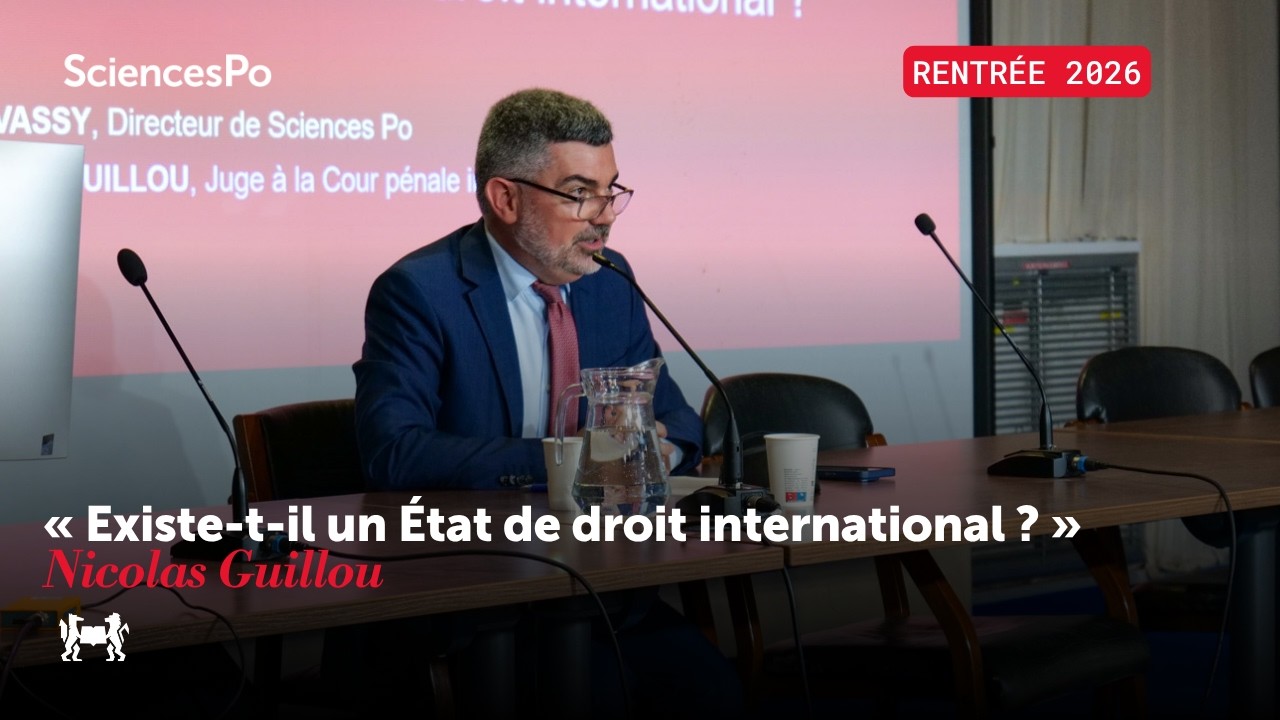
Nicolas Guillou - Leçon inaugurale de l'École de droit de Sciences Po
Nicolas Guillou - Sciences Po Law School Inaugural Lecture
Keywords
Summary
211 words
Critical Evaluation
Value of the Information & Strength of the Argument
The lecture offers substantial value through its combination of theoretical rigor and practical experience. Guillou does not simply enumerate criticisms of international law; he deconstructs them and provides nuanced responses. For instance, he acknowledges the critique of double standards in international criminal justice but contextualizes it by noting the historical evolution from ad hoc tribunals to the permanent ICC. He also addresses the legal-positivist concerns about norm vagueness and judicial law-making, illustrating with Article 68 of the Rome Statute. The argumentation is coherent: he moves from a definitional framework to a historical assessment, then to contemporary critiques, and finally to a constructive outlook. The speaker openly discusses weaknesses of the system, such as the colonial legacy and the democratic legitimacy gap, which strengthens his credibility. His use of examples—like the ICC’s mandate for Netanyahu and the US sanctions against him—grounds abstract concepts in real-world events. The lecture is not simply an apology for international law; it is a critical yet hopeful evaluation.
Scientific Rigor, Source Quality, Title Accuracy
The lecture demonstrates high scholarly rigor. Guillou refers to key legal instruments and institutions: the UN Charter, the Rome Statute, the European Court of Human Rights, and the International Court of Justice. He also references philosophical traditions (Kant, Abbé de Saint-Pierre) and contemporary legal doctrines (originalism). The presentation structure (first part: project incomplete, second part: contestation, third part: hope) is clear and logical. The title is perfectly matched with the content—the entire lecture is an interrogation of the existence of an international rule of law. Moreover, the speaker’s own experience as a judge facing political pressure (US sanctions) adds authentic weight. The video includes no external source citations in the description beyond official Sciences Po links, but the oral lecture implicitly draws on a deep body of legal scholarship and case law. The absence of visual aids or written references does not diminish the intellectual quality, as the speaker’s authority and reasoning are self-contained.
331 words
Title / Content Match
The title accurately reflects the content: an inaugural lecture by Nicolas Guillou on the existence of an international rule of law. The lecture directly addresses this question, exploring both the foundations and the current challenges to this concept.
Quality & Reliability
9/10
The lecture is delivered by a sitting judge at the International Criminal Court who brings first-hand experience in international criminal justice. The argumentation is rigorous, well-structured, and carefully balances theoretical frameworks with practical judicial insights. The speaker explicitly addresses counterarguments and acknowledges the critical limitations of the international legal order, demonstrating intellectual honesty and deep expertise.
Key Moments
Markers derived by PSI from the transcript: the creator did not define chapters.
- Introduction by Julie Clin and Guillaume Vasse, welcoming Nicolas Guillou.
- Guillou begins the lecture, framing the provocative question and outlining the three-part structure.
- Discusses the historical roots of the international rule of law, from Kant to the UN era.
- Critique of colonial origins and the inherent inequality in the international order.
- Examination of legal uncertainty, including vagueness of norms and the hardening of soft law.
- Addresses the democratic deficit and fragmentation of international law.
- Concluding message of hope, emphasizing the role of civil society and the ongoing construction of international rule of law.
Cited Sources
- Sciences Po Apple App Store — Official application for Sciences Po, mentioned in the video description.
- Sciences Po LinkedIn page — Official LinkedIn presence of Sciences Po, linked in the description.
- Sans Transition podcast — Sciences Po's podcast channel, linked in the description.
- Sciences Po Snapchat — Official Snapchat account of Sciences Po, linked in the description.
Contribution & Novelties
This lecture provides a rare insider perspective on the functioning and challenges of international criminal justice, delivered by a judge who has faced direct political consequences for judicial decisions. It articulates a sophisticated defense of the international rule of law while candidly acknowledging its flaws, offering a balanced view often missing in public discourse. The discussion of legal uncertainty and the democratic deficit brings a practitioner’s insight to debates usually dominated by academics. The lecture contributes to contemporary debates about the legitimacy of international courts, especially in light of U.S. sanctions against ICC personnel.
Pour aller plus loin :
- Rome Statute of the International Criminal Court — The foundational treaty establishing the ICC, central to Guillou’s work.
- Immanuel Kant’s Perpetual Peace — A philosophical precursor to the idea of international rule of law.
- Rule of Law (Wikipedia) — A general overview of the concept, useful for understanding the domestic analogy.
- International Criminal Court / US sanctions incident — Context for the sanctions mentioned in the lecture.
166 words
Radar Profile
The profile shows high scores in quality and reliability, reflecting the expertise of the speaker and the rigor of the argumentation. The quantity of information is substantial, though the technical level indicates a target audience with legal background. The lecture is dense and intellectually rich, with a strong emphasis on critical analysis rather than broad accessibility.