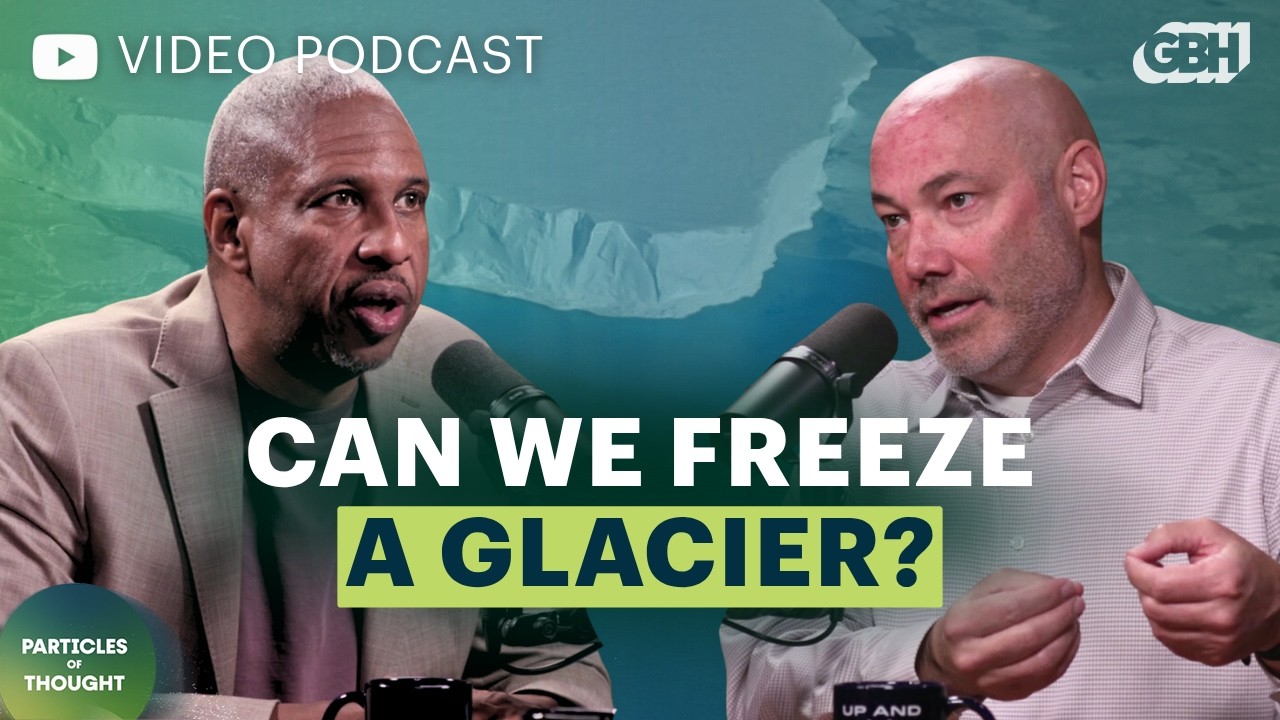
Interview: How to Save The “Doomsday Glacier” with Brent Minchew | Particles of Thought
Keywords
Summary
152 words
Critical Evaluation
Value of the Information & Strength of the Argument
The information is highly valuable, offering a clear explanation of complex glacial processes and the state of the science. Minchew provides concrete numbers (e.g., 50 billion tons of ice loss per year) and analogies (bank account, brake pads) that make the science accessible. His argumentation is solid, grounded in multiple independent measurement techniques that converge on the same conclusion. He also presents the proposed stabilization method as a natural analog, citing that glaciers can self-stabilize through feedbacks. However, he acknowledges the lack of persistent monitoring and funding challenges, which tempers certainties.
Scientific Rigor, Source Quality, Title Accuracy
The scientific rigor is high, with the guest being a leading expert from Caltech and MIT. He references specific satellite missions (GRACE, interferometric SAR) and data from the IPCC, though he doesn’t cite specific papers. The title accurately reflects the content. Sources cited are from the description, which are about the podcast itself rather than scientific references, so the video doesn’t rely heavily on external citations but on the expert’s knowledge.
177 words
Title / Content Match
The title accurately reflects the interview's focus on the Thwaites Glacier and proposed stabilization ideas.
Quality & Reliability
9/10
Interview with a leading glaciologist from Caltech/MIT, discussing well-established science with references to satellite data and observations.
Key Moments
Markers derived by PSI from the transcript: the creator did not define chapters.
- Introduction to the podcast and guest Brent Minchew.
- Discussion of the Thwaites Glacier's size and ice loss.
- Explanation of the conveyor belt analogy and feedback loops.
- Overview of measurement techniques using GRACE and radar.
- Presentation of the idea to freeze the glacier to its bed.
- Minchew's personal journey from 9/11 first responder to glaciologist.
Cited Sources
- Particles of Thought on Apple Podcasts — Apple Podcasts link for the episode.
- Particles of Thought Podcast on Apple Podcasts — Main podcast page.
- NOVA Newsletter — Sign-up for NOVA's newsletter for more science content.
Contribution & Novelties
The interview provides an accessible yet detailed explanation of the mechanisms behind Thwaites Glacier’s potential collapse and introduces a proposed intervention—enhancing basal friction to ‘freeze’ the glacier to its seabed. This perspective shift from passive observation to active stabilization is relatively new and highlights the urgency of the problem. The guest’s personal narrative adds a unique human element.
Pour aller plus loin :
- Thwaites Glacier — Overview of the glacier and its significance.
- GRACE and GRACE-FO — Satellite mission used to measure ice mass changes.
- Marine ice sheet instability — The feedback mechanism discussed in the video.
97 words
Radar Profile
The profile shows high values in quality and reliability, moderate in quantity and technique. This indicates a well-informed expert discussion rather than a technical deep-dive, with strong credibility and solid information density.