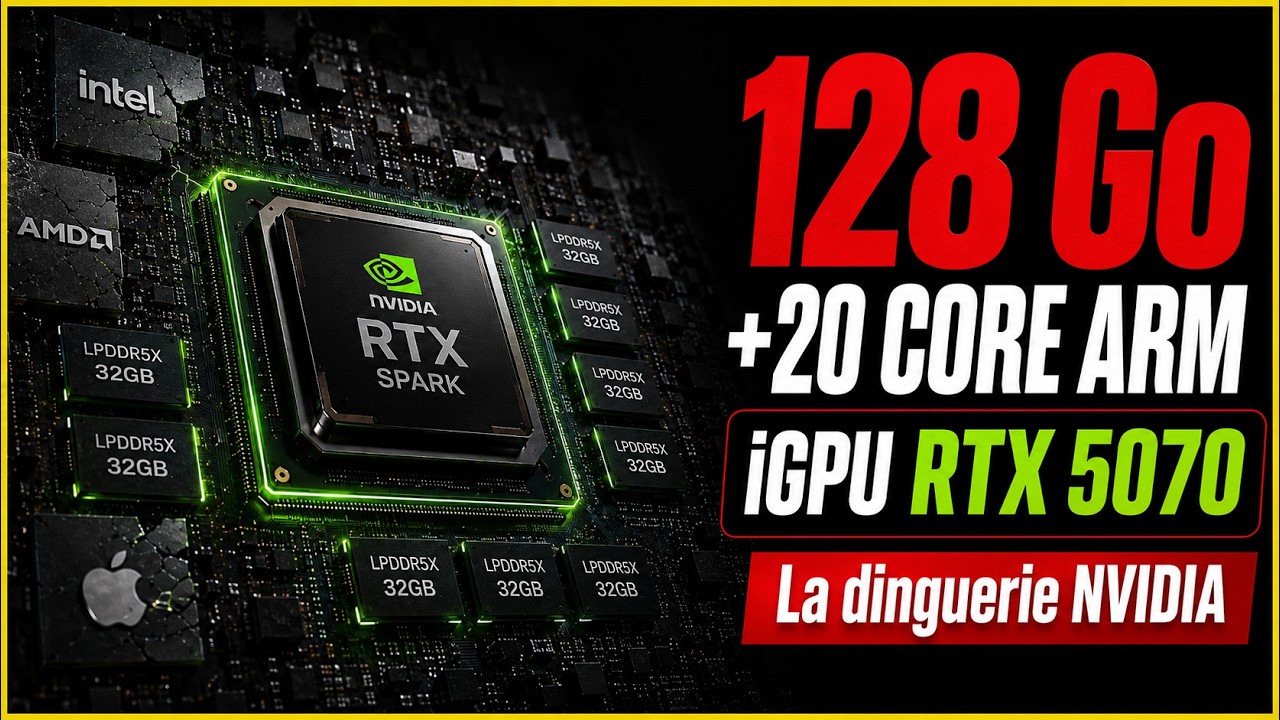
RTX Spark : NVIDIA déclare la GUERRE à Intel, AMD et Apple
RTX Spark: NVIDIA declares WAR on Intel, AMD and Apple
Title history
- RTX Spark : NVIDIA déclare la GUERRE à Intel, AMD et Apple — observed on 20261101-0117 UTC (YouTube)
Keywords
Summary
206 words
Critical Evaluation
Value of the Information & Strength of the Argument
The video provides an interesting perspective on Nvidia’s strategic pivot toward unified hardware and AI-capable laptops. It offers useful context about the industry shift toward SoCs and unified memory, including comparisons with existing products. The argumentation is structured but heavily opinionated: the presenter supports his claims with anecdotal evidence, personal preferences, and rhetorical questions rather than systematic analysis. He effectively highlights the potential issues with Windows bloatware and the high cost, but his dismissal of Nvidia’s strategy relies on subjective judgments about the company’s priorities. The technical explanations are accessible for a general audience, though some statements are simplified or imprecise.
Scientific Rigor, Source Quality, Title Accuracy
The video lacks explicit citations or references to primary sources. The presenter does not mention any specific reports, datasheets, or official announcements beyond what is common knowledge. He uses approximate benchmark numbers and makes comparisons without offering verifiable data. The title is attention-grabbing but slightly sensationalist; the ‘war’ metaphor is arguable given the cooperative aspects with MediaTek and Intel. The content matches the title in tone and scope, but the lack of sourcing reduces its reliability as a factual reference. No public comments were provided for analysis, so trends cannot be assessed.
208 words
Title / Content Match
The title accurately reflects the content, which discusses Nvidia's RTX Spark as a competitive move against Intel, AMD, and Apple. The dramatic wording matches the presenter's confrontational tone.
Quality & Reliability
5/10
The video presents a personal, opinionated analysis of Nvidia's RTX Spark SoC. It provides some factual specifications and benchmark figures, but lacks citations, includes subjective judgments, and makes unverified claims. The reasoning is plausible but not scientifically rigorous.
Key Moments
Markers derived by PSI from the transcript: the creator did not define chapters.
- Introduction to the RTX Spark (N1X) and its potential impact.
- Explains traditional PC architecture with separate CPU/GPU and PCIe bus.
- Details the RTX Spark specs: 20 ARM cores, Blackwell GPU, unified memory.
- Discusses benchmark results: ~3000 single-core, ~19000 multi-core, compared to M3 Max and Intel 285HX.
- Pricing and models: from $1500 to $4800, with various manufacturers.
- Concerns about Windows on ARM, anti-cheat compatibility, and memory consumption.
- Analyzes Nvidia's encirclement strategy with MediaTek and Intel partnerships.
- Lists upcoming devices from Microsoft, Asus, MSI, Dell, HP; comments on storage limitations.
- Final verdict: skeptical about the product's value and Nvidia's direction.
Contribution & Novelties
This video offers a speculative and evaluative take on Nvidia’s entry into the laptop SoC market, discussing the potential disruption to existing CPU/GPU market dynamics. It highlights the integration of ARM cores, Blackwell GPU, and unified memory as a new paradigm for portable AI hardware. The presenter’s personal experience and critical perspective provide a contrast to typical promotional content.
Pour aller plus loin :
- ARM architecture family — Overview of ARM processor designs relevant to the RTX Spark’s CPU cores.
- Nvidia Drake (Blackwell GPU) — Background on Nvidia’s Blackwell architecture used in the integrated GPU.
- Windows on ARM — Explains compatibility challenges and the history of Windows on ARM devices.
110 words
Radar Profile
The profile shows moderate scores across the board, with quantitative information and technical level slightly higher than quality and reliability. This indicates a video that provides a fair amount of data and technical context but lacks the rigor and external validation needed for high confidence. The relatively low reliability score reflects the absence of sources and the subjective nature of the analysis.