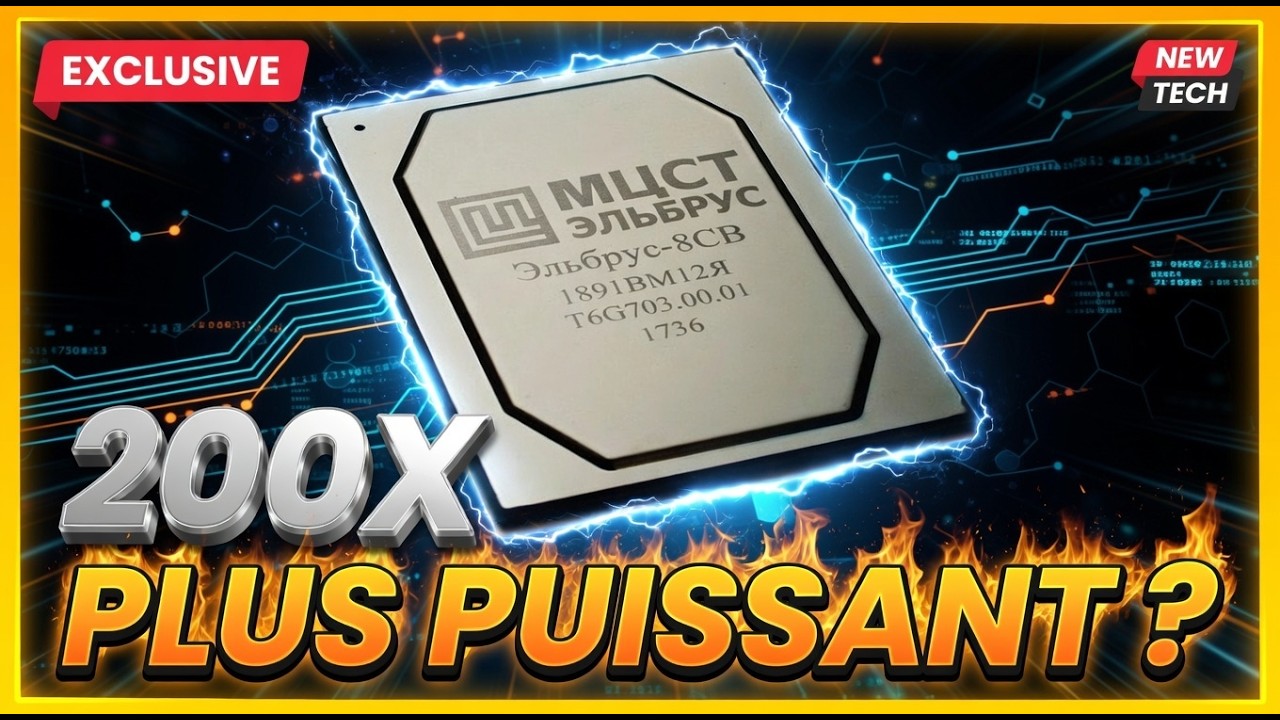
CPU Elbrus-B (2027) : 200 fois plus puissant qu’un Intel sur le même process… Vraiment possible ?
Elbrus-B CPU (2027): 200 times more powerful than an Intel on the same process… Really possible?
Title history
- CPU Elbrus-B (2027) : 200 fois plus puissant qu’un Intel sur le même process… Vraiment possible ? — observed on 20261101-0133 UTC (YouTube)
Keywords
Summary
149 words
Critical Evaluation
Value of the Information & Strength of the Argument
Value of information: The video provides a rich overview of the VLIW architecture and its trade-offs, using the Elbrus processors as a case study. It effectively explains how VLIW differs from superscalar designs, and the historical precedent of Intel’s Itanium serves as a cautionary tale. The details on the 8S/8SV and the proposed Elbrus-B specifications give viewers a clear picture of Russia’s semiconductor strategy. The connection to sanctions and national security adds a valuable geopolitical dimension.
Solidity of argumentation: The argumentation is generally coherent but leans heavily on speculative claims. The 30-200x performance assertion is presented as a claim from Russian sources without independent validation. The creator does acknowledge these are dubious, framing them as “optimistic” and noting the absence of external benchmarks. The reasoning about software optimisation and compilation challenges is sound, and the use of historical analogies (Itanium, HP Dynamo, Transmeta) strengthens the analysis. However, the video lacks concrete data or expert interviews to substantiate the central performance promises, leaving the argumentative chain vulnerable at its core.
Scientific Rigor, Source Quality, Title Accuracy
Scientific rigour: The video maintains a moderate level of rigour, explaining architectural concepts with reasonable accuracy. It cites historical examples and known limitations of VLIW, but the key performance figures are not traced to a verifiable source. No research papers or official datasheets are referenced, and the linked Amazon affiliate page provides no additional information.
Quality of sources: The only explicit source is the creator’s own previous videos and the Amazon affiliate link. The video mentions internal Russian documents and institutional claims but does not provide URLs or access paths. This makes independent verification impossible. The reliance on unofficial or third-party hearsay diminishes the scientific quality.
Title-content fit: The title asks if a 200-fold improvement is really possible, and the video directly addresses this question. The content critically examines the claim, presenting arguments both for and against. While the title overstates the promise, the video itself is balanced and skeptical, so the fit is acceptable.
339 words
Title / Content Match
The title is catchy and accurately reflects the video's focus on the Elbrus-B's ambitious performance claims and their feasibility. The content directly addresses these claims.
Quality & Reliability
6/10
The video offers a detailed overview of the Elbrus CPU lineage and the VLIW architecture, but the central performance claims (30-200x) are presented without independent benchmarks or peer-reviewed sources. The geopolitical context is well articulated, yet the technical rigour suffers from a lack of verifiable references.
Key Moments
Markers derived by PSI from the transcript: the creator did not define chapters.
- Introduction of Elbrus as Russia's response to US chip dominance.
- Historical background of Soviet Elbrus computers and Lebedev institute.
- Explanation of VLIW architecture vs superscalar designs.
- Specifications of Elbrus 8S/8SV processors.
- Discussion of dynamic binary translation and software compatibility.
- Presentation of Elbrus-B and its claimed 30-200x performance boost.
- Comparison with Intel Itanium failure and skepticism about claims.
- Conclusion on Russia's need for self-sufficiency and viewer thoughts.
Cited Sources
- Amazon Affiliate Store — Link used by the creator for affiliate purchases, not a technical source.
Concurring Sources
- What is VLIW? — Confirms the basic principles of VLIW and its challenges.
Dissenting Sources
- Itanium architecture — The commercial failure of Itanium shows that VLIW alone does not guarantee performance gains, contradicting Elbrus-B's claims of 30-200x improvement.
Contribution & Novelties
The video offers a digestible explanation of VLIW architecture and its application in a contemporary geopolitical context. It highlights a niche topic rarely covered in Western media, giving insights into Russia’s attempts to overcome sanctions through unconventional processor design. The novelty lies in the detailed exposition of the Elbrus roadmap and the critical analysis of its claims.
Pour aller plus loin :
- VLIW on Wikipedia — Explains the concept and its history, relevant to understanding the fundamental architecture.
- Intel Itanium — Details the fate of a similar architecture, providing comparative context.
- Dynamic binary translation — Related to the compatibility layer used in Elbrus, helps understand its software ecosystem.
108 words
Radar Profile
The profile shows high quantity of information and moderate technical level, with lower scores for quality and reliability. This reflects a video that is informative but relies on unverified claims, creating an unbalanced radar where the richness of content is not matched by scientific rigour.
💬 Sur les 29 commentaires analysés, le climat est globalement positif mais nuancé : beaucoup de curieux et de sceptiques, avec des éloges pour l'intérêt du sujet et quelques critiques sur le manque de preuves. Overall, the tone is enthusiastic about the topic but cautious about the performance claims.