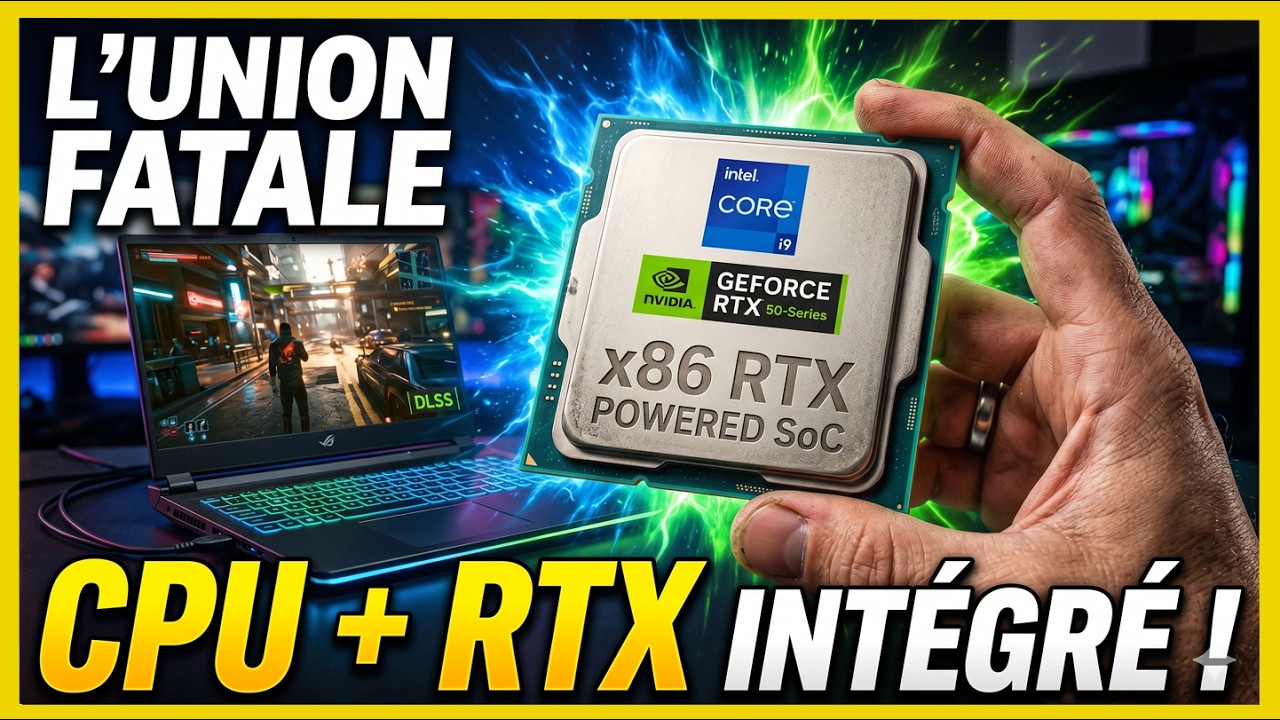
INCROYABLE : Pourquoi l'APU Intel+NVIDIA va tout changer et c'est une révolution
INCREDIBLE: Why the Intel+NVIDIA APU will change everything and it's a revolution
Title history
- INCROYABLE : Pourquoi l'APU Intel+NVIDIA va tout changer et c'est une révolution — observed on 20261101-0122 UTC (YouTube)
Keywords
Summary
137 words
Critical Evaluation
Value of the Information & Strength of the Argument
The video adds value by synthesizing available news about the Intel-Nvidia partnership and translating technical details into consumer-relevant implications. The argumentation is structured around the two announced axes and explores consequences for different market segments. However, it leans heavily on speculation, especially regarding Intel Foundry and the future of Arc GPUs, without providing concrete evidence or expert interviews. The creator’s enthusiasm is evident, but the reasoning sometimes jumps to conclusions, such as assuming Apple Silicon will be directly harmed. Despite this, the discussion of CUDA’s importance and the potential impact on APU competition is well articulated and offers a plausible perspective.
Scientific Rigor, Source Quality, Title Accuracy
The video lacks direct citations of primary sources; it references Reuters and AMD’s financial filing but does not provide URLs or specific documents. The description contains only an Amazon affiliate link and a link to the creator’s own blog, which limits verifiability. The title is aligned with the content, though it adopts a hype tone typical of tech commentary. The absence of precise sourcing reduces the scientific rigor, and some claims (e.g., ‘Nvidia adopted RISC-V’ from a comment but not in the video) are not addressed. The overall reliability is moderate, as the video appears to be a commentary based on secondary reporting rather than original research.
223 words
Title / Content Match
The title accurately reflects the video's focus on the Intel-NVIDIA alliance and its potential impact, though it uses sensational language consistent with typical tech hype.
Quality & Reliability
6/10
The video provides a coherent overview of the Intel-Nvidia partnership, but contains speculative assertions and a few factual inaccuracies (e.g., mischaracterizing AMD as a Chinese company). Claims are largely based on industry reports and the creator's interpretation, with limited direct sourcing.
Key Moments
Markers derived by PSI from the transcript: the creator did not define chapters.
- Introduction to the Intel-Nvidia alliance and its potential impact on the PC market.
- Official announcements: custom x86 CPUs for Nvidia AI platforms and SoCs with RTX chiplets.
- Implications for AMD and its APU dominance, including competition in gaming laptops and handhelds.
- Analysis of the future of Intel Arc GPUs and potential conflicts of interest.
- Discussion of broader market trends, including ARM/RISC-V competition and conclusion.
Cited Sources
- Makertronic Blog - Intel-Nvidia Alliance: What It Really Means — Mentioned in the description as a supplementary resource by the video creator, likely providing a written version of the analysis.
Contribution & Novelties
The video contributes by translating a complex technical partnership into consumer-oriented analysis, highlighting the potential for integrated RTX GPUs in future processors and the strategic reasoning behind the deal. It offers a genuine synthesis of information for French-speaking audiences. However, it does not present original data or exclusive insights beyond general commentary.
Pour aller plus loin :
- APU (Accelerated Processing Unit) — Provides background on AMD’s integrated CPU-GPU architecture, central to the discussion.
- Chiplet — Explains the heterogeneous integration approach used for the proposed Intel-Nvidia SoCs.
- NVLink — Describes Nvidia’s high-bandwidth interconnect, key to the data-center CPU-GPU integration.
- CUDA — Details the proprietary parallel computing platform that gives Nvidia an AI software advantage.
113 words
Radar Profile
The radar profile shows moderate to good information quantity and technical depth, but lower reliability due to limited sourcing and speculative elements. The balance suggests a video that is informative for a general audience but not rigorous enough for expert review.
💬 balanced. Sur les 30 commentaires analysés, l'ambiance est mitigée : certains sont enthousiastes et y voient une innovation majeure, tandis que d'autres expriment des doutes sur les prix, la concurrence AMD, et la stratégie d'Intel, avec quelques corrections factuelles.