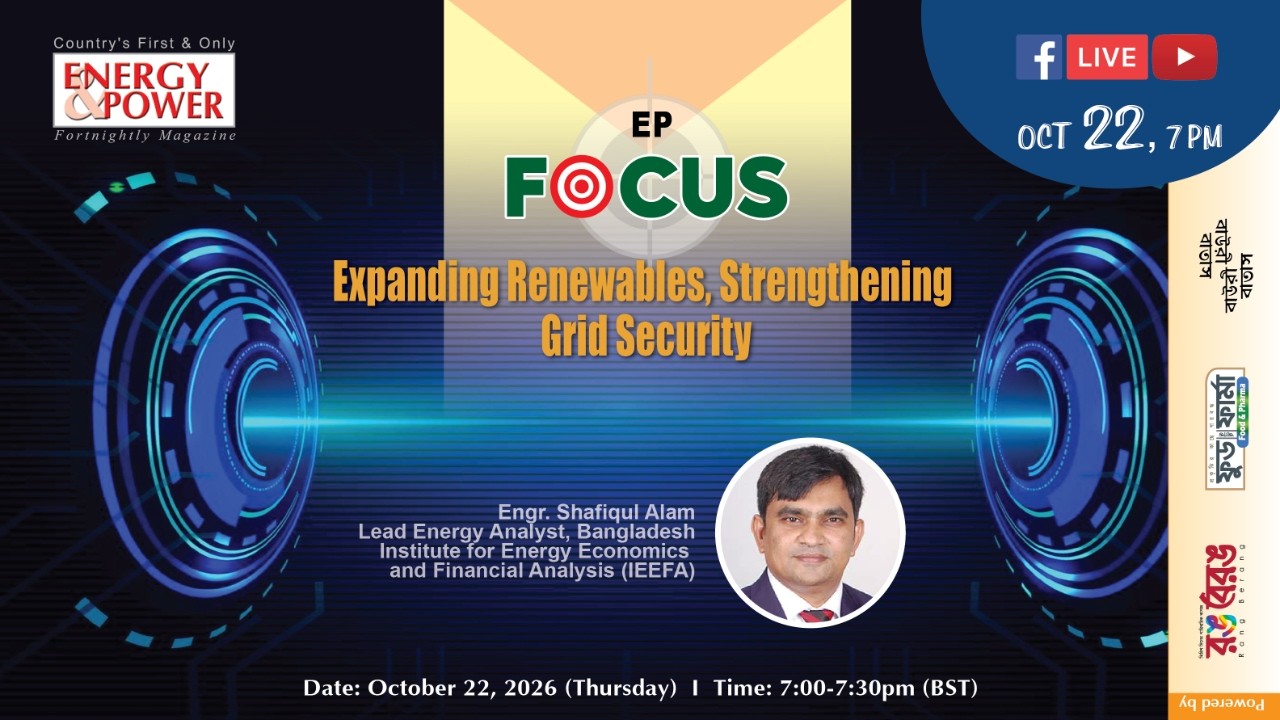
EP FOCUS: Expanding Renewables, Strengthening Grid Security
Title history
- EP FOCUS: Expanding Renewables, Strengthening Grid Security — observed on 20261025-1505 UTC (YouTube)
Keywords
Summary
205 words
Critical Evaluation
Value of the Information & Strength of the Argument
The value of the information is high, as the guest provides specific data points (e.g., household income statistics, import duty reduction, ongoing grid projects) and a nuanced analysis of policy implications. The argumentation is solid: he supports his views with references to his own studies and global examples like Australia and Sri Lanka. However, some points remain speculative, particularly regarding the feasibility of the 3,000-4,000 MW target, which he admits is challenging. The discussion is well-structured, with the host prompting deeper exploration of critical issues.
Scientific Rigor, Source Quality, Title Accuracy
The scientific rigor is moderate: the guest is a recognized analyst, but no external sources are cited directly during the interview, and his claims rely on personal expertise and internal assessments. The title accurately represents the content, focusing on renewable expansion and grid security. There is a minor divergence in that the discussion also covers social equity and affordability, but the core themes are well-matched.
165 words
Title / Content Match
The title accurately reflects the core themes of renewable expansion and grid security, matching the content well.
Quality & Reliability
7/10
The discussion features an experienced energy analyst providing specific data and policy analysis, but lacks independent verification, external citations, and relies on the interlocutor's subjective assessments. The reliability is moderate.
Key Moments
Markers derived by PSI from the transcript: the creator did not define chapters.
- Introduction of the topic and guest, Engr. Shafiqul Alam.
- Discussion of renewable targets, import duty reduction, and market signals.
- Challenges for low-income households in adopting rooftop solar and need for program revision.
- Analysis of Sri Lanka's grid failure and implications for Bangladesh.
- Emphasis on smart meters, grid modernization, and storage solutions.
Cited Sources
- IEEFA (Institute for Energy Economics and Financial Analysis) — The guest's affiliation and the source of his analyst perspective.
Contribution & Novelties
This video contributes a country-specific analysis of renewable energy expansion in Bangladesh, highlighting social equity concerns and grid security risks. It provides practical insights into policy design and infrastructure needs, drawing on comparative examples. The discussion of rooftop solar affordability and the need for smart meters is particularly relevant.
Pour aller plus loin :
- Smart grid — Relevant to the discussion of grid modernization and smart meters.
- Distributed generation — Central to the rooftop solar and grid integration debate.
- Net metering — A key policy instrument mentioned in the context of paying for surplus solar.
- Vehicle-to-grid — Future flexibility option referenced via Australia’s example.
104 words
Radar Profile
The radar profile shows balanced scores across quantity, quality, technical level, and reliability, with no extreme peaks. This indicates a moderately informative and technically sound discussion that does not venture into speculative territory, but could benefit from stronger source citations.