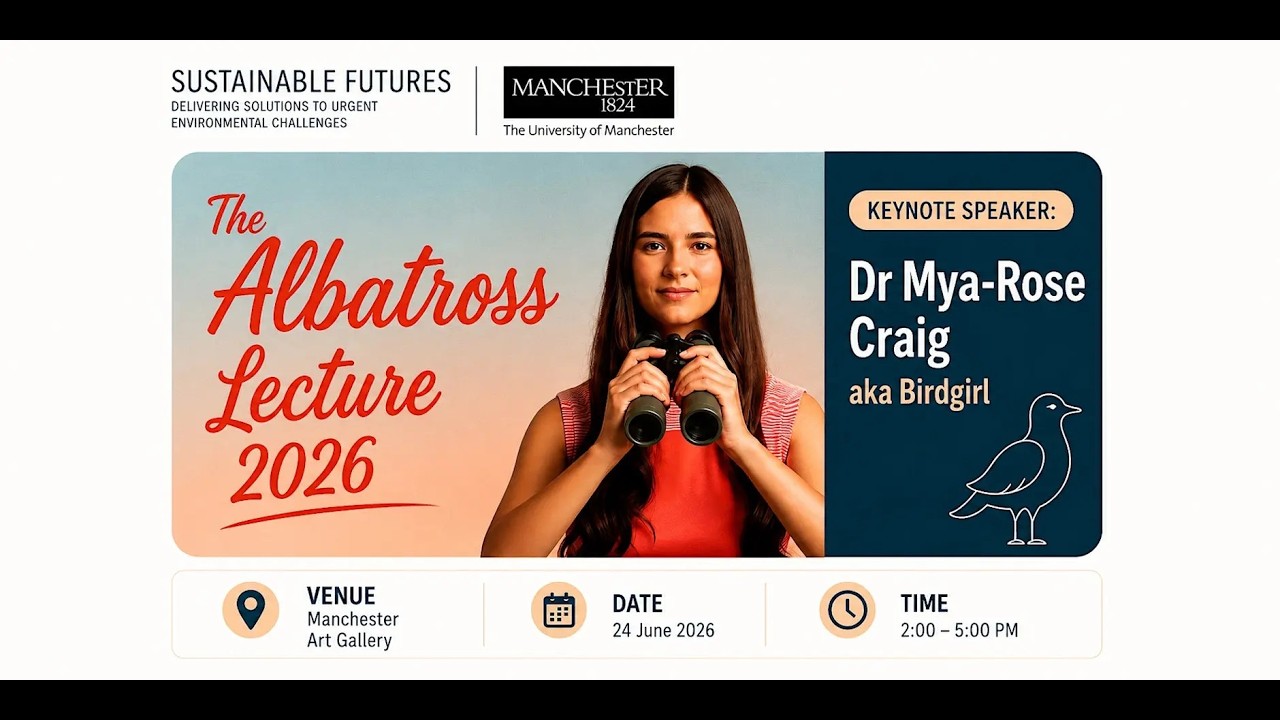
Albatross Lecture 2026: Dr. Mya-Rose Craig
Keywords
Summary
178 words
Critical Evaluation
Value of the Information & Strength of the Argument
The lecture’s primary value lies in its compelling synthesis of personal narrative and concrete case studies that illustrate how human well-being and environmental protection are interlinked. The argumentation is structured around a persuasive emotional core—her mother’s recovery in Ecuador—which humanizes the scientific and social claims made. Craig argues convincingly that environmental degradation is frequently a symptom of poverty, and she supports this with tangible examples: the yellow-headed picathartes in Ghana, where protection funded a school; the red-fronted macaw in Bolivia, which shifted poachers into protectors; and the spoon-billed sandpiper in Bangladesh, where ex-poachers were funded to start new trades. This evidence base effectively challenges the common narrative of human-nature opposition. While the argumentation is robust and cohesive, it relies heavily on anecdotal evidence and skips rigorous statistical or ecological data, making it more persuasive rhetorically than scientifically exhaustive.
Scientific Rigor, Source Quality, Title Accuracy
From a scientific rigor perspective, the content is built on direct field observations and organizational involvements (e.g., WWT), but it does not dive deep into research methodologies or provide formal literature citations. The examples are accurate and well-known to conservationists, which strengthens the lecture’s credibility, though the lack of quantitative analysis or peer-reviewed references bounds its scientific weight. Sources mentioned include the IPBES and WWT, but no formal papers are cited. The title perfectly aligns with the content and the institutional setting of the Sustainable Futures platform. The lecture fulfills the expected scope of an ‘Albatross Lecture’ by mixing personal experience with a broader social thesis, and the absence of comments prevents any public reaction analysis.
269 words
Title / Content Match
The title accurately reflects the content: a distinguished lecture for the Sustainable Futures Albatross Lecture series featuring Dr. Mya-Rose Craig.
Quality & Reliability
7/10
Lecture provides credible anecdotal evidence and concrete species-specific examples (e.g., spoon-billed sandpiper numbers, ecotourism in Ghana and Bolivia) drawn from personal field experience, but lacks formal citations or peer-reviewed references, placing it in the realm of expert testimony rather than rigorous research.
Key Moments
Markers derived by PSI from the transcript: the creator did not define chapters.
- Host Helen Holmes opens the lecture, delivers practical housekeeping, and introduces the Sustainable Futures platform and its six key themes.
- Helen Holmes introduces Dr. Mya-Rose Craig, highlighting her achievements in ornithology, activism, and communication.
- Craig begins her talk, describing her family's obsession with birdwatching and the 'Big Year' that parallelled her mother's mental health crisis.
- Craig discusses her family trip to Ecuador, where she witnessed her mother's recovery in nature, identifying this as the root of her understanding of nature's importance for health.
- She recounts witnessing severe environmental destruction during her childhood travels, including palm oil deforestation in Southeast Asia, and reflects on local communities' economic drivers.
- Craig presents concrete ecotourism successes, such as the yellow-headed picathartes in Ghana and red-fronted macaw in Bolivia, as examples of aligning conservation with local prosperity.
- She details the Bangladesh oil spill and her subsequent fundraising, along with her campaign for the spoon-billed sandpiper, emphasizing community-led conservation.
- The lecture concludes with a call for inclusive environmentalism, and the session transitions into a panel discussion chaired by Dr. Ian Thornhill.
Cited Sources
- IPBES (Intergovernmental Science-Policy Platform on Biodiversity and Ecosystem Services) — Mentioned by the host as a platform with which Sustainable Futures collaborates for advancing biodiversity and ecosystem services science.
- WWT (Wildfowl & Wetlands Trust) — Crucial partner in the spoon-billed sandpiper conservation project described in the lecture, involving local community transition to alternative livelihoods.
- The Times of Bangladesh (Bangladesh's national newspaper) — Cited as the outlet that published Craig's article about the spoon-billed sandpiper, raising awareness among the local population.
Concurring Sources
- IPBES Global Assessment Report on Biodiversity and Ecosystem Services — The host's mention of IPBES corroborates the lecture's backdrop of concerning global biodiversity loss and ecosystem degradation, which frames Craig's examples.
- WWT Spoon-billed Sandpiper Conservation Project — The detailed account of the spoon-billed sandpiper project aligns with WWT's official ongoing conservation efforts, which use community engagement strategies like those described.
Contribution & Novelties
The lecture’s original contribution lies in weaving together personal mental health experience, field-based conservation anecdotes, and explicit social equity arguments to redefine who environmentalism is for. It moves beyond typical nature documentaries by centering the voices of local communities and highlighting economic incentives as a viable path to conservation. The presentation successfully translates complex ecological issues into accessible human narratives, urging a shift from antagonistic eco-activism to cooperative, inclusive solutions.
Pour aller plus loin :
- Environmental justice — Directly aligns with Craig’s core thesis about unequal access to nature and the disproportionate burden on disadvantaged communities.
- Spoon-billed sandpiper — The critically endangered species central to her major campaign; provides background on its population trends and the international recovery effort.
- Nature deficit disorder — Supports her connection between reduced nature exposure and mental health issues, particularly in urbanized and minority populations.
140 words
Radar Profile
The radar profile shows a moderate level of quantitative information (6/10) versus a higher qualitative score (7/10), reflecting a lecture rich in narrative and case studies but lighter on statistical depth. The low technical score (4/10) indicates accessible language suited for a broad audience, while the global reliability score (7/10) mirrors the presenter's authoritative field status and the factual accuracy of the anecdotes shared.