Keywords
Summary
342 words
Critical Evaluation
Value of the Information & Strength of the Argument
The informational value is high for a long-form documentary: rather than a list of curiosities, the film builds a single cumulative argument and keeps returning to it. The central conceptual move — separating the reversibility of the microscopic laws from the irreversibility of macroscopic arrangements — is stated early (‘what is missing is the coordination’) and then earned through successive layers: classical mechanics, Hamiltonian state space, Liouville’s theorem, unitarity in quantum mechanics, and finally Boltzmann’s counting. The pedagogical scaffolding is unusually disciplined. The billiard break shot, the 100-coin toss, the 52-card shuffle and the 25-billion-trillion-molecules calculation are not decorative; each isolates a specific point (arrangement versus law, overwhelming multiplicity of high-entropy states, the difference between impossible and improbable). The argument is also honest about its own limits in three places that weaker treatments usually fudge: the explicit statement that weak-force T-violation is not the cause of the second law, the observation that the H-theorem’s arrow is placed in the molecular-chaos assumption rather than derived, and the admission that the same statistics that predict a melting ice cube also predict it was more melted a minute ago, which forces the past hypothesis. That last move is the intellectual peak of the film and is handled correctly. The weaknesses are in resolution rather than in direction. Several key quantities are gestured at rather than given: entropy values are never made concrete, the recurrence timescale is described only as ’too large to write out’, and the distinction between the Gibbs and Boltzmann entropies — which matters for the reversibility debate — is absent. The treatment of decoherence as the reason measurements look irreversible is correct as far as it goes but conflates a practical limitation with a physical one. The ‘2026 entropy clock’ in ultracold atoms is announced twice and never properly explained, so it functions rhetorically rather than evidentially. Finally, the film presents the past hypothesis as the terminus of the discussion without acknowledging that it is a research problem with active competing proposals, which slightly flattens the frontier it claims to be exploring.
Scientific Rigor, Source Quality, Title Accuracy
The rigour is markedly above the genre average. Claims are anchored to named researchers, dated publications and specific experiments: Carnot 1824, Clausius 1865, the H-theorem of 1872, Loschmidt’s objection of 1876, Poincaré’s recurrence theorem of 1890, Zermelo’s 1896 use of it, Hahn’s spin echo in 1950, Einstein’s 1905 explanation of Brownian motion with Perrin’s later confirmation, Cronin and Fitch in 1964, the BaBar result reported in 2012 with its 14-standard-deviation significance and 468 million B-meson pairs, and the CMB measurements from COBE through WMAP to Planck. Numerical statements are order-of-magnitude but correctly framed as such (‘roughly’, ‘about one part in 100,000’), and the film distinguishes observation from interpretation explicitly when it labels the CMB temperature map as ‘one of the best measured facts in cosmology’. The main source-quality gap is structural: the description carries no bibliography, no article links and no further reading, so nothing in the presentation is traceable by the viewer — the references exist only as spoken names and years. The 2019 quantum ‘rewind’ experiment is described with appropriate caution (85% success on two qubits, every step externally guided) and the headlines around it are explicitly corrected, which is good practice. The weakest evidential link is the repeated ‘2026’ experiment on an entropy-derived internal time parameter in a cloud of cold atoms: no group, no journal and no method are given, and the claim cannot be checked from the material supplied. Regarding title and content, the match is strong on substance — the film is entirely about the forward direction of time — with the caveat that the absolute ’never’ in the title sits awkwardly against the film’s own conclusion that reversal is not forbidden, only fantastically improbable.
638 words
Title / Content Match
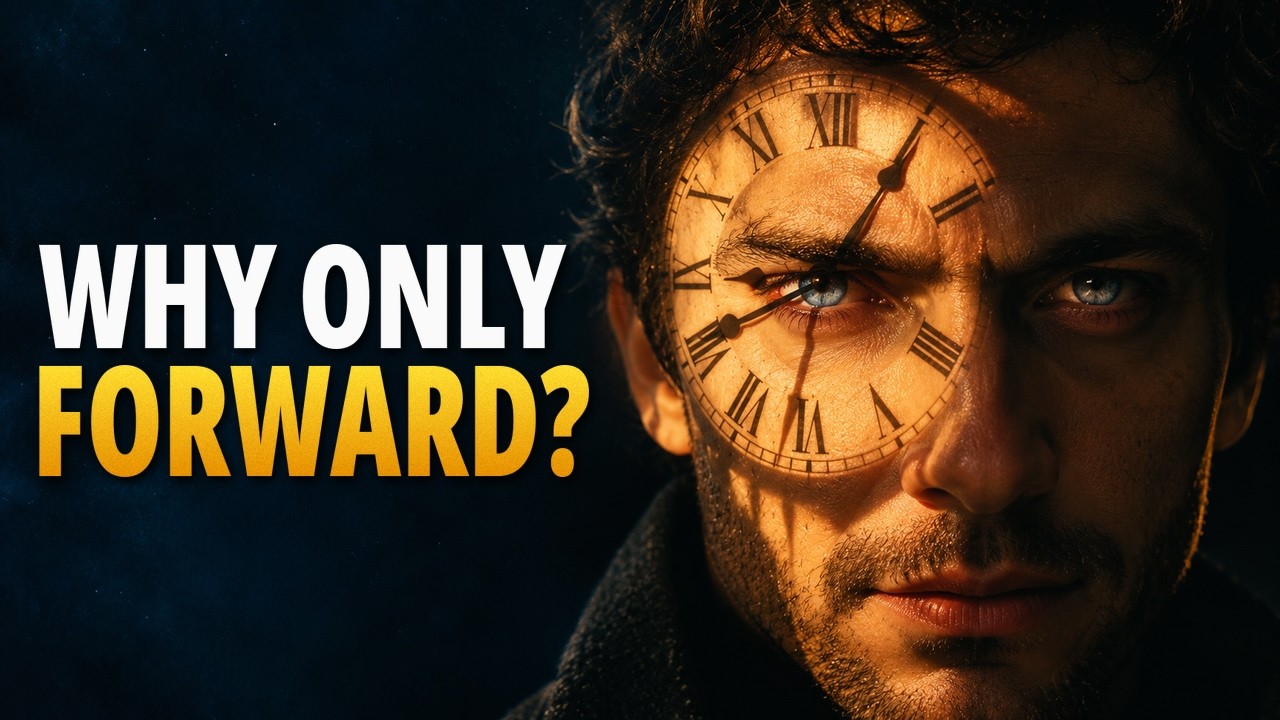
The title is a simplified hook, but the body delivers exactly the promised subject: why the macroscopic arrow of time points forward, and why the microscopic laws mostly do not forbid reversal. Only the absolute 'never' oversells a conclusion the film itself states in statistical terms ('not forbidden, just fantastically improbable').
Quality & Reliability
8/10
The physics presented is mainstream and largely accurate: the distinction between time-reversal-symmetric microscopic laws and the macroscopic arrow, Boltzmann's statistical reading of entropy, the past hypothesis, Loschmidt's and Zermelo's objections, spin echo, the BaBar time-reversal-violation result and the cosmic microwave background are all described in line with the standard literature. Dates, experiment names and approximate figures are correct, and the film explicitly refuses two common overclaims (that T-violation in the weak force explains the second law, and that quantum-computing 'time reversal' experiments sent anything backwards). Weaknesses: no citations or external links in the description, several quantitative statements are left deliberately vague, and the touted '2026 entropy clock' in ultracold atoms is too thinly described to be identified or checked. Names in the transcript are phonetically garbled (Clausius, Boltzmann, Loschmidt, Poincaré, Zermelo, Penzias, BaBar, SLAC, COBE/WMAP/Planck), which affects the text rather than the underlying content.
Key Moments
Markers derived by PSI from the transcript: the creator did not define chapters.
- Opening: the shattered glass played backwards, and the puzzle that the laws governing each atom would not object.
- Energy is conserved in the break, yet the event is irreversible; the missing ingredient is identified as coordination among billions of atoms.
- Carnot, Clausius naming entropy in 1865, the two-sentence statement of the second law, and Eddington's 1927 'arrow of time'.
- Records as evidence of the past: scratches, footprints, photographs, lunar craters — and no record of the future.
- Time-reversal symmetry established: Newton, Hamilton's position-momentum state space, Liouville's theorem, general relativity, and quantum unitarity with decoherence as the practical obstacle.
- Loschmidt's paradox, then the empirical answers: Hahn's 1950 spin echo and the 2019 two-qubit 'rewind' experiment that succeeded in about 85% of runs.
- The one real asymmetry: Cronin and Fitch 1964, CP violation, and the BaBar 2012 direct observation of time-reversal violation at 14 sigma — and why it does not explain breaking glass.
- Boltzmann: macrostates versus microstates, the 100-coin and 52-card analogies, S = k log W, and the H-theorem's molecular-chaos assumption.
- Poincaré recurrence and Zermelo's objection, fluctuation-driven local entropy drops, and why open systems (snowflakes, cells, Earth) can lower their own entropy.
- The past hypothesis, the cosmic microwave background as the oldest record, and the closing puzzle of why the initial state was so special.
Cited Sources
- Rudolf Clausius, naming of entropy and statement of the second law (1865) — Presented as the origin of the concept and of the 'entropy of the universe tends to a maximum' formulation.
- Ludwig Boltzmann, H-theorem (1872) and the statistical definition of entropy S = k log W — The core explanatory framework of the film; the formula is noted as engraved on Boltzmann's tombstone in Vienna.
- Joseph Loschmidt's reversibility objection (1876) — Introduced as the decisive criticism forcing Boltzmann to treat the second law as statistical rather than absolute.
- Henri Poincaré, recurrence theorem (1890), and Ernst Zermelo's use of it (1896) — The second objection to Boltzmann's picture, answered in the film by the astronomical waiting times involved.
- Erwin Hahn, discovery of spin echo (1950) — Cited as a genuine physical reversal of dephasing spins, and as the basis of MRI techniques.
- Albert Einstein (1905) on Brownian motion, confirmed experimentally by Jean Perrin — Used to show that statistical fluctuations are directly observable and helped settle the reality of atoms.
- Cronin and Fitch (1964) on CP violation, and the BaBar 2012 direct observation of time-reversal violation — The one demonstrated fundamental asymmetry in time; the film stresses it is confined to the weak force and rare particle decays.
- Lesovik-led quantum-computing 'time reversal' experiment (2019) — Described as a controlled reversal of a two-qubit evolution succeeding in roughly 85% of runs, with the accompanying headlines explicitly corrected.
- Penzias and Wilson (1965) discovery of the cosmic microwave background; COBE, WMAP and Planck mapping — Presented as the observational anchor for the low-entropy initial condition and its uniformity to about one part in 100,000.
Concurring Sources
- Arrow of time — Wikipedia — Confirms the standard framing of the thermodynamic, cosmological and quantum arrows used throughout the film.
- Loschmidt's paradox — Wikipedia — Corroborates the account of the 1876 reversibility objection and Boltzmann's statistical response.
- T-symmetry — Wikipedia — Supports the description of time-reversal symmetry in classical and quantum mechanics and of its violation in the weak interaction.
- Cosmic microwave background — Wikipedia — Agrees with the account of the 1965 discovery and of the COBE/WMAP/Planck measurements and their one-part-in-100,000 uniformity.
Dissenting Sources
- The film's own framing versus its conclusion — The title and the narration's refrain ('you can never go back in time') assert an absolute prohibition, whereas the physics presented establishes only that reversal is extraordinarily improbable for macroscopic systems. The film acknowledges this internally ('not forbidden, just fantastically improbable'), so the tension is rhetorical rather than factual — but it is a real divergence between the packaging and the argument.
- The 2026 cold-atom 'entropy clock' experiment — Announced at the start and referenced later as a headline result, this experiment is given no group, no publication and no method, and cannot be cross-checked against the literature from the material supplied. It should be treated as unverified pending a primary reference.
Contribution & Novelties
The film’s contribution is not new science but unusually careful synthesis. It refuses the standard shortcuts of popular time-travel content in three specific ways: it separates microscopic time-reversal symmetry from macroscopic irreversibility and keeps the two threads distinct for the full hour; it states plainly that CP/T violation in the weak force is not the explanation of the second law, closing a door that documentaries often leave ajar; and it follows the statistical argument all the way to its uncomfortable conclusion, namely that Boltzmann’s reasoning runs equally well towards the past and therefore requires an independent low-entropy boundary condition, the past hypothesis. The systematic treatment of the objections — Loschmidt via spin echo and quantum ‘rewind’, Zermelo via recurrence timescales, and local entropy drops via open systems — gives the film a genuine argumentative spine rather than a sequence of vignettes. Its weaker originality lies in the framing of a 2026 cold-atom ’entropy clock’, which is presented as a culmination but never described in enough detail to evaluate.
Pour aller plus loin :
- Arrow of time — Overview of the thermodynamic, cosmological, quantum and psychological arrows that structure the whole film.
- Entropy — Background on the Clausius and Boltzmann definitions and on the macrostate/microstate counting central to the second half.
- Loschmidt’s paradox — The reversibility objection that the film treats as the hinge of the argument.
- T-symmetry — Context for time-reversal symmetry, CP violation and the BaBar result.
- Cosmic microwave background — The observational basis for the uniformity claim and the past-hypothesis discussion.
- David Albert’s formulation of the Past Hypothesis — philosophical literature framing the low-entropy boundary condition as an independent postulate; worth reading alongside the film’s closing act.
279 words
Radar Profile
The profile is broad and reasonably balanced: information density and global reliability are high, reflecting a film that covers a large territory without obvious factual error, while the technical level sits deliberately below the informational content, since the mathematics is translated into analogies rather than displayed. Quality slightly trails quantity, which is the expected signature of a wide-ranging synthesis that occasionally gestures at results (the 2026 clock, recurrence timescales) instead of specifying them.