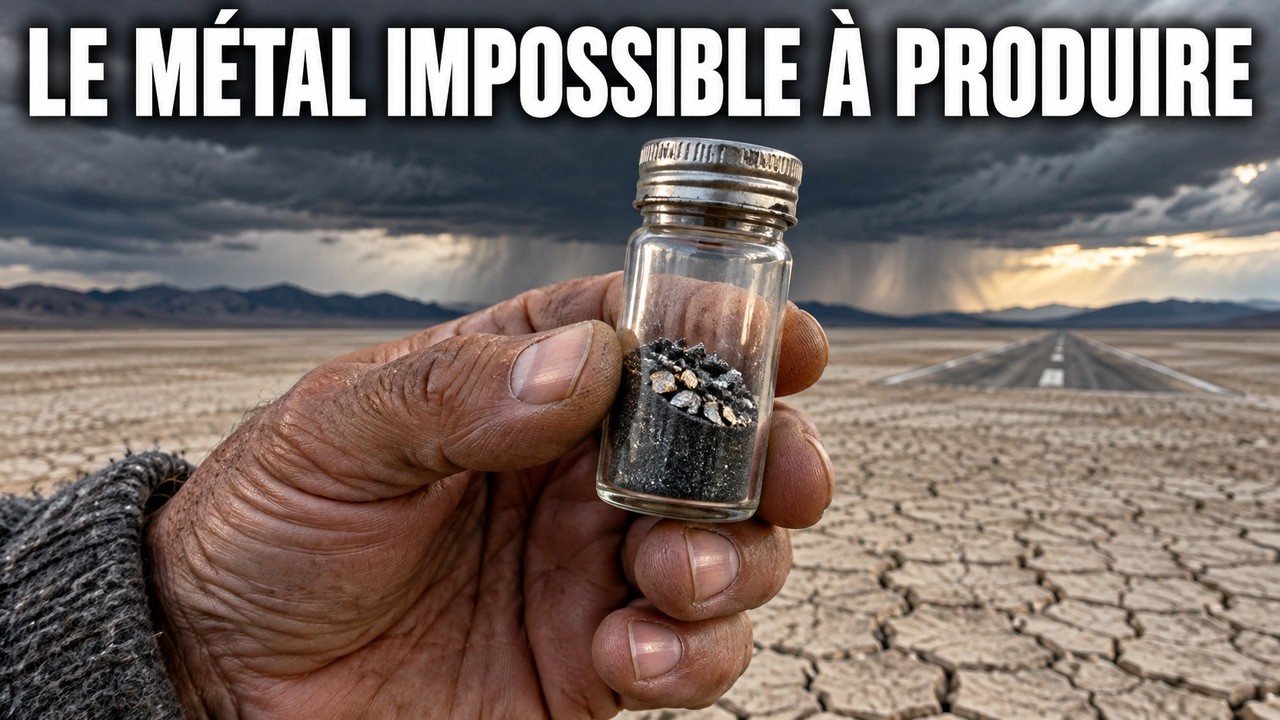
Est-ce le métal le plus difficile à produire du monde ? — L'histoire du titane
Is this the most difficult metal to produce in the world? — The history of titanium
Title history
- Est-ce le métal le plus difficile à produire du monde ? — L'histoire du titane — observed on 20261117-0331 UTC (YouTube)
Keywords
Summary
169 words
Critical Evaluation
Value of the Information & Strength of the Argument
The video provides substantial historical and technical information, weaving together chemistry, engineering, and sociology of technology. It explains why titanium is difficult to produce by focusing on its chemical reactivity, and supports this with concrete examples like the failed attempts with carbon, the success of the Hunter and Kroll processes, and the operational challenges at Lockheed. The argumentation is coherent and well-paced, using a chronological structure that builds a compelling case. It also balances the glorification of aerospace achievements with human and industrial tragedies, giving a nuanced perspective. The concluding claim that titanium is more difficult because it is abundant yet resistant to extraction is well-supported. However, some claims, such as the exact rejection rate and secret Soviet purchases, are presented without direct citation, relying on general knowledge rather than demonstrated evidence.
Scientific Rigor, Source Quality, Title Accuracy
The video references several authoritative institutions (Royal Society of Chemistry, USGS, NASA, CIA, Chemical Safety Board, BRGM) without providing specific URLs or documents. The content appears accurate based on known historical facts, but the lack of direct citations reduces the verifiability. The title’s question is addressed comprehensively, and the content matches the title well. The video’s scientific rigor is generally high, with correct terms (e.g., ductility, carbide formation, melting points) and up-to-date production data. The only minor caveat is that some dramatic details, such as the 95% rejection rate, are stated without source, though they are plausible. Overall, the title accurately reflects the content, and the documentary demonstrates a careful synthesis of available knowledge.
261 words
Title / Content Match
The title poses a question that the video directly addresses through the historical narrative, concluding that titanium is not the most difficult metal in absolute terms but is extremely challenging to produce due to its chemical reactivity.
Quality & Reliability
8/10
The video is a well-structured documentary that cites credible institutions (NASA, USGS, Chemical Safety Board, BRGM) and presents historical facts with technical precision. However, no direct URLs or primary sources are provided in the description, and some claims might be simplified for narrative effect.
Key Moments
Markers derived by PSI from the transcript: the creator did not define chapters.
- Discovery by William Gregor in Cornwall
- Matthew Hunter produces pure titanium in 1910
- William Kroll develops his process
- Lockheed Skunk Works and the A-12 development
- SR-71 sets speed record
- 95% of first titanium shipment rejected
- Current titanium sponge production statistics
- BRGM: 89% of titanium goes to oxide uses
Cited Sources
- Royal Society of Chemistry — Mentioned as a source for chemical facts about titanium
- USGS — Likely source for production statistics
- NASA — Referenced for Apollo program titanium tanks
- CIA — Context of the A-12 project
- Chemical Safety Board — Investigation of the 2010 titanium dust explosion
- BRGM — French geological survey cited for titanium oxide usage data
Contribution & Novelties
The video offers an original synthesis of titanium’s history, emphasizing the chemical reasons behind its production difficulty and tying them to both historical milestones and modern industrial realities. It effectively contrasts the metal’s performance in aerospace with its actual majority use as titanium dioxide, offering a fresh perspective on the element. The narration weaves together technical detail, economic data, and human stories, providing a rich account that goes beyond typical material science explanations.
Pour aller plus loin :
- Kroll process — The standard industrial method for producing titanium, explained in detail.
- Titanium — General properties, history, and applications.
- SR-71 Blackbird — The aircraft that famously used titanium extensively.
- Titanium dioxide — The oxide used in pigments, which constitutes the majority of titanium consumption.
123 words
Radar Profile
The profile shows high scores in information quantity and quality, with a moderate technical level and good reliability. It indicates a content-heavy documentary that balances accessibility with depth, making it suitable for a broad audience interested in material science history.