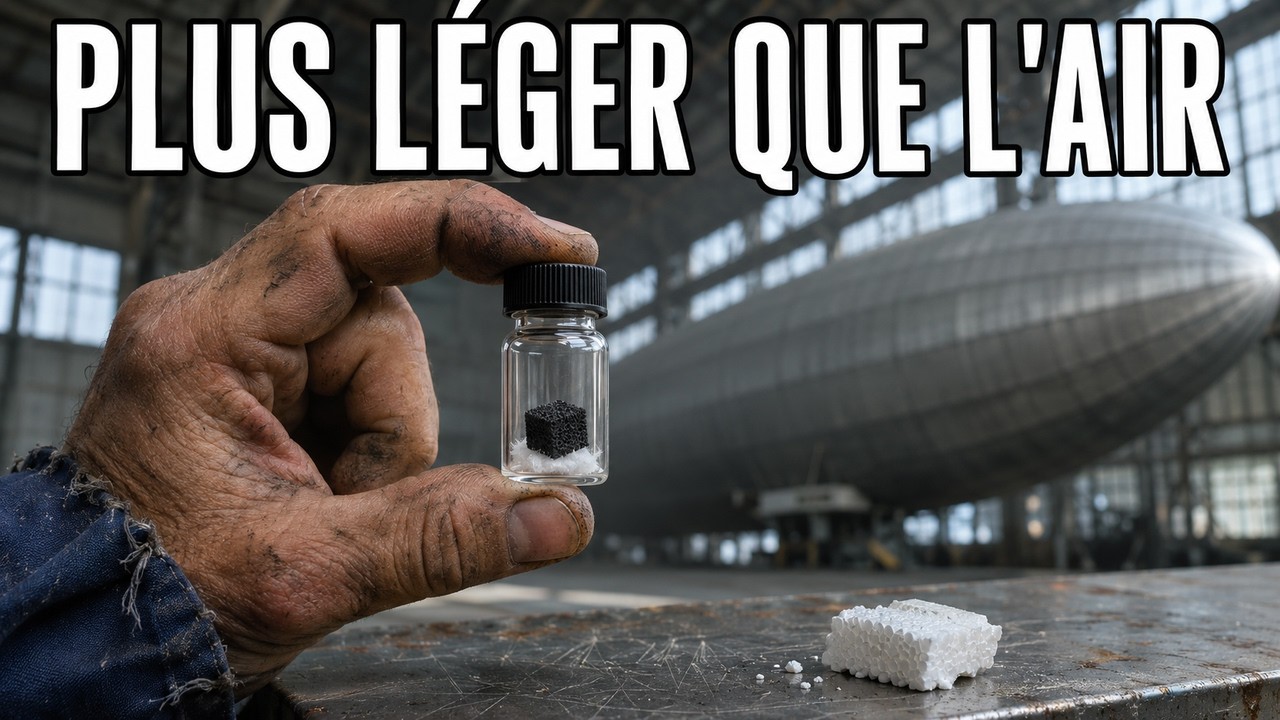
L'Allemagne a découvert quelque chose de plus léger que l'air
Germany has discovered something lighter than air
Title history
- L'Allemagne a découvert quelque chose de plus léger que l'air — observed on 20261117-0331 UTC (YouTube)
Keywords
Summary
233 words
Critical Evaluation
Value of the Information & Strength of the Argument
The video provides substantial value by weaving together historical context, technical details, and applications in a clear narrative. It explains complex physical concepts (e.g., why a solid lighter than air doesn’t float) with accessible analogies, and supports its claims with specific experimental data, such as the material’s ability to support 40,000 times its own weight and recovery from compression up to 95%. The argumentation is solid: the video distinguishes between well-established results (e.g., the synthesis method and mechanical properties) and speculative proposals (e.g., solar sails), and it acknowledges uncertainties in density measurements. The storyline about the record competition is presented objectively, and the final shift to practical applications underscores the material’s real-world relevance beyond merely a record.
Scientific Rigor, Source Quality, Title Accuracy
The video demonstrates high scientific rigor by referencing specific peer-reviewed articles (e.g., Kistler 1931 in Nature, Mecklenburg et al. 2012 in Advanced Materials, Schaeedler et al. 2011 in Science, and a 2020 study by Heller et al.). It also mentions concrete dates, institutions, and researcher names, which enhances credibility. The title is accurate, as the content indeed focuses on a German discovery of a material lighter than air, and it correctly addresses the paradoxical behavior. No commercial or sponsored content is present. The video’s claims are consistent with known scientific literature, and any minor discrepancies (such as the exact density) are explicitly noted, demonstrating transparency.
237 words
Title / Content Match
The title accurately reflects the central subject—a material lighter than air discovered in Germany—and the video thoroughly explains why it doesn't float, as well as its properties and applications.
Quality & Reliability
9/10
The video is a well-researched documentary that traces the history and science of aerographite, citing specific researchers, journal articles, and experimental details. It clearly distinguishes between established facts and hypothetical applications, and presents multiple perspectives without overstatement. The narrative is coherent and technically accurate, with only minor discrepancies in reported density values (0.2 vs 0.18 mg/cm³) acknowledged.
Key Moments
Markers derived by PSI from the transcript: the creator did not define chapters.
- Introduction: presentation of a black block with density 0.2 mg/cm³, lighter than air.
- Historical context: Montgolfier brothers' balloon in 1783 and the principle of lighter-than-air gases.
- Samuel Kistler invents the aerogel in 1931, solving the problem of drying gels without collapse.
- Discovery of aerographite in September 2010 at Hamburg; unexpected transformation under microscope.
- American nickel microlattice record from November 2011 in Science, density 0.9 mg/cm³.
- Aerographite published in Advanced Materials in June 2012; four times lighter than nickel lattice.
- Fabrication process: zinc oxide template, carbon deposition, zinc evaporation resulting in porous carbon tubes.
- Material is 99.99% air; density about 0.18–0.2 mg/cm³; shown to be lighter than air but not floating due to air inside pores.
- Mechanical properties: can be compressed up to 95% and recovers; supports 40,000 times its own weight; becomes stronger after compression.
- 2016 sensor application: aerographite-based detector for CO₂ and H₂ with low power consumption.
- 2020 solar sail proposal by Heller et al. to use aerographite spheres propelled by sunlight to reach Mars in ~60 days.
- Chinese graphene aerogel in February 2013: density 0.16 mg/cm³, breaking aerographite's record.
- Evolution into aeromaterials family at Kiel; applications in batteries, filters, and tissue scaffolds.
- Spin-off company 'Aero Materials' in 2025, focusing on large-scale production for electronics and lightweight construction.
Cited Sources
- Coherent Expanded Aerogels and Jellies (Kistler, 1931) — Samuel Kistler's foundational work on aerogels published in Nature, mentioned at 02:43.
- Ultralight Metallic Microlattices (Schaeedler et al., 2011) — American nickel microlattice record described at 05:04, published in Science.
- Aerographite: Ultra Lightweight, Flexible Nanowall, Carbon Microtube Material (Mecklenburg et al., 2012) — The paper presenting aerographite in Advanced Materials, mentioned at 05:35.
- Ultralight Graphene Aerogel (Gao Chao et al., 2013) — Chinese graphene aerogel with density 0.16 mg/cm³, published in Nature (per the video), discussed at 15:11.
- Solar sail concept using aerographite (Heller et al., 2020) — Astronomers' proposal for solar sails made of aerographite, described at 12:38.
Contribution & Novelties
The video provides an original synthesis of aerographite’s history and applications, emphasizing that its significance lies beyond the record of being the lightest solid. It explains the material’s true novelty: a highly ordered, mechanically robust, electrically conductive network of carbon tubes that can be tailored via a template-based synthesis. The documentary shows how initial sensational reporting was followed by a decade of practical development, including gas sensors, tissue scaffolds, and a spin-off company. It also corrects the naive question of why a material lighter than air doesn’t float by clarifying that internal air contributes to total weight.
Pour aller plus loin :
- Aerographite - Wikipedia — General overview and properties.
- Aerogel - Wikipedia — Historical and technical background of the class of materials.
- Solar sail - Wikipedia — Concept behind the proposed interplanetary sail.
- Graphene aerogel - ScienceDirect — Details on the 2013 Chinese aerogel.
145 words
Radar Profile
The radar shows very high scores in information quantity, quality, and reliability, with a slightly lower technical level (8/10) indicating that the content is accessible yet scientifically rich. The balance between technical depth and clarity is optimal for a general audience interested in materials science.