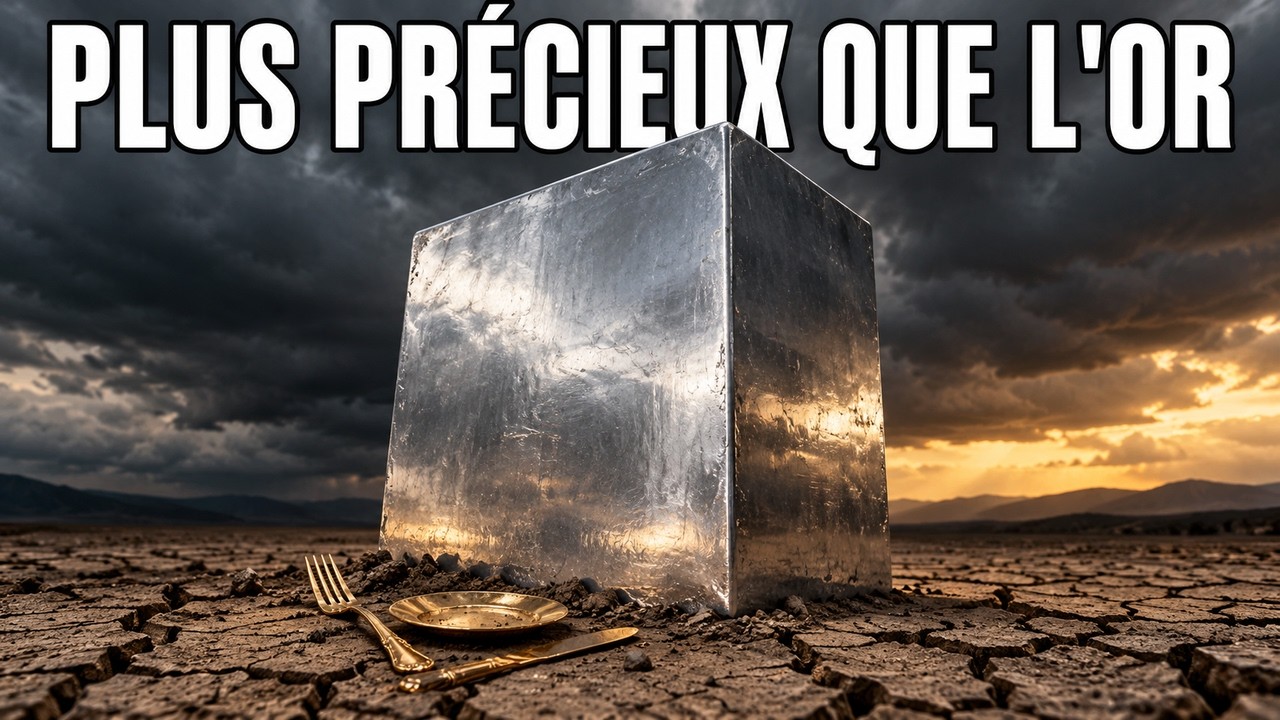
Est-ce le métal le plus abondant du monde ? — L'histoire de l'aluminium
Is it the most abundant metal in the world? — The history of aluminum
Title history
- Est-ce le métal le plus abondant du monde ? — L'histoire de l'aluminium — observed on 20261117-0331 UTC (YouTube)
Keywords
Summary
206 words
Critical Evaluation
Value of the Information & Strength of the Argument
The video offers significant value by weaving together scientific discovery, industrial history, and social impact in an engaging narrative. The argumentation is clear and well-structured, using specific examples and data to support claims about aluminium’s properties, production methods, and economic implications. The use of tangible artifacts like the Washington Monument pyramid and the Wright engine adds concreteness, making the scientific concepts accessible. The video effectively communicates the paradox of aluminium’s abundance and its historical scarcity, and it provides a balanced view of the metal’s benefits and environmental costs. The persuasive power lies in the storytelling, which connects chemistry to human endeavor.
Scientific Rigor, Source Quality, Title Accuracy
The video demonstrates scientific rigor by accurately presenting historical facts and chemical processes, such as the Hall-Héroult and Bayer processes. It mentions specific researchers, dates, and technical details, indicating a solid foundation. However, it does not provide explicit citations or references, which limits its verifiability. The title appropriately reflects the content, as the video directly answers the question about aluminium’s abundance. The description also clarifies the scope. While the video is informative, the lack of a reference list could be a minor weakness for viewers seeking to verify claims. Overall, the scientific content is reliable, but the sourcing could be more transparent.
218 words
Title / Content Match
The title poses a question that is clearly answered in the video, with a nuanced discussion on abundance in the Earth's crust versus rarity due to extraction difficulty.
Quality & Reliability
7/10
The video provides a well-researched historical narrative with accurate scientific facts, but lacks explicit citations and makes some simplifications for narrative flow.
Key Moments
Markers derived by PSI from the transcript: the creator did not define chapters.
- Introduction: Washington Monument aluminium pyramid in 1884, highlighting the metal's rarity.
- Early discovery attempts: Humphry Davy, Ørsted, and Wöhler and the difficulty of isolating aluminium.
- Henri Sainte-Claire Deville's method and Napoleon III's support; 1855 Paris Exposition showcases aluminium as precious.
- Charles Martin Hall and Paul Héroult independently discover the electrolytic process in 1886.
- Industrialization: Early plants, the Wright brothers' aluminium engine, and growing applications.
- Energy demands and environmental impact: electricity consumption, Gardanne accident, and red mud disposal.
- Modern production: China's dominance, recycling potential, and the story of the Washington Monument pyramid.
Cited Sources
- Deville, H. S.-C. (Primer on aluminium production and properties) — Mentioned as the first comprehensive book on aluminium, read by Hall and Héroult.
- Gayle, F. & Goodway, M. (Study of the Wright engine alloy) — Microscopic examination revealed natural age-hardening, predating Wilm's discovery.
- van der Reijk, C. (Researcher on bauxite processing) — Explains that 4 kg of bauxite are needed to produce 1 kg of aluminium.
Contribution & Novelties
This video provides an original perspective by intertwining the scientific and industrial history of aluminium with a compelling narrative centered on the Washington Monument pyramid. It effectively explains the metal’s paradoxical status—abundant yet historically rare—and highlights the environmental and energy trade-offs. The inclusion of lesser-known details, such as the Wright brothers’ engine alloy and the Gardanne accident, enriches the story.
Pour aller plus loin :
- Hall–Héroult process — Essential electrolytic method that made aluminium production viable.
- Bayer process — Key industrial process for extracting alumina from bauxite.
- Aluminium — Overview of the metal’s properties and history.
- Bauxite — The primary ore of aluminium and its formation.
106 words
Radar Profile
The radar profile indicates a strong performance in quantity of information and overall reliability, with slightly lower but still decent scores in information quality and technical depth. This suggests a well-rounded documentary that is informative and credible, though it could benefit from more explicit citations and deeper technical detail to enhance its scholarly value.