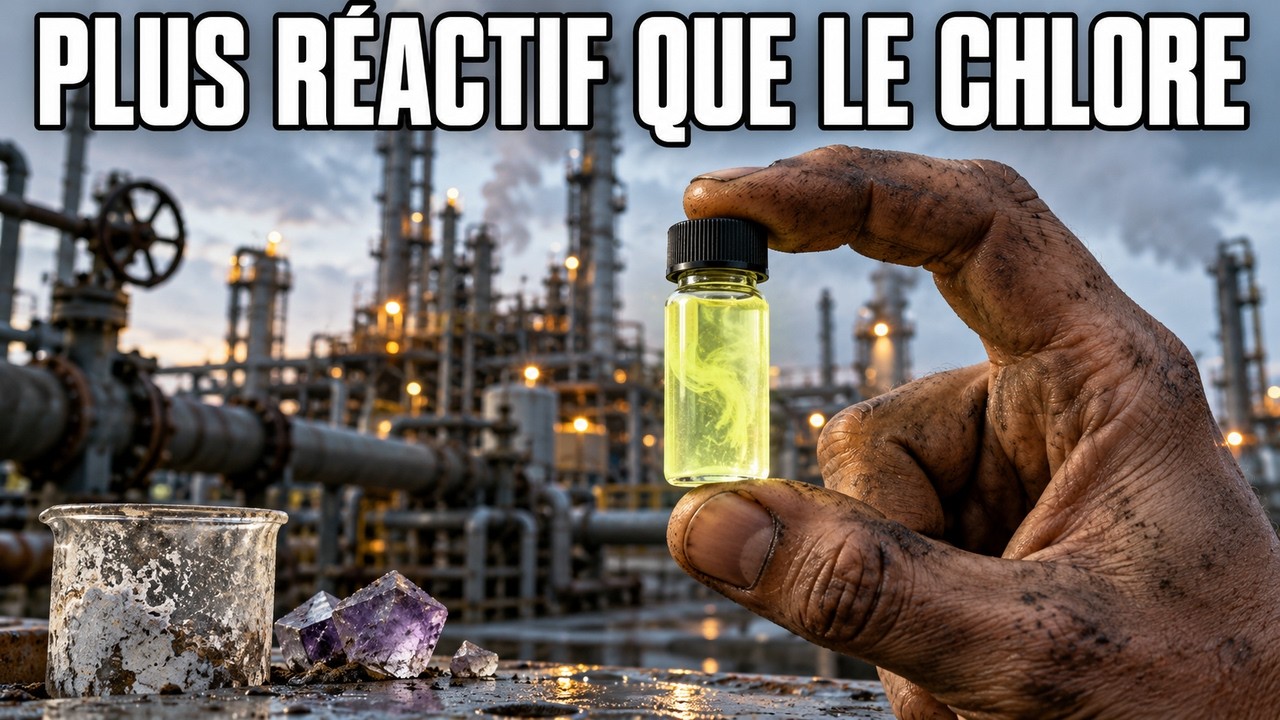
Est-ce l'élément le plus agressif du monde ? — L'histoire du fluor
Is this the most aggressive element in the world? — The story of fluorine
Title history
- Est-ce l'élément le plus agressif du monde ? — L'histoire du fluor — observed on 20261117-0331 UTC (YouTube)
Keywords
Summary
235 words
Critical Evaluation
Value of the Information & Strength of the Argument
The video provides substantial value by weaving a compelling historical narrative with clear explanations of fluorine’s chemical behavior. It uses vivid analogies (the ‘diner grabbing the salt shaker’) to illustrate electronegativity, and it effectively connects the historical difficulties to modern applications. The argumentation is solid: it builds a logical chain from the chemical properties to the failures of early attempts, Moissan’s breakthrough, and the subsequent industrial uses. The inclusion of human costs and industrial accidents adds depth and prevents romanticizing the subject. The reasoning is coherent and supports the claim that fluorine is ’the most aggressive element’ by demonstrating its reactivity and resilience.
Scientific Rigor, Source Quality, Title Accuracy
The scientific rigor is high for a popular documentary: it explicitly references institutions like INRS for safety limits and mentions specific dates, names, and quantities. The sources cited are historical (letters, experiments) and contemporary (INRS, industrial statistics), though no direct external links are given in the description. The title is appropriate: it poses a question that the content directly answers, and the story of fluorine is thoroughly told. The video’s claims align with established chemistry history, and the narrative does not overstate or distort facts. The only minor caveat is the lack of verifiable links in the description, but the content itself is internally consistent and relies on well-known historical events.
229 words
Title / Content Match
The title asks about the most aggressive element and promises the story of fluorine; the video indeed recounts the discovery, properties, and applications of fluorine, giving a strong answer to the question.
Quality & Reliability
8/10
The video presents a well-documented historical account with precise dates, names, and chemical details, and mentions institutional sources like INRS for safety limits. The narrative is internally consistent and aligns with known chemistry history, though some specific claims (e.g., exact dates) are not independently verified here.
Key Moments
Markers derived by PSI from the transcript: the creator did not define chapters.
- Ampère's letter to Davy proposing electrolysis of anhydrous acid and suggesting the name 'fluorine'.
- Moissan's demonstration before Academy witnesses fails because his acid was too pure; the next day it succeeds.
- Roy Plunkett discovers a white powder in a sealed bottle of tetrafluoroethylene, leading to Teflon.
- Neil Bartlett reacts xenon with a platinum-fluorine compound, producing the first noble gas compound.
- Description of the 1986 Sequoyah Fuels accident where a uranium hexafluoride cylinder ruptured, releasing HF.
- The Tricastin plant in France producing fluorine on-site for uranium conversion, using Moissan's principle.
Cited Sources
- Carl Wilhelm Scheele's preparation of hydrofluoric acid (1771) — Mentioned as the starting point of the story, highlighting the acid's ability to etch glass.
- Ampère's letter to Humphry Davy (1810) — Ampère suggests isolating fluorine via electrolysis and proposes the name 'fluorine'.
- Henri Moissan's isolation of fluorine (1886) — The breakthrough experiment using a platinum U-tube with low temperature and added salt.
- Institut national de recherche et de sécurité (INRS) — fluorine exposure limits — Cited for the indicative limit of 1 part per million in air over an 8-hour workday.
- Roy Plunkett's discovery of Teflon (1938) — Accidental polymerization of tetrafluoroethylene into polytetrafluoroethylene.
- Neil Bartlett's noble gas compound (1962) — Synthesis of xenon hexafluoroplatinate, disproving the inertness of noble gases.
Contribution & Novelties
The video offers an engaging and well-structured narrative that humanizes the scientific pursuit of fluorine, highlighting the dangers and sacrifices. It integrates chemistry, history, and industry, showing how a dangerous element became indispensable. The novel angle is the emphasis on the ’non-domestication’ of fluorine: chemists don’t control it but rather exploit its reactivity to create stable compounds. This perspective ties together Teflon, CFCs, UFO6, and modern medicine.
Pour aller plus loin :
- Fluorine — Comprehensive overview of the element, its properties, and history.
- Henri Moissan — Biography of the chemist who first isolated fluorine.
- Polytetrafluoroethylene (Teflon) — Detailed article on the polymer discovered by Plunkett.
- Noble gas compound — Explains Bartlett’s breakthrough and the chemistry of noble gas compounds.
- Manhattan Project — Context for the uranium hexafluoride production at Oak Ridge.
131 words
Radar Profile
The scores show a strong profile in quantity and quality of information (both 8/10), with moderate technical level (6/10) and reliable sourcing (7/10). This suggests a well-researched documentary that is accessible to a broad audience while still maintaining scientific credibility. The lower technical score indicates that advanced chemistry is explained in a simplified manner, which is appropriate for the intended audience.