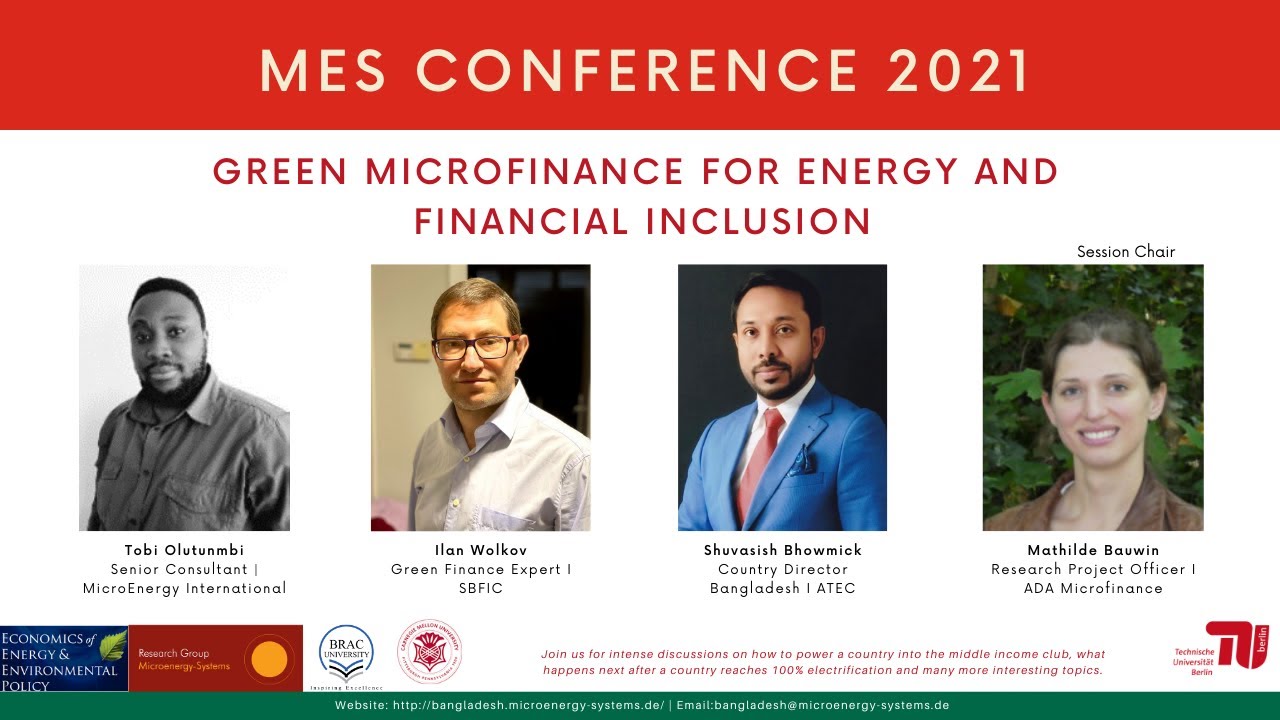
Green Microfinance for Energy and Financial Inclusion | 2021 MES Conference
Keywords
Summary
168 words
Critical Evaluation
Value of the Information & Strength of the Argument
The value of this session lies in the practical, on-the-ground perspectives from three distinct types of organizations: a technology provider (ATEC), a consultancy (MicroEnergy International), and a financial institution (SBFIC). Each presents real-world projects, offering concrete examples of how green microfinance can be implemented. The argumentation is based on experiential evidence rather than formal research, which gives it credibility in terms of practical applicability but limits its generalizability. The panelists do not shy away from discussing challenges, such as the difficulty of persuading internal staff and the need for effective partnerships. The overall argument is coherent and supported by specific project details, though it lacks quantitative impact data that would strengthen the claims.
Scientific Rigor, Source Quality, Title Accuracy
The title accurately describes the content, which is a focused panel discussion on green microfinance and energy. The sources cited within the video are primarily the panelists’ own projects and experiences, with no external academic references. The description provides a link to the MicroEnergy Research Group website, which is the host of the conference. The discussion is rigorous in its practical orientation, but from a scientific standpoint, it is more anecdotal than evidence-based. The title aligns perfectly with the topics covered, and the session is well-structured, with clear presentations followed by a Q&A segment.
222 words
Title / Content Match
The title accurately reflects the content: a session on green microfinance for energy and financial inclusion, with presentations from different stakeholders.
Quality & Reliability
8/10
Panel discussion with experienced practitioners, providing concrete case studies and practical insights, but lacking rigorous empirical data.
Key Moments
Markers derived by PSI from the transcript: the creator did not define chapters.
- Introduction by Mathilde Bauwin, presenting the ecosystem of actors for green energy access through inclusive finance.
- Shuvashis Bhowmick (ATEC) presents biogas solutions in Bangladesh and Cambodia, discussing affordability and pay-as-you-go systems.
- Tobi Olutunmbi (MicroEnergy International) discusses climate finance projects in Grenada, focusing on mitigation and adaptation for MSMEs.
- Ilan Wolkov (SBFIC) presents a Myanmar project on green finance for SMEs, including training and partnerships with banks.
- Q&A: Audience question on whether biogas installations can be shared by multiple families, answered by ATEC.
- Panel discussion on challenges in building partnerships between technology providers and financial institutions.
Cited Sources
- MicroEnergy Research Group — Official website of the organizing research group, providing further information on MES activities and resources.
External References
Contribution & Novelties
This panel session provides a multi-stakeholder perspective on green microfinance, highlighting the complementarity and challenges of technology providers, consultancies, and financial institutions. The original contribution is the synthesis of real-world project experiences across different geographical contexts, revealing common barriers like staff buy-in and partnership design. The discussion moves beyond theoretical concepts to practical insights, which is valuable for practitioners in the field.
Pour aller plus loin :
- Microfinance — Foundational concept for understanding the financial inclusion mechanisms discussed.
- Pay-as-you-go — A business model for energy access that is central to ATEC’s operations.
- Biogas — The renewable energy technology promoted by ATEC, with broader implications for sustainable agriculture.
- Financial inclusion — Key social and economic goal that this session aims to advance.
- Green finance — The overarching theme of the session, linking environmental benefits with financial services.
136 words
Radar Profile
The radar profile shows balanced scores with moderate ratings across all dimensions. The strongest aspect is the credibility of the speakers (fiabilite_globale=7), while information density and technical depth are slightly lower (quantite_information=6, niveau_technique=6). This suggests a pragmatic and insightful discussion that is accessible to a broader audience but not exhaustive in rigorous data or advanced technical analysis.