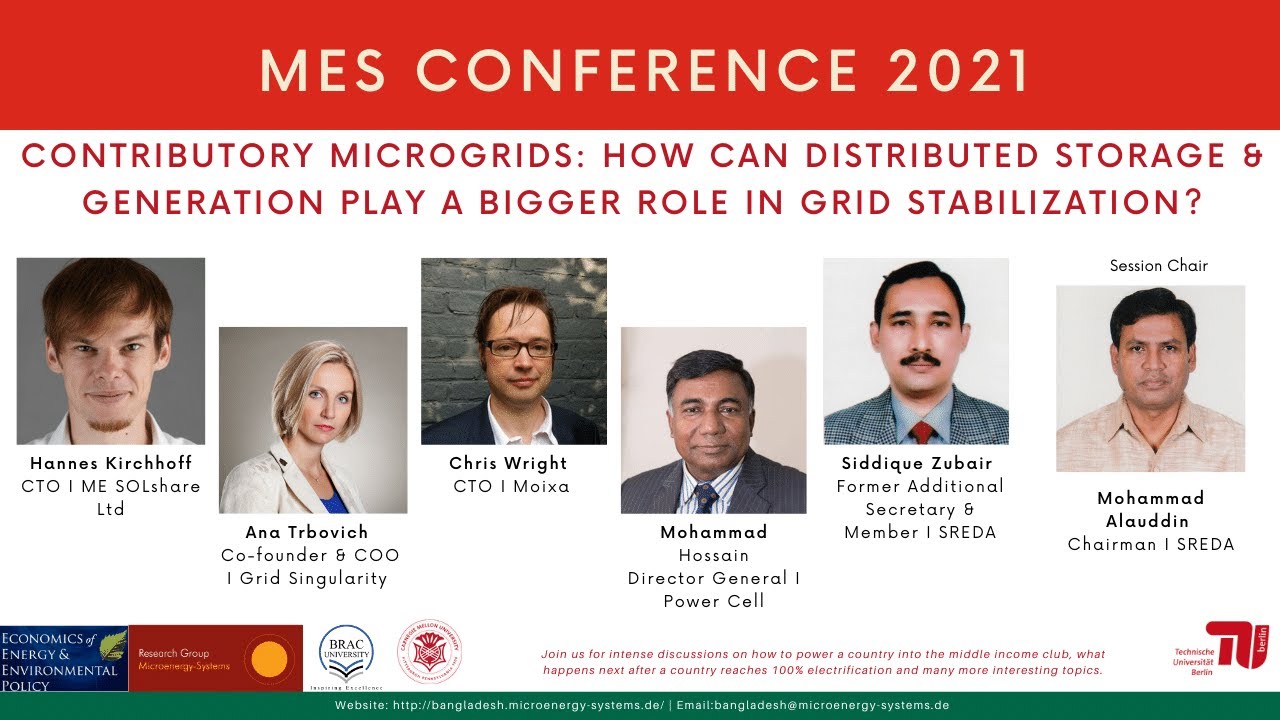
Contributory Microgrids | 2021 MES Conference
Keywords
Summary
198 words
Critical Evaluation
Value of the Information & Strength of the Argument
The value of the information lies in the practical perspectives shared by experts directly involved in energy projects and policy. Arguments for distributed storage and generation are grounded in concrete challenges: high system losses, voltage drops, and the underutilization of generation capacity. The panelists propose actionable solutions such as pooling solar home systems, implementing peer-to-peer trading with digital twins, and using regulatory sandboxes to test new models. The reasoning is coherent and consistent, though it relies more on anecdotal evidence and case studies than on quantitative analysis. The discussion is persuasive in highlighting the untapped potential of existing distributed assets and the need for adaptive policies.
Scientific Rigor, Source Quality, Title Accuracy
The sources are primarily the speakers’ professional experiences and ongoing projects, with no formal citations to academic papers or data sets. The title is well-aligned with the content, as the panel explicitly discusses how contributory microgrids (distributed storage and generation) can stabilize the grid. The session does not include a critical review of conflicting evidence, but the diversity of panelists (policy makers, industry, academia) adds credibility. The description provides a link to the MicroEnergy Research Group website, which is a legitimate academic source. Overall, the rigor is acceptable for an expert-opinion panel, though it lacks structured data and formal citations.
221 words
Title / Content Match
The title accurately reflects the panel topic, which focuses on how distributed storage and generation (contributory microgrids) can enhance national grid stabilization.
Quality & Reliability
7/10
Panel features senior energy policy makers, industry CTOs, and academics, providing credible insights grounded in real-world projects. However, the discussion relies on qualitative assessments and experiences rather than quantitative data or peer-reviewed studies.
Key Moments
Markers derived by PSI from the transcript: the creator did not define chapters.
- Mohammad Hossain outlines Bangladesh's grid capacity and peak demand mismatch.
- Siddique Zubair discusses system losses (11.23%) and proposes distributed storage at feeder/substation levels.
- Ana Trbovich introduces peer-to-peer energy trading and a digital twin experiment with European grid operators.
- Hannes Kirchhoff explains SOLshare's work on pooling solar home systems into points of common coupling under a regulatory sandbox.
- Discussion on the need for market mechanisms and flexible grid fees to encourage distributed storage adoption.
- Concluding remarks and call for policy collaboration between Bangladesh and international partners.
Cited Sources
- MicroEnergy Systems Research Group — Official website of the research group that organized the conference, providing additional context on their work.
External References
Contribution & Novelties
This video offers a unique cross-disciplinary perspective on integrating distributed energy resources in Bangladesh, combining technical, economic, and policy viewpoints. It presents the emerging concept of ‘contributory microgrids’ as an evolution of standalone systems, and highlights concrete experiments such as SOLshare’s regulatory sandbox and Grid Singularity’s digital twin trials. The discussion provides original insights into the challenges of scaling decentralized generation in a developing country context.
Pour aller plus loin :
- Peer-to-peer energy trading — Relevant to the proposed market-based approach for distributed resources.
- Digital twin — Used by Ana Trbovich to model the grid and enable flexibility trading.
- Virtual power plant — Concept closely related to aggregating distributed generation and storage for grid services.
115 words
Radar Profile
The profile shows moderate scores across all dimensions, with quantity of information slightly higher, reflecting a substantive but not deeply technical or data-heavy discussion. The balance suggests a valuable expert overview, though it could benefit from more rigorous evidence and higher technical depth.