22 SETIEMBRE
22 SEPTEMBER
Keywords
Summary
192 words
Critical Evaluation
Value of the Information & Strength of the Argument
The value of the information lies in its practical, practitioner-oriented guidance on navigating ethics in pediatric research. The argumentation is well-structured, building from general principles to concrete examples (e.g., the Shakira confidentiality case) and addressing common misconceptions such as the belief that retrospective studies carry no risk. The speaker effectively argues that ethical review is integral to research validity and that exclusion of vulnerable groups is unjust, citing both ethical principles and institutional requirements. However, the presentation is more expository than critically argued; it does not engage with opposing viewpoints or complex ethical dilemmas in depth. The strength of the argumentation is in its clarity and alignment with established guidelines, but it lacks novel insights or critical analysis beyond standard teaching.
Scientific Rigor, Source Quality, Title Accuracy
The scientific rigor is moderate-to-high: the content is consistent with authoritative international guidelines, and the speaker demonstrates familiarity with regulatory frameworks (e.g., Helsinki Declaration, INS regulations). However, no direct citations or references are provided within the talk, and the title ‘22 SETIEMBRE’ bears no relation to the subject, appearing to be a placeholder for a date. The quality of sources is not directly verifiable from the video, but the alignment with established ethical doctrine supports reliability. The adequacy between title and content is poor, potentially misleading viewers about the video’s topic. No external links or references are provided in the description, limiting traceability.
239 words
Title / Content Match
The title '22 SEPTEMBER' is a date placeholder and does not reflect the actual content, which addresses ethical governance in pediatric research.
Quality & Reliability
7/10
The speaker is affiliated with a national health institute and the content is consistent with internationally recognized ethical guidelines (Belmont Report, Helsinki Declaration). However, the presentation lacks specific citations or references to recent literature, and the video appears to be an internal training session.
Key Moments
Markers derived by PSI from the transcript: the creator did not define chapters.
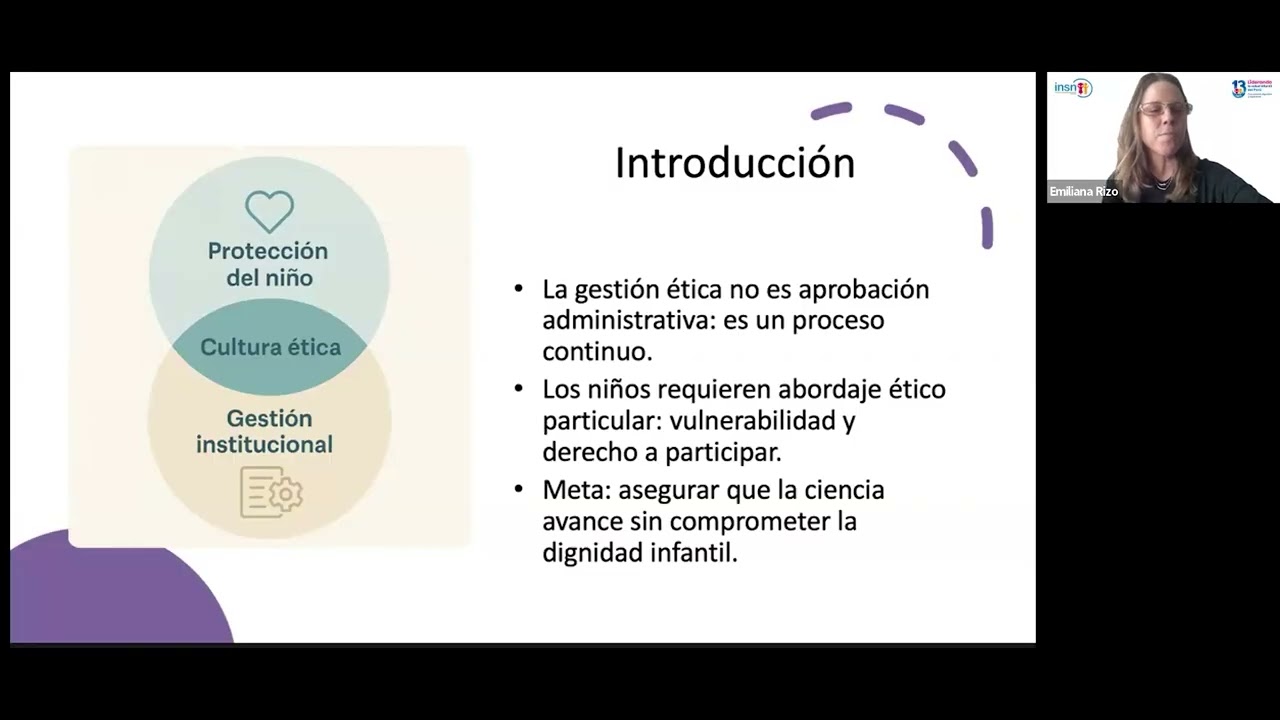
- Introduction: ethics as a means to conduct research, not an administrative step.
- Discussion of children's double vulnerability and the need for inclusion.
- Review of ethical principles: respect, beneficence, non-maleficence, justice.
- Informed consent and assent, including requirements for children over 6.
- Risk-benefit assessment, including examples of minimal risk and confidentiality.
- Composition of ethics committees and role of community members.
- Q&A: clarifying what constitutes research involving human participants.
Cited Sources
- The Belmont Report — Mentioned as the origin of core ethical principles (1979).
- WMA Declaration of Helsinki — Referred to as an updated international guideline (latest version 2024).
- INSNSB Regulation on Research Ethics (document 2020) — Mentioned as institutional requirement for training in research ethics.
Contribution & Novelties
The video provides a concise, practical overview of pediatric research ethics tailored to a Peruvian context, emphasizing the principle that overprotection can lead to exclusion of vulnerable children. Its original contribution lies in highlighting the double vulnerability of children and the ethical duty to ensure their participation while managing risks. It also underscores the role of community members in ethics committees as a safeguard for participant perspectives.
Pour aller plus loin :
- The Belmont Report — Core ethical principles for research with human subjects, directly relevant to the content.
- Declaration of Helsinki — The most widely cited ethical guideline for medical research, updated in 2024.
- UN Convention on the Rights of the Child — Provides the legal framework for protecting children’s rights, including in research contexts.
126 words
Radar Profile
The profile shows balanced scores across all dimensions, with a slight emphasis on quality of information and fiabilité, while quantity and technical level are moderately high. This indicates a well-structured but not overly technical presentation that values ethical accuracy and practical applicability.