6 OCTUBRE
6 OCTOBER
Keywords
Summary
183 words
Critical Evaluation
Value of the Information & Strength of the Argument
The presentation provides a comprehensive and practical overview of publication ethics, using real-world cases (Surgisphere, Vioxx) to illustrate the consequences of misconduct. The argumentation is clear and logical, building from specific incidents to general principles. The speaker effectively explains the dual nature of authorship—credit and accountability—and emphasizes that hiding conflicts is a serious violation. The use of the ICMJE criteria and CRediT taxonomy offers concrete frameworks that researchers can apply. The reference to a Cochrane review adds empirical weight to the discussion about industry bias. The talk is persuasive, advocating for transparency and responsibility, and it addresses common dilemmas such as authorship disputes and acknowledgments. The logical flow from authorship to contributions to conflicts of interest creates a coherent narrative that strengthens the overall message.
Scientific Rigor, Source Quality, Title Accuracy
The speaker demonstrates familiarity with authoritative sources: the ICMJE recommendations, COPE flowcharts, and the CRediT taxonomy are credible and widely recognized. The Surgisphere and Vioxx cases are well-documented in the scientific literature, though no specific URLs are provided. The Cochrane review is mentioned with statistical details (odds ratios), but the exact reference is not given. The presentation is generally rigorous, but the lack of explicit citations for some claims reduces its scientific robustness. The title ‘6 October’ is unrelated to the content, which is a clear inadequacy. However, the content itself is accurate and aligns with current ethical standards in scientific publishing.
242 words
Title / Content Match
The title '6 October' appears to be a date or internal code and does not reflect the substantive content on scientific publication ethics.
Quality & Reliability
7/10
The talk is well-structured, based on recognized international guidelines (ICMJE, COPE) and documented cases (Surgisphere, Vioxx). However, specific statistics (e.g., Cochrane review) are mentioned without precise citations, and some claims lack direct references. The speaker is an experienced professional from a national health institute.
Key Moments
Markers derived by PSI from the transcript: the creator did not define chapters.
- Introduction: speaker Miguel Bejar presents himself and the topic of authorship, scientific contributions, conflicts of interest, and responsibility.
- Case study: Surgisphere and the Lancet hydroxychloroquine paper, including its retraction and the role of data integrity.
- ICMJE criteria for authorship: four essential conditions for being an author, including substantial contribution, drafting, approval, and accountability.
- Types of authorship distortion: honorary, guest, ghost, and coercive authorship, with examples and explanations.
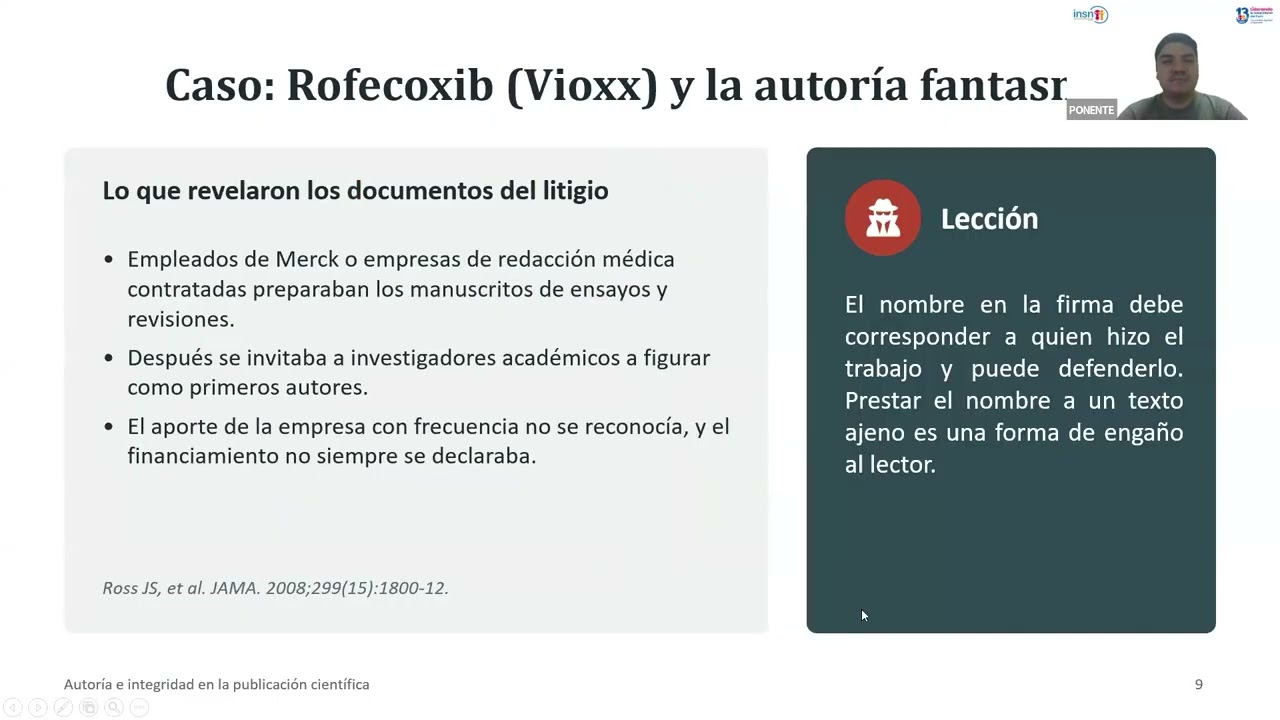
- Vioxx case: ghostwriting by Merck and the ethical issues of undisclosed sponsorship and authorship manipulation.
- Author ordering: first author, intermediate authors, last author, and the role of the corresponding author in communication and accountability.
- CRediT taxonomy: 14 standardized roles for declaring contributions, with an example of a contribution statement.
- Conflicts of interest: definitions, types (financial, non-financial), and evidence from a Cochrane review on industry sponsorship impact.
Cited Sources
- The Lancet article on hydroxychloroquine (Surgisphere case) — Mentioned as a case of data inconsistency and eventual retraction.
- Cochrane review on industry sponsorship and results — Cited with specific odds ratios (1.27 for favorable efficacy, 1.34 for favorable conclusions, 0.83 for concordance).
- Ross et al. 2008 JAMA article on Vioxx ghostwriting — Described as a documented case of guest and ghost authorship involving Merck.
- ICMJE Recommendations — Referenced for authorship criteria and uniform requirements.
- COPE (Committee on Publication Ethics) — Mentioned for flowcharts on authorship changes and ethical guidance.
- CRediT Taxonomy — Introduced as a standardized 14-role system for declaring author contributions.
Concurring Sources
- ICMJE Recommendations — Aligns with the authorship criteria and responsibility requirements discussed.
- COPE — Provides the ethical frameworks for authorship changes and conflict resolution.
- CRediT Taxonomy — Matches the contribution declaration model described in the talk.
Contribution & Novelties
The talk offers a practical, case-based introduction to publication ethics, emphasizing the interdependence of authorship credit and accountability. It uniquely integrates real-world scandals with established guidelines, making it useful for early-career researchers. The presentation clarifies the CRediT taxonomy and conflict-of-interest management, which are often underexplained. It also provides actionable advice on avoiding authorship disputes, such as defining roles at the protocol stage. The inclusion of a Cochrane meta-analysis quantifies the bias risk from industry sponsorship, adding tangible evidence.
Pour aller plus loin :
- ICMJE Recommendations — The core framework for authorship and publication ethics.
- COPE Flowcharts — Decision trees for handling authorship changes and ethical breaches.
- CRediT Taxonomy — Standardized roles for author contributions.
- Office of Research Integrity (ORI) — Institutional resource on research misconduct and responsible conduct.
- Read the Barcelona Principles — A modern approach to scientific communication and integrity.
141 words
Radar Profile
The radar profile shows balanced scores across information quantity, quality, and reliability, with a slightly lower technical level, indicating an accessible yet rigorous presentation. The high reliability reflects alignment with authoritative guidelines, while the moderate technical level suggests the talk is aimed at a broad scientific audience rather than specialists.