1 setiembre
1 September
Keywords
Summary
145 words
Critical Evaluation
Value of the Information & Strength of the Argument
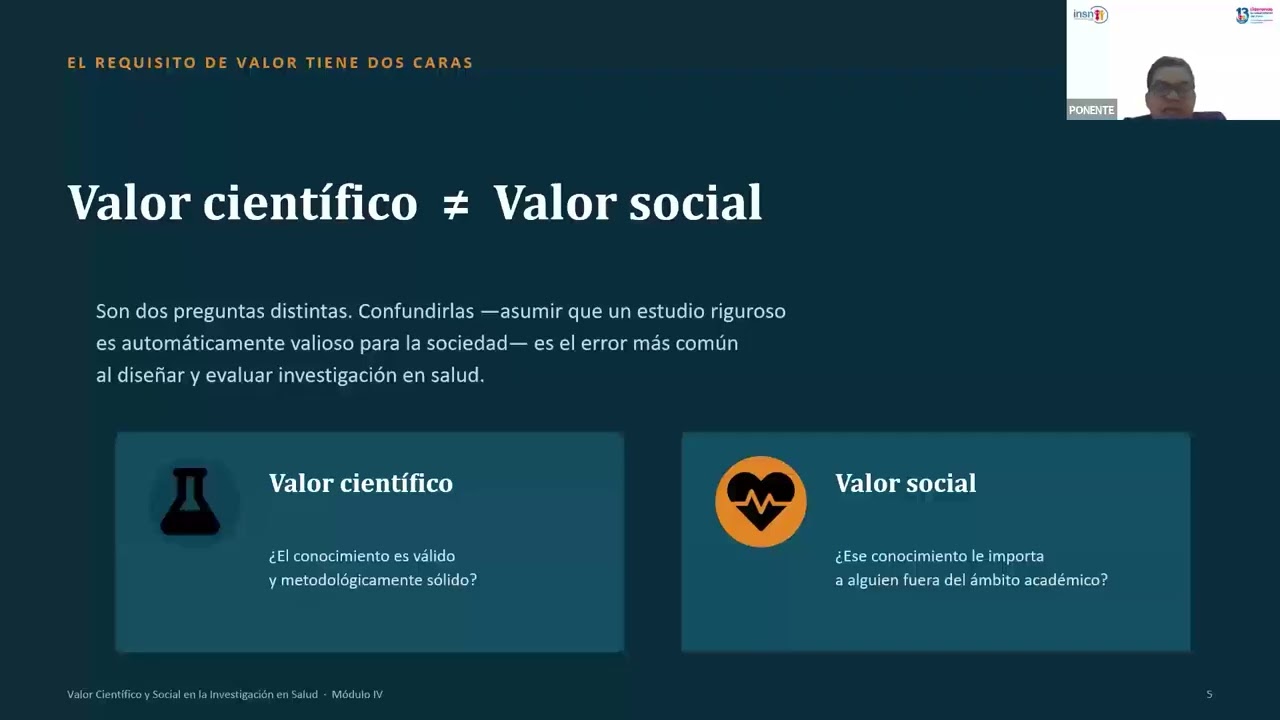
The presentation delivers substantial value by systematically distinguishing scientific and social value, a frequent point of confusion in health research. The argumentation is logical and well-supported with concrete examples (e.g., dengue in Asia, burnout syndrome studies) and reference to authoritative guidelines. The speaker provides a clear framework with four possible value combinations (high/high, high/low, low/high, low/low) and practical self-assessment questions. The reasoning is coherent, though it relies mainly on expert exposition rather than empirical evidence or critical analysis of contradictory literature.
Scientific Rigor, Source Quality, Title Accuracy
The rigor is high with respect to citing foundational documents (Declaration of Helsinki, CIOMS, Belmont Report) and acknowledging the 2000 JAMA article on ethical requirements. The speaker accurately explains these frameworks and uses them to structure the discussion. However, no direct URLs or detailed citations are provided in the video, making verification difficult. The title is non-descriptive and seems unrelated to the content, which may reduce clarity for potential viewers. Despite this, the content itself is scientifically sound and well-presented.
176 words
Title / Content Match
The title '1 setiembre' (September 1st) does not reflect the content; it appears to be a date rather than a descriptive title.
Quality & Reliability
8/10
The talk is well-structured, citing recognized international ethical guidelines (Declaration of Helsinki, CIOMS, Belmont Report) and providing clear definitions and examples. However, it is a single expert presentation without peer review or external verification of the claims.
Key Moments
Markers derived by PSI from the transcript: the creator did not define chapters.
- Introduction and welcoming of Dr. Silva Fiestas
- Definition of the ethical problem: value justifies research risks
- Presentation of the seven ethical requirements from JAMA (2000)
- Distinction between scientific value and social value
- Components of scientific value: research question, design, honest communication
- Definition and conditions for social value
- Review of international and national ethical frameworks
- Practical questions to assess social value in research protocols
- Conclusion and summary of key takeaways
Cited Sources
- Declaration of Helsinki — Cited as a foundational ethical guideline, specifically article 21 on justification of research risks.
- CIOMS (Council for International Organizations of Medical Sciences) — Referenced for definitions of scientific and social value in health research.
- Belmont Report (1979) — Cited for ethical principles of respect, beneficence, and justice.
- Emanuel et al. (2000) JAMA — Mentioned as source of the seven ethical requirements for clinical research.
Concurring Sources
- Declaration of Helsinki — Supports the principle that research should have social value and be justified.
- CIOMS guidelines — Aligns with definitions of scientific and social value presented.
Contribution & Novelties
The contribution of this video is a clear, practical distinction between scientific and social value in health research, emphasizing that both are necessary for ethical justification. It offers a checklist of questions to help researchers evaluate social value, which is often overlooked. The talk integrates multiple ethical frameworks into a coherent narrative for a professional audience.
Pour aller plus loin :
- Research ethics — Overview of ethical principles in research.
- Declaration of Helsinki — Key international guideline for medical research.
- Clinical trials — Context on how scientific and social value apply in trial design.
- CIOMS — International guidelines for health research involving human subjects.
104 words
Radar Profile
The scores are balanced, with slightly lower technical level (7) reflecting the accessible presentation style, while information quantity and quality are high (8), indicating a comprehensive overview of ethical values in research. Reliability is also high (8), but the lack of verifiable links and reliance on a single expert may slightly reduce it.