SEMANA DE LA CIENCIA 2026. 17. Taller: La importancia del humor en la salud mental. Risoterapia.
SCIENCE WEEK 2026. 17. Workshop: The Importance of Humor in Mental Health. Laughter Therapy.
Keywords
Summary
298 words
Critical Evaluation
Value of the Information & Strength of the Argument
The informational value lies less in novel content than in the pedagogical packaging: the session converts well-known cognitive psychology principles into immediately usable mental routines, and the explicit instruction to formulate realistic positive reappraisals (‘afortunadamente…’) rather than vague consoling statements is a defensible and practically useful formulation of cognitive restructuring. The perceptual illusion demonstrations are the argumentative high point, because they do something the rest of the talk does not: they let the audience experience, rather than simply accept, the claim that perception is selective, that switching frames requires effort, and that the default frame reasserts itself once effort ceases. That is a genuinely well-constructed argument by demonstration, and it carries the broader thesis about the plasticity of perspective.
The weaknesses are argumentative rather than stylistic. The central thesis oscillates between two very different claims: a modest and well-supported one (attention and appraisal can be deliberately redirected, with measurable effects on mood) and an immodest one (’the reality cannot be changed, but its perception can’, ’laughter is the only technique that cuts negative thoughts’, ‘it eliminates psychosomatic illness’). The second family of claims is asserted in absolute terms with no qualification, no boundary conditions and no counter-examples, whereas the empirical literature would support only partial, dosed and conditional effects. Several explanatory moves are circular: laughter heals because it produces happy states, and happy states are good because one feels better. The neurotransmitter section is presented as causal mechanism while functioning as metaphor, and the hemisphere-based incongruity model is invoked to explain everything from jokes to creativity without ever being tested against a case it would fail to explain. The consistent reliance on anecdote — the speaker’s own travels, television habits, the pavement outside his home — makes the talk warm and persuasive but substitutes personal authority for evidence at precisely the points where evidence would matter. The framing of laughter therapy as complementary and not substitutive is, however, a genuine act of intellectual honesty that partly counterbalances the rhetoric.
Scientific Rigor, Source Quality, Title Accuracy
Scientific rigor is the weakest dimension. No study, dataset, meta-analysis or clinical guideline is cited by name with enough precision to be located; references appear as ornament rather than as support. Voltaire is quoted without a source, Nietzsche’s Apollonian/Dionysian distinction is invoked without textual reference, and Freud is paraphrased on humor and the reduction of fear without a work being named. The one biomedical authority invoked, a professor of biochemistry and molecular biology at the University of Navarra, is cited verbally and the resulting model of a bilateral ‘central error detection’ region is presented as settled neuroscience, although the speaker himself frames it as something ‘being investigated’ — a caveat that is then abandoned as the model is used to explain creativity, humor and hemispheric balance. Quantitative claims (420 muscles versus some ten for a smile, fourfold air intake during laughter, laughter appearing at around four months) are given as fact without any indication of their provenance or the conditions under which they were measured, and the assertion that laughter ’eliminates psychosomatic illness’ or is ’the only technique’ that interrupts negative thought is a categorical claim that no responsible source would endorse in that form. The physiological mechanism descriptions (dopamine, serotonin, adrenaline) are directionally consistent with the popular literature but are stated as established causal chains rather than as plausible correlates. The source base is therefore essentially oral and authorial: an institutional speaker, a professional body’s working group, and no documented bibliography — which is acceptable for a practical workshop but should not be mistaken for a scientific review. On the title/content match, the fit is good: humor, mental health and laughter therapy are all genuinely and substantially addressed, with the practical component occupying roughly half the runtime; only the word ‘science’ overpromises relative to what is actually demonstrated.
643 words
Title / Content Match
The title is accurate: the session is explicitly a Science Week workshop on humor, optimism and laughter therapy applied to mental health, and roughly the first half is a conceptual framing before the practical exercises. The 'science' framing is looser than the title's institutional context might suggest, since little formal evidence is presented.
Quality & Reliability
4/10
Content is delivered by a professional body (the Official College of Psychologists of Madrid) and is framed as a practical workshop rather than a research presentation. The claims made are largely standard cognitive-behavioural commonplaces (reframing, attentional bias, channelling attention away from rumination) and are therefore broadly credible in direction, but they are stated without citations, several are overstated ('the only technique that cuts negative thoughts', 'laughter eliminates psychosomatic illness'), and the few quantitative or neurobiological assertions (420 muscles, fourfold air intake, hemisphere-based error-detection model of humor) are given without source, protocol or nuance. The workshop is honest about laughter therapy being a complementary technique and not a therapy, which is a notable point of epistemic caution.
Key Moments
Markers derived by PSI from the transcript: the creator did not define chapters.
- Opening statement of the session's plan: humor and optimism, mental techniques, then a practical laughter-therapy workshop.
- Definition of laughter therapy as a technique rather than a therapy, and the term 'gelotherapy' from the Greek gelos.
- Distinction between humor in general and 'good humor' as a learned way of perceiving life events from a more agreeable angle.
- Three routes to humor: an external stimulus, a psychological trait, and a perspective on life expressed as conduct.
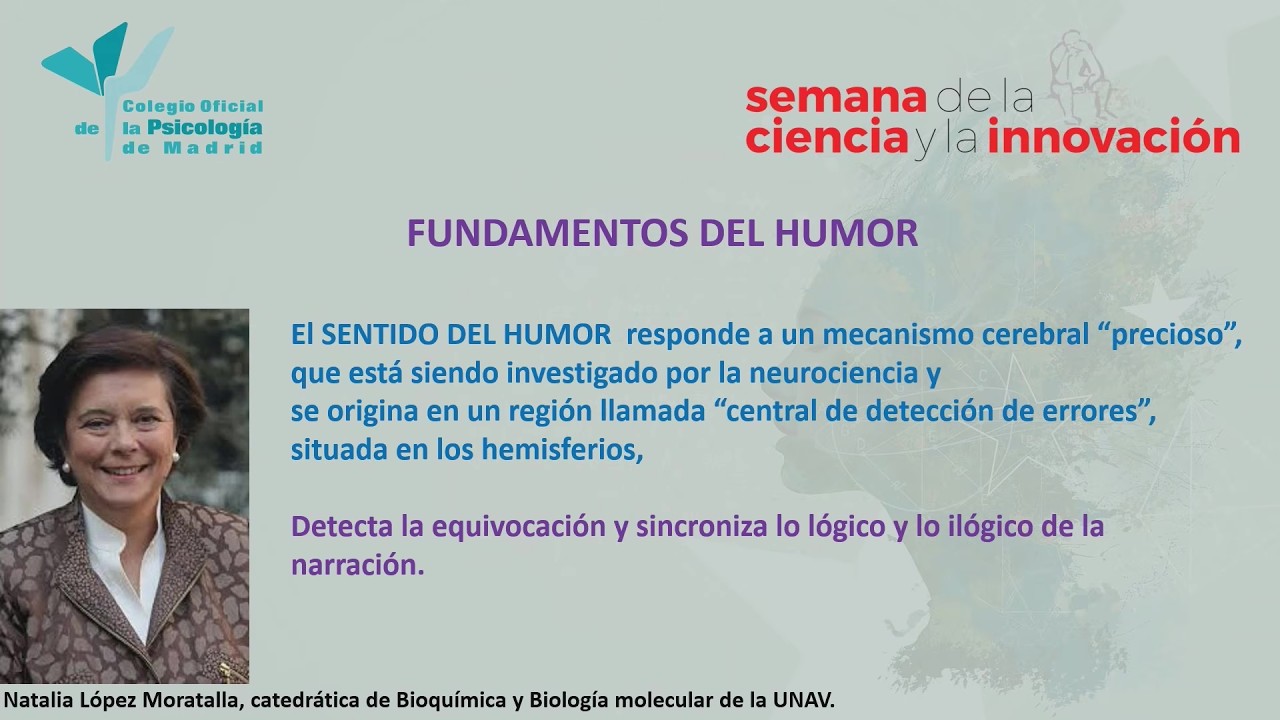
- Quotation attributed to Natalia López Morataya on humor as a cerebral mechanism distributed across both hemispheres.
- Definition of optimism via Voltaire, then the split between realistic/intelligent optimism and negligent/unrealistic optimism.
- First exercise: participants in pairs produce realistic positive consequences for bad news, four of them using the word 'afortunadamente'.
- Perceptual illusions (two faces, old man/young man, bidirectional arrows) used to argue that perception is partial and frame-switching requires effort.
- Claim that laughter arises either from resolving a problem or from a break in expected reality, illustrated by people falling in the street.
- Neurotransmitter explanation (dopamine, serotonin, adrenaline) and the list of psychological benefits, including interruption of negative thought.
Cited Sources
- Natalia López Morataya, professor of Biochemistry and Molecular Biology, University of Navarra — Cited verbally for a model in which the sense of humor arises from a bilateral cerebral 'error detection' system, with the left hemisphere registering incongruity and the right accepting the illogical.
- Voltaire — Quoted for a definition of optimism as the habit of continuing to think everything is fine when things are going badly.
- Sigmund Freud — Paraphrased on humor helping to solve problems and reduce fears and phobias through exaggeration or embellishment; no specific work named.
- Friedrich Nietzsche — Invoked for the distinction between Apollonian laughter (intellectual, sometimes mechanical) and Dionysian laughter (spontaneous, directed at oneself and shared with others).
- Tibetan lamas — Mentioned as the speaker's personal source for the idea that learning occurs when a practice is repeated consciously until it becomes installed in the unconscious.
- Grupo de Trabajo Psicología del Humor y el Optimismo (description) — Working group of the Colegio Oficial de la Psicología de Madrid within which the session took place, per the video description.
Contribution & Novelties
The session’s originality is not conceptual but operational. It offers a concrete, transferable protocol for cognitive reappraisal — formulate a negative event, then generate a plausible and specific positive consequence, with the first four attempts constrained by the word ‘afortunadamente’ — and it makes the constraint explicit: the reappraisal must be believable and grounded in the participant’s own situation, not a generic consolation. The pairing of that verbal exercise with visual ambiguity demonstrations is an effective pedagogical sequence, since the illusions supply the experiential proof that frame-shifting is effortful and reversible, which is exactly what a sceptical participant needs in order to try the verbal exercise. The speaker also makes a distinction that popular treatments of the topic usually blur: humor as a stimulus-driven response versus humor as a stable trait versus humor as a general attitude toward life, and, in parallel, realistic versus negligent optimism. His insistence that laughter therapy is complementary to and not a substitute for psychotherapy is the most important practical caveat in the talk and is worth retaining from an otherwise loosely sourced presentation.
Pour aller plus loin :
- Gelotology — Overview of the study of laughter and its physiological and psychological effects, providing the scholarly frame the workshop leaves implicit.
- Optimism — Covers the dispositional versus explanatory-style accounts of optimism and, importantly, the distinction between realistic and unrealistic optimism that the talk sketches.
- Cognitive behavioral therapy — The clinical framework the speaker says laughter therapy combines with; useful for judging how far the workshop’s reframing exercise maps onto an evidence-based method.
- Laughter — Entry point to the physiology, social function and contagion of laughter, and to the scientific literature on laughter and health.
- Robert Provine’s work on the structure and social function of laughter — the reference point for any claim about laughter’s evolutionary and conversational role; cited by name only, as no specific publication was verified.
- Sophie Scott’s neuroimaging research on laughter perception — relevant to any serious evaluation of the hemispheric account of humor offered in the video; cited by name only.
340 words
Radar Profile
The profile is characteristic of a live practical workshop rather than a research briefing: information density and technical level sit in the middle range because the runtime is dominated by interaction, repetition and digression, while quality and reliability are pulled down by the near-total absence of citable evidence. The gap between quantity and quality is the signature of an experienced practitioner speaking from professional authority rather than from documentation.