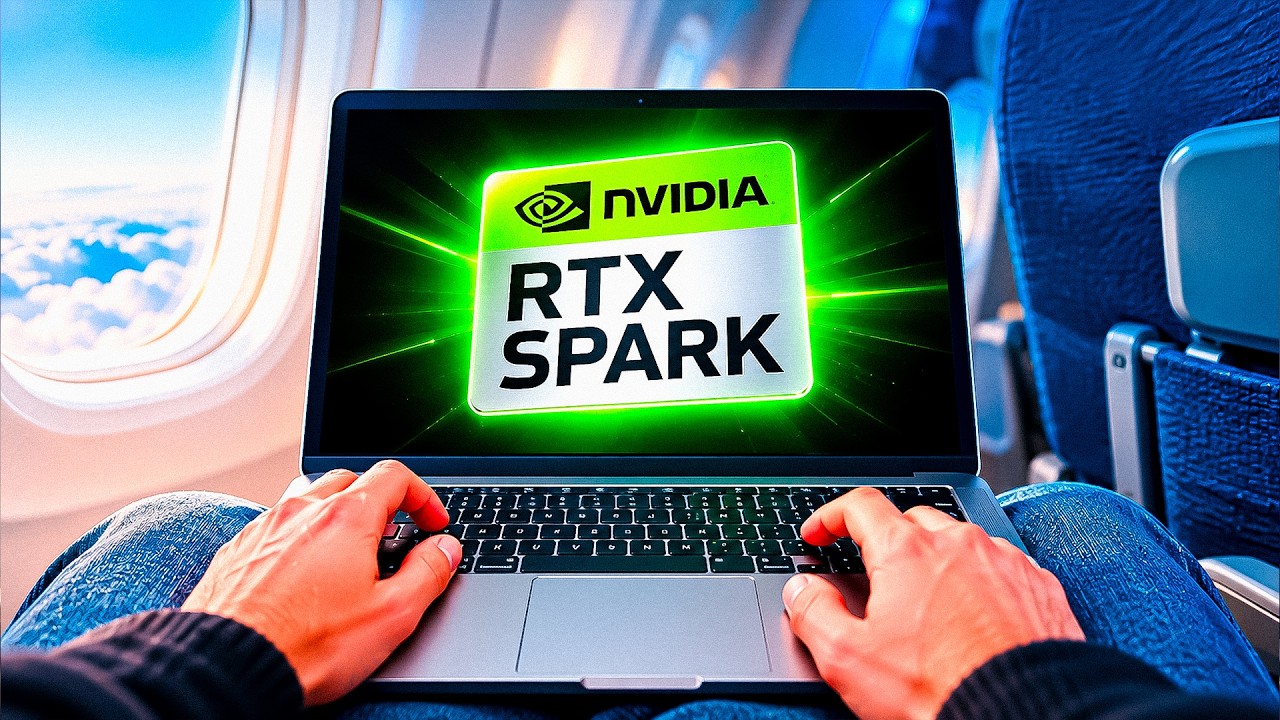
Nvidia RTX Spark : l’IA gratuite tourne SANS abonnement
Nvidia RTX Spark: free AI runs WITHOUT subscription
Keywords
Summary
166 words
Critical Evaluation
Value of the Information & Strength of the Argument
The video offers valuable first-hand impressions of running local AI on a new architecture, with concrete demonstrations and performance measurements (tokens per second, time for transcription). The argumentation is generally convincing, but the presenter makes a few technical oversights, such as not fully explaining the Mixture of Experts (MoE) distinction between Qwen 3.6 35B-A3B and Qwen 3.8 27B, leading to an incorrect speed comparison. He also misstates the battery unit as ‘W/h’ instead of Wh. Despite these, the core narrative—that local AI is becoming viable but with trade-offs—is well-supported and transparent about failures encountered.
Scientific Rigor, Source Quality, Title Accuracy
The video cites its own related articles in the description, providing references to more detailed tests on the same product. However, it does not reference external scientific papers or official Nvidia documentation within the video itself. The title matches the content well, focusing on the ability to run AI without a subscription. The commentary reveals that viewers noted several inaccuracies, and the creator acknowledged some in a pinned comment, showing a willingness to correct errors. Overall, the sourcing is adequate for a tech review but relies on internal links rather than independent verification.
202 words
Title / Content Match
The title accurately captures the central theme (running AI locally without a subscription), though it simplifies the hardware and cost requirements.
Quality & Reliability
6/10
The video provides an engaging hands-on review but contains approximations and factual errors (e.g., MoE explanation, battery unit 'W/h' instead of Wh) as flagged by viewers. It is informative but not fully precise.
Chapters
Cited Sources
- J'ai remplacé ChatGPT par une IA chinoise gratuite — Related article describing a similar experience with local AI on the Nvidia RTX Spark.
- On a testé la puce Nvidia RTX Spark qui veut réinventer le PC — Full test of the Nvidia RTX Spark chip.
- Test de l'Asus ProArt P16 — Detailed test of the Asus ProArt P16 used in the video.
External References
Contribution & Novelties
The video contributes a practical, real-world evaluation of local AI on a consumer laptop, demonstrating both capabilities and limitations. It offers a clear comparison with cloud-based AI and highlights the trade-offs in terms of speed, battery, and cost. The inclusion of hands-on tasks like audio transcription and game development adds originality.
Pour aller plus loin :
- Mixture of experts — Explains the MoE architecture that underlies the speed difference between Qwen 3.6 and 3.8 models.
- Whisper (speech recognition) — The model used for audio transcription in the video.
- Local LLM — Background on running LLMs locally, with references to tools like Ollama.
- Qwen — The family of open-weight models used in the video (note: if URL uncertain, we can omit).
120 words
Radar Profile
The radar profile shows moderate to high scores in information quantity and technical level, but lower scores in quality and reliability due to the noted inaccuracies. This reflects a content that is rich and engaging but not entirely rigorous in its details.
💬 Mixed, generally positive but with pointed technical corrections. Many commenters praised the video's vibe and usefulness, while several flagged specific errors (MoE explanation, battery unit, price) and suggested the need for more precise information.