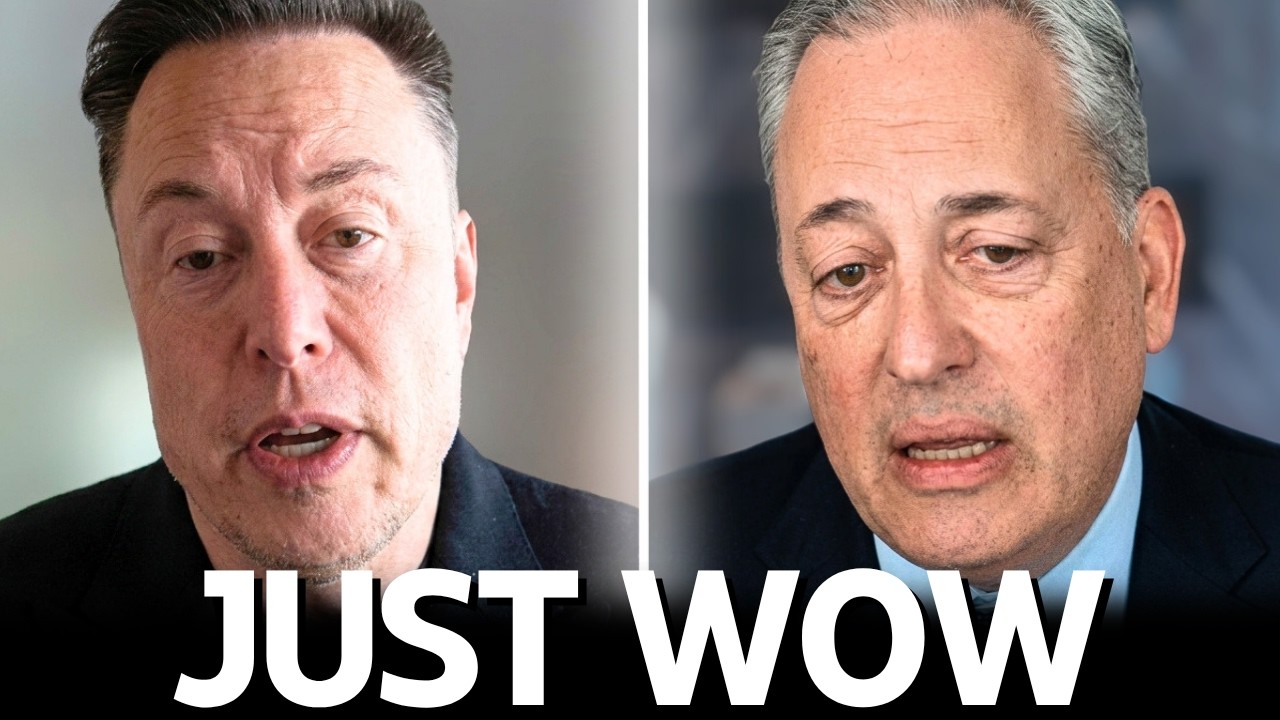
INTERNET BREAKS w/ Elon Musk Speech at G20
Title history
- INTERNET BREAKS w/ Elon Musk Speech at G20 — observed on 20261110-0253 UTC (YouTube)
Keywords
Summary
159 words
Critical Evaluation
Value of the Information & Strength of the Argument
The video provides direct access to influential voices on AI and energy policy. Musk’s arguments are compelling but often anecdotal, relying on personal projections. Sacks makes a logical case against heavy pre-market regulation, though he generalizes from US examples. Mumgaard’s perspective on fusion is grounded in specific technical and regulatory challenges. The strength of argumentation varies: Musk’s claims about robot counts are extreme, lacking detailed evidence; Sacks’ arguments are more structured; Mumgaard is balanced. The value lies in hearing primary opinions, but critical evaluation is needed given the speculative nature.
Scientific Rigor, Source Quality, Title Accuracy
The video does not cite external sources; it relies on the speakers’ expertise. However, the original G20 event is a credible venue. The title’s sensationalism (‘INTERNET BREAKS’) may mislead viewers about the content’s depth. The description includes links to books and articles that appear to relate, but these are not referenced within the speech. The adequacy is partial: the title focuses on Musk’s viral moment rather than the broader discussion. Scientific rigor is moderate, with some unsubstantiated claims. No contradictions with established knowledge are evident, but the projections are not falsifiable in the short term.
200 words
Title / Content Match
The title is sensationalist, implying the speech 'broke the internet,' but it accurately signals the video's focus on Musk's G20 remarks. It does not include other speakers, though they appear.
Quality & Reliability
7/10
The video presents views from high-profile figures (Elon Musk, David Sacks, Bob Mumgaard) at a G20 event. While they are credible experts, many claims are forward-looking projections without empirical verification. The transcript is a primary source but lacks citations to external studies or data.
Key Moments
Markers derived by PSI from the transcript: the creator did not define chapters.
- Elon Musk on the need for a 'default legal' regulatory environment and the 'saplings vs trees' analogy.
- Musk estimates AI will increase global economy by 20-30% and reach 'Stockfish level' in software soon.
- Discussion of humanoid robots: over a billion in 10 years, each 5x more productive than a human.
- Musk highlights a 15 GW power shortfall for AI chips by 2027, mentioning SpaceX compute leasing.
- David Sacks on existing laws applicable to AI and opposition to an 'FDA for AI'.
- Sacks on data centers lowering electricity costs and local community benefits, citing Loudoun County.
- Bob Mumgaard on fusion energy, 'avoiding the fallacy that the past is prologue,' and public-private partnerships.
Cited Sources
- Original G20 Video — The original source of the speeches by Musk, Sacks, and Mumgaard.
- Master Plan: What Elon Musk is Actually Building (book) — Linked in description; may provide background on Musk's strategies.
- Abundance or Collapse (book) — Linked in description; possibly related to themes of AI and energy.
- Farzad.fm Official Site — Channel's website with additional analysis and resources.
- Elon's G20 sit-down: 15 GW AI Power Wall — Exclusive article on Farzad's site summarizing the key points of Musk's speech.
Concurring Sources
- Original G20 Video — Same content, providing direct verification of the speeches.
External References
Contribution & Novelties
The video provides unfiltered access to primary stakeholders’ views on AI, energy, and innovation policy. It captures the moment when tech leaders and policymakers converge at the G20, offering a unique snapshot of current discourse. The claims about power shortfalls and robot deployments are forward-looking and may influence future policy debates. The video’s contribution is less about new data and more about framing the conversation.
Pour aller plus loin :
- Permissionless innovation — Key principle discussed by Sacks, underpinning Silicon Valley success.
- Data center — Infrastructure central to the AI boom and power challenges.
- Fusion power — Bob Mumgaard’s field, with potential to address energy needs.
- Stockfish — Chess engine used by Musk to illustrate AI’s superiority over humans.
119 words
Radar Profile
The radar profile shows high information quantity (8) but moderate quality (6), technical depth (5), and reliability (6). This suggests a content-rich video with speculative elements, suitable for general audiences interested in AI and policy but lacking rigorous scientific backing.
💬 très positif — The 30 comments analyzed overwhelmingly praise Elon Musk, expressing admiration and support for his vision, with some comments also reflecting political enthusiasm. The sentiment is highly favorable, though a few critical voices exist but are in the minority.