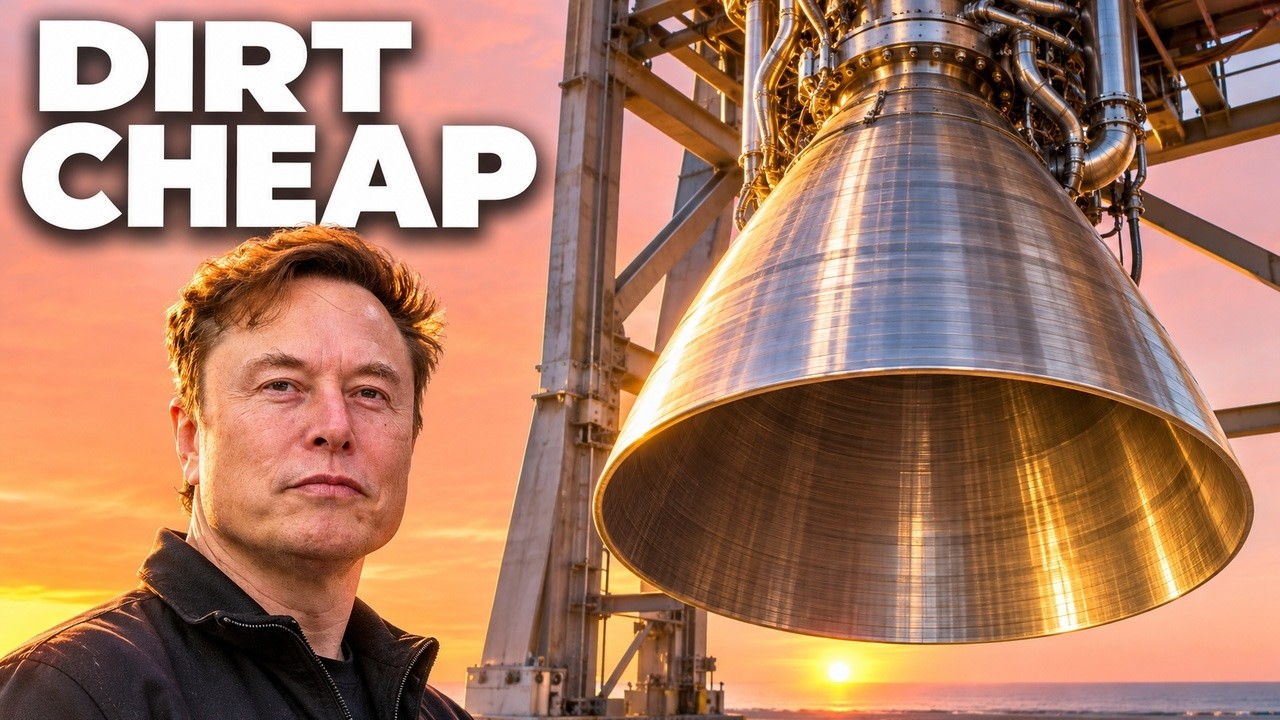
This Century-Old Shape Makes SpaceX Unstoppable
Keywords
Summary
366 words
Critical Evaluation
Value of the Information & Strength of the Argument
The informational value is high for a general-audience engineering explainer. The video does something genuinely useful: it takes a ubiquitous but rarely examined piece of hardware and reconstructs the reasoning behind its shape, moving from the symmetry of chamber pressure to the mass-flow/exit-velocity/exit-pressure triad, then to the choking phenomenon at the throat and the necessity of a diverging section for supersonic expansion. The garden-hose analogy is set up deliberately and then overturned, which is an effective pedagogical device for the counter-intuitive behaviour of compressible flow, and the treatment of the exit-pressure mismatch as a three-way trade (under-expansion, over-expansion, separation) is conceptually accurate and unusually clear. The argument chain is broadly linear and each step follows from the previous one: geometry determines expansion, expansion determines exit velocity and pressure, ambient pressure changes with altitude, therefore a fixed contour is always a compromise, therefore engineers either split the engine cycle or try variable geometry. The comparison between sea-level and vacuum bells, and the concrete ratios of exit-to-throat area for the Merlin Vacuum vs. Raptor Vacuum and the space shuttle main engine, give the abstraction a numerical anchor. The economic opening is rhetorically strong but methodologically weak: the 2% materials figure and the ‘$36,000 per launch’ style comparison are presented as settled arithmetic rather than as order-of-magnitude reasoning resting on contested assumptions about flight rate, refurbishment cost and amortisation. The same applies to the abrupt leap in the final chapter, where an argument about nozzles is used to support a forecast about orbital data centres, a transition that is asserted rather than argued. There is also a persistent habit of stating planned or projected events in the past tense, which makes the narrative feel more conclusive than the underlying evidence allows. Overall the argumentation is solid on physics, weaker on economics and speculative on consequences.
Scientific Rigor, Source Quality, Title Accuracy
On scientific rigour, the video is at its best when it stays close to established propulsion literature: it invokes a 1967 NASA liquid engine design book, a NASA nozzle handbook dated 1976, de Laval’s late-1880s steam-turbine work and patent, Goddard’s 1926 liquid-fuelled flight, and the 1958 parabolic contour study, which are all real and correctly located in their historical sequence. It is at its weakest on attribution: the parabola contour is credited to an engineer named only as ‘Ralph’, almost certainly a garbled rendering of G. V. R. Rao, and several names are mangled by transcription (‘Aerrol 10’ for RL10, ‘Rocket Dine’ for Rocketdyne), which undermines confidence that the underlying documents were consulted directly rather than summarised from secondary sources. Numerical claims such as the 58% pressure limit for a simple convergent nozzle, the roughly 2% thrust loss from a 15-degree cone, and the ‘80% bell’ saving a fifth of the length are in the right ballpark of the classical literature but are delivered without citations, so a viewer cannot check them. On source quality, the video supplies no bibliography, no paper titles, and no data; the only links offered are the author’s own books, his personal site, an AI bot link and sponsor/affiliate URLs, none of which substantiate the technical claims. Several contemporary statements (a shuttle-derived engine test firing at Stennis in November 2026, an Artemis 2 launch in April 2026, a Starship return in November 2026) are presented as accomplished facts with no reference to a press release, mission log or agency statement, and the closing prediction about orbital AI compute by 2031 is offered as personal conviction rather than sourced analysis. On title/content fit, the ‘century-old shape’ element is honestly delivered and forms the bulk of the video, while the ‘SpaceX unstoppable’ element is promotional wrapping around an argument the video does not seriously attempt to prove; this mismatched half is a marketing overlay rather than a misrepresentation of the technical content.
642 words
Title / Content Match
The title's 'century-old shape' is genuinely the subject: roughly eighty percent of the runtime is a well-structured explanation of the de Laval/bell nozzle. The 'makes SpaceX unstoppable' half is promotional framing that only occupies the final chapters, and 'unstoppable' is an editorial claim the content does not attempt to demonstrate.
Quality & Reliability
6/10
The core physics is presented correctly: subsonic vs. supersonic nozzle behaviour, the choking condition at Mach 1 at the throat, the need for a diverging section past the throat, the parabola-based bell contour, and the exit-pressure/flow-separation problem at off-design altitude are all standard gas-dynamics and rocket-propulsion material, and the narration correctly attributes the bell contour to 1958 work and references NASA design handbooks. However, the presentation is loose on names and dates (the parabola contour is credited to 'Ralph', almost certainly G. V. R. Rao; the RL10 is rendered as 'Aerrol 10'; Rocketdyne as 'Rocket Dine'; the pressure-ratio rule of thumb and the '80% bell' figure are given without proper sourcing). Several statements are asserted as accomplished facts rather than reported news or projections (an Artemis 2 launch in April 2026, an Artemis 4 landing planned for 2028, a Starship return in November 2026, ~600 booster landings), and the closing claim that orbital solar-powered AI compute will be the cheapest option by 2031 is an explicit personal forecast carrying no supporting data. No formal references, papers or data tables are given in the video itself; the description links are books, a personal site and sponsor/affiliate links.
Chapters
Cited Sources
- Master Plan: What Elon Musk is Actually Building (author's book) — Promoted in the description and in the final chapter as the extended treatment of SpaceX's first-principles engineering and Starship economics.
- Abundance or Collapse (author's book) — Second book linked in the description, framing the author's broader thesis on disruptive innovation.
- farzad.fm — author's site — Author's own platform, presented as the home of his analysis on disruptive technologies.
- NASA liquid rocket engine design reference (1967) — cited in narration, no URL given — Invoked to explain why losses above the throat are negligible compared with the supersonic diverging section; no link or exact title is provided in the description.
- NASA nozzle design handbook (1976) — cited in narration, no URL given — Used for the claim that almost every operational liquid engine flew a bell by 1976 and for the assessment of aerospike prospects; no link provided.
Concurring Sources
- De Laval nozzle (Wikipedia) — Confirms the convergent-divergent principle, the Mach 1 condition at the throat and the need for a diverging section to reach supersonic exit velocities.
- Rocket engine nozzle (Wikipedia) — Corroborates the bell contour, the altitude-dependent optimum, over/under-expansion and the separation risk for over-expanded nozzles.
- Aerospike engine (Wikipedia) — Consistent with the description of the aerospike as an altitude-compensating, wall-less concept tested but never flown operationally.
- RL10 (Wikipedia) — Supports the account of the RL10 family and its deployable carbon-carbon nozzle extension used on Delta IV upper stages.
- Flow separation (Wikipedia) — Provides the general fluid-dynamic basis for the separation-induced side loads described in the altitude-trap segment.
External References
Contribution & Novelties
The original contribution is pedagogical rather than scientific: the video assembles a coherent, first-principles narrative that connects a single geometric feature, the bell contour, to launch economics. It does so by refusing to treat the nozzle as background hardware and instead walking through each design decision as a response to a specific physical constraint: the choking limit at the throat, the shock-formation risk of turning supersonic flow too sharply, the length/weight penalty of shallow cones, and the single-altitude optimum that forces engine-cycle splits. The synthesis of historical material (de Laval’s steam turbines, Goddard’s 1926 flight, the 1958 parabolic contour, the never-flown aerospike work of the X-33 era) with contemporary hardware (Merlin Vacuum, Raptor Vacuum, RL10 extendable skirts) into one continuous argument is what gives the piece its value. The weakest original content is the forecast chain that closes the video, in which cheap launch is extended to orbital solar-powered AI compute by 2031; this is presented as a personal projection without modelling or cited studies.
Pour aller plus loin :
- De Laval nozzle — Background on the convergent-divergent geometry, the Mach 1 throat condition and the historical origin of the hourglass shape discussed throughout the video.
- Rocket engine nozzle — Covers the bell/parabolic contour, expansion ratio, over- and under-expansion, and flow separation, i.e. the technical core of the middle chapters.
- Aerospike engine — Reference for the ‘inside-out’ altitude-compensating concept and the linear aerospike work associated with the X-33 programme.
- RL10 — The extendable-nozzle upper stage engine family described in the chapter on transforming bells.
- Flow separation — The aerodynamic phenomenon behind the visible exhaust rings and the side loads described during the altitude-compromise discussion.
- G. V. R. Rao’s 1958 method of characteristic contour design (cited in the video only as ‘Ralph’) — no URL given here, as the exact reference could not be confirmed.
304 words
Radar Profile
The profile is broad but not maximal: information density and technical level are both solidly above average, reflecting a genuinely well-structured engineering explainer with real numbers and historical anchors, while reliability is held back by garbled attributions, missing citations and future-dated claims stated as facts. The relatively lower reliability relative to information quality captures the central tension of the video: accurate physics delivered with weak sourcing and an editorialised, speculative conclusion.